Kynrem Falls, Location, Formation, Geographical Features, Significance

Kynrem Falls

Kynrem Falls is the highest three-tiered waterfall in Meghalaya and one of the highest waterfalls in India, with a total height of about 305 metres (1,001 feet). It is located within Thangkharang Park, near Sohra (Cherrapunji) in the East Khasi Hills district of Meghalaya. The waterfall is renowned for its three distinct cascades and its spectacular flow during the Southwest Monsoon.

Kynrem Falls Location

  • Kynrem Falls is located in the East Khasi Hills district of Meghalaya, near Sohra (Cherrapunji).
  • It is situated within Thangkharang Park, managed by the Meghalaya Forest Department.
  • The waterfall lies on the southern escarpment of the Shillong (Meghalaya) Plateau, overlooking the plains of Bangladesh.
  • It falls within the Sohra-Mawsynram high-rainfall belt, one of the wettest regions in the world.

Kynrem Falls Formation

Kynrem Falls is formed by a small rain-fed stream on the Shillong Plateau. As the stream reaches the steep southern edge of the plateau, it flows down three successive rocky ledges, forming a tiered (cascade) waterfall. The waterfall carries the maximum volume of water during the Southwest Monsoon, when the Khasi Hills receive heavy orographic rainfall from moisture-laden winds blowing from the Bay of Bengal. Over time, continuous erosion by the flowing water has shaped the cliff and valley into their present form.

Kynrem Falls Geographical Features

  • Kynrem Falls descends about 305 metres in three distinct tiers, making it the highest three-tiered waterfall in Meghalaya.
  • It is a tiered (cascade) waterfall, where water flows down three successive rocky ledges instead of a single vertical drop.
  • The waterfall is surrounded by steep hills, rocky cliffs and dense evergreen forests of the Khasi Hills.
  • As a rain-fed waterfall, it flows most strongly during the Southwest Monsoon (June–September), when the region receives heavy rainfall.

Kynrem Falls Ecological Significance

Kynrem Falls is located in the ecologically important Khasi Hills of the Shillong Plateau, a region known for exceptionally high rainfall and rich biodiversity. The surrounding forests support diverse flora and fauna and form part of the broader ecosystem of Northeast India, one of the country’s important biodiversity regions.

Kynrem Falls FAQs

Q1: Where is Kynrem Falls located?

Ans: Kynrem Falls is located in Thangkharang Park near Sohra (Cherrapunji) in the East Khasi Hills district of Meghalaya.

Q2: What is the source of Kynrem Falls?

Ans: Kynrem Falls is formed by a small seasonal rain-fed stream originating on the Shillong Plateau and is not fed by a major perennial river.

Q3: What type of waterfall is Kynrem Falls?

Ans: It is a three-tiered (cascade) waterfall, where water descends through three successive rocky ledges.

Q4: Why does Kynrem Falls have a high discharge during the monsoon?

Ans: The waterfall is rain-fed and receives abundant water from the intense orographic rainfall caused when moisture-laden Southwest Monsoon winds from the Bay of Bengal rise over the Khasi Hills.

Q5: Which physiographic region does Kynrem Falls belong to?

Ans: Kynrem Falls is situated on the Shillong (Meghalaya) Plateau, a detached extension of the Peninsular Plateau of India.

Festivals of Sikkim 2026, Name List, Features, Importance

Festivals of Sikkim

The Festivals of Sikkim 2026 reflect the state's rich cultural heritage, religious diversity and centuries old traditions. People belonging to Buddhist, Hindu, Christian, Muslim, Lepcha, Bhutia, Nepali, Limboo, Rai, Tamang, Gurung, Mangar and Newar communities celebrate their festivals together with harmony and mutual respect. These celebrations preserve local customs and strengthen the social unity of Sikkim.

Festivals of Sikkim 2026

Festivals of Sikkim are religious, cultural and seasonal celebrations observed according to Hindu, Tibetan, Buddhist, Islamic and local community calendars. They mark harvests, New Year celebrations, birth anniversaries of saints, important events in Buddhism and Hinduism and nature worship. Traditional Chaam masked dances, monastery ceremonies, river fairs, archery competitions, music, local cuisine, handicrafts and community participation make these festivals an important part of Sikkim's cultural life.

Also Read:- Fairs and Festivals of India

List of Festivals of Sikkim 2026

The list of Major Festivals of Sikkim has been provided below:

  • Maghe Sankranti: Celebrated on 14 January, this major Nepalese festival marks the beginning of warmer weather and the month of Magh. Holy river bathing, fairs at Jorethang, Saramsa, Rorathang and Triveni, handicrafts and cultural programmes are major attractions.
  • Sonam Lochar: The Tamang community celebrates its New Year on the first day of the twelfth lunar month with traditional rituals, music, dances and joyful community gatherings.
  • Losar: The Tibetan New Year falls on the first day of the first Tibetan lunar month, generally in February. Families gather for prayers, feasts and festivities, while Gutor Chaam is performed before the celebrations.
  • Holi: Celebrated on the Phalgun full moon, Holi marks the victory of good over evil and welcomes spring with colourful celebrations across Sikkim.
  • Ramnawami (Chaite Dasain): Observed on the ninth day of Chaitra, this Hindu festival celebrates the birth of Lord Rama and honours his righteous and ideal rule.
  • Sakewa: Celebrated by the Kirat Khambu Rai community during Baisakh full moon, this nine day Bhoomi Puja honours Mother Earth through rituals, prayers and the traditional Sakewa Silior dance.
  • Saga Dawa: The holiest Mahayana Buddhist festival commemorates Lord Buddha's birth, enlightenment and Mahaparinirvana on the fourth Tibetan lunar month's full moon. Monastic processions carrying holy scriptures are organised across Sikkim, especially in Gangtok and Gyalshing.
  • Drukpa Tshechi: Celebrated on the fourth day of the sixth Tibetan lunar month, it commemorates Lord Buddha's first sermon on the Four Noble Truths at Sarnath.
  • Guru Rinpoche's Thrungkar Tshechu: Celebrated on the tenth day of the fifth Tibetan lunar month, this festival marks the birth anniversary of Guru Padmasambhava with processions, Chaam dances and monastery ceremonies.
  • Tendong Lho Rum Faat: One of the oldest Lepcha festivals, celebrated on 8 August, it honours Mount Tendong, believed to have saved the Lepcha people during the great flood of Mayel Lyang.
  • Indrajatra: The Newar community celebrates this festival to honour Lord Indra and his mother for timely rainfall and a good harvest.
  • Pang Lhabsol: Unique to Sikkim, Pang Lhabsol honours Mount Khangchendzonga as the guardian deity and commemorates the Lepcha-Bhutia blood brotherhood. Masked Lama dances, Pang-Toed, Warrior Dance and Chaams are its major highlights.
  • Durga Puja (Dasain): Celebrated during Ashvin, this major Hindu festival commemorates Goddess Durga's victory over Mahishasura and symbolises the triumph of good over evil. Elders bless younger family members with tika.
  • Diwali (Laxmi Puja/Tihar): Celebrated as the festival of lights, Diwali symbolises the victory of light over darkness. Homes are decorated with lamps, flowers and lights and Goddess Lakshmi is worshipped.
  • Lhabab Dhuechen: Observed on the 22nd day of the ninth Tibetan lunar month, it marks Lord Buddha's descent from heaven after teaching his mother and celestial beings.
  • Losoong/Namsoong: The Sikkimese New Year and harvest festival begins on the 29th day of the tenth Tibetan month. Bhutias celebrate Losoong, Lepchas observe Namsoong, while Chaam dances, monastery rituals and archery competitions continue for about a week.
  • Kagyed Dance: Held on the 28th and 29th days of the tenth Tibetan month, monks perform colourful masked Chaam dances. Burning effigies made of wood, paper and flour symbolises the destruction of evil and the arrival of prosperity.
  • Other major festivals: Teyongsi Sirijunga Sawan Tongnam (23 December), Barahimizong, Christmas (25 December), Tamu Lochar (30 December), Bumchu at Tashiding Monastery, Kalchakra Puja, Mha Puja, Guthor Chaam, Tyohar, Geel and Sunwar Sagoon are also important cultural and religious celebrations of Sikkim.

Also Read:- Harvest Festivals in India

Festivals of Sikkim 2026 FAQs

Q1: Which is the most famous festival of Sikkim 2026?

Ans: Saga Dawa is considered one of the most famous and sacred festivals of Sikkim, celebrating the birth, enlightenment and Mahaparinirvana of Lord Buddha.

Q2: Which is the most unique Festival of Sikkim 2026?

Ans: Pang Lhabsol is a unique festival of Sikkim that honours Mount Khangchendzonga as the guardian deity and celebrates the historic unity between the Lepcha and Bhutia communities.

Q3: Which communities celebrate Losoong and Namsoong in Sikkim?

Ans: The Bhutia community celebrates Losoong, while the Lepcha community celebrates Namsoong to mark the end of the harvest season and the Sikkimese New Year.

Q4: What is the Maghe Sankranti Festival in Sikkim?

Ans: Maghe Sankranti marks the beginning of warmer weather and is celebrated with holy river baths, fairs, cultural programmes and community gatherings across Sikkim.

Q5: Why is Saga Dawa celebrated in Sikkim?

Ans: Saga Dawa is important because it commemorates Lord Buddha's birth, enlightenment and Mahaparinirvana, making it the holiest Buddhist festival celebrated across Sikkim.

Dudhsagar Falls, Location, Formation, Geographical Features, Significance

Dudhsagar Falls

Dudhsagar Falls is one of the highest waterfalls in India and among the most spectacular waterfalls of the Western Ghats. Formed by the Mahadayi River (known as the Mandovi River in Goa), it descends from a height of about 310 metres (1,017 feet) in four distinct tiers along the Goa-Karnataka border. The name Dudhsagar, meaning “Sea of Milk”, is derived from the milky white appearance created by the water cascading over rocky cliffs during the southwest monsoon. 

Dudhsagar Falls Location

  • Dudhsagar Falls is located on the Goa-Karnataka border in South Goa district.
  • It is formed by the Mahadayi River, which is known as the Mandovi River after entering Goa.
  • The waterfall lies within the Bhagwan Mahavir Wildlife Sanctuary and Mollem National Park.
  • It is situated on the western escarpment of the Western Ghats, where the Deccan Plateau descends sharply towards the Konkan Coast.
  • The famous railway bridge across the waterfall forms part of the Braganza Ghat section of the South Western Railway, connecting Castle Rock (Karnataka) with Kulem (Goa).

Dudhsagar Falls Formation

Dudhsagar Falls was formed by the combined action of tectonic uplift and long-term river erosion. The Mahadayi River originates in the Bhimgad Wildlife Sanctuary in Karnataka and flows westwards towards the Arabian Sea. As the river reaches the steep western escarpment of the Western Ghats, it encounters a sharp change in elevation and plunges over resistant crystalline rocks, forming a tiered plunge waterfall. Over thousands of years, continuous river erosion has deepened the gorge, while the resistant rocks have preserved the steep cliff and the waterfall’s distinctive four-tiered structure.

Dudhsagar Falls Geographical Features

Dudhsagar Falls possesses several distinctive geographical characteristics.

  • It has a total height of about 310 metres, making it one of the highest waterfalls in India.
  • The waterfall descends through four distinct tiers, creating a spectacular cascade during the southwest monsoon.
  • It is formed by the Mahadayi-Mandovi river system, one of the major west-flowing river systems of the Western Ghats.
  • The surrounding landscape consists of rugged hills, deep valleys, dense evergreen forests and rocky escarpments.
  • Heavy monsoon rainfall significantly increases the discharge of the river, giving the waterfall its characteristic milky-white appearance.

River Significance

Dudhsagar Falls forms part of the Mahadayi-Mandovi River Basin, an important west-flowing river system of the Western Ghats.

  • The river originates in the Bhimgad Wildlife Sanctuary in Karnataka as the Mahadayi River and is known as the Mandovi River after entering Goa.
  • It flows westwards across Goa before draining into the Arabian Sea near Panaji.
  • The river supports drinking water supply, irrigation, inland navigation and estuarine ecosystems in Goa.
  • The river is associated with the Mahadayi Water Disputes Tribunal (MWDT), which adjudicated the interstate water-sharing dispute involving Karnataka, Goa and Maharashtra.
  • The dispute centres on Karnataka’s Kalasa-Banduri Nala Project, which proposes diverting water from the Mahadayi basin to the Malaprabha River (a tributary of the Krishna River) for drinking water supply. Goa has opposed the project due to concerns over reduced downstream flows and ecological impacts.

Dudhsagar Falls FAQs

Q1: Where is Dudhsagar Falls located?

Ans: It is located on the Goa-Karnataka border, within Bhagwan Mahavir Wildlife Sanctuary and Mollem National Park in South Goa.

Q2: Dudhsagar Falls is formed by which river?

Ans: Dudhsagar Falls is formed by the Mahadayi River, which is known as the Mandovi River in Goa.

Q3: What type of waterfall is Dudhsagar Falls?

Ans: Dudhsagar Falls is a tiered plunge waterfall consisting of four distinct tiers.

Q4: Why is Dudhsagar Falls called the “Sea of Milk”?

Ans: During the southwest monsoon, the water cascades over rocky cliffs in a frothy white stream, giving it the appearance of a sea of milk.

Q5: Which protected areas are associated with Dudhsagar Falls?

Ans: Dudhsagar Falls is located within the Bhagwan Mahavir Wildlife Sanctuary and Mollem National Park in the Western Ghats, an ecologically important region recognised as a UNESCO World Heritage Site.

PM Modi Inaugurates India’s First Hydrogen Train on Jind-Sonipat Route

PM Modi Inaugurates India's First Hydrogen Train

India has taken a major step towards green and sustainable transportation with the launch of its first hydrogen-powered train on the Jind-Sonipat route in Haryana. The project reflects India's commitment to reducing carbon emissions, promoting clean energy, and modernizing its railway network. Hydrogen-powered trains are expected to play an important role in achieving the country's long-term climate and net-zero goals.

What is a Hydrogen Train?

A hydrogen train is a train that runs using hydrogen fuel cells instead of diesel. The fuel cells generate electricity by combining hydrogen with oxygen, which powers the train's electric motors. Unlike diesel trains, hydrogen trains emit only water vapour and heat, making them an eco-friendly mode of transport. They are an important step towards cleaner and more sustainable rail transportation.

How Does a Hydrogen Train Work?

A hydrogen train generates electricity through hydrogen fuel cells instead of using a diesel engine. This electricity powers the train's electric motors, making it a clean and energy-efficient mode of rail transport.

  • Hydrogen Storage: Compressed hydrogen gas is stored in specially designed high-pressure tanks mounted on the train.
  • Supply to Fuel Cell: The stored hydrogen is supplied to the fuel cell stack through a controlled fuel delivery system.
  • Oxygen Intake: Oxygen from the surrounding air enters the fuel cell through the air intake system.
  • Electrochemical Reaction: Inside the fuel cell, hydrogen reacts with oxygen in an electrochemical process without combustion.
  • Electricity Generation: The reaction produces electricity, which is used to operate the train's electric traction motors.
  • Battery Support: Excess electricity generated by the fuel cells is stored in onboard lithium-ion batteries and used during acceleration or when additional power is required.
  • Train Propulsion: The electric motors convert electrical energy into mechanical energy, driving the wheels and moving the train.
  • Zero Harmful Emissions: The only by-products of the fuel cell reaction are water vapour and heat, with no carbon dioxide or harmful pollutants released.
  • Energy Efficiency: Fuel cells are more energy-efficient than conventional diesel engines and help reduce fuel consumption.
  • Regenerative Braking: During braking, the train recovers some of the energy and stores it in the batteries, improving overall efficiency.

Hydrogen Train Features

India's first hydrogen train marks a significant advancement in sustainable railway transportation. It combines clean energy technology with modern rail infrastructure to reduce pollution and improve energy efficiency. The key features of Hydrogen Train are:

  • Powered by hydrogen fuel cell technology instead of diesel engines.
  • Operates on the Jind–Sonipat route in Haryana.
  • Generates electricity through an electrochemical reaction between hydrogen and oxygen.
  • Emits only water vapour and heat, making it a zero tailpipe emission train.
  • Equipped with high-pressure hydrogen storage tanks and fuel cell systems.
  • Uses electric traction motors for smooth and efficient operation.
  • Includes onboard batteries to store excess electricity and support acceleration.
  • Designed to operate efficiently on non-electrified railway routes.
  • Produces significantly lower noise compared to conventional diesel trains.
  • Supports Indian Railways' vision of adopting clean and sustainable technologies.

Hydrogen Train Benefits

  • Environment-Friendly: Eliminates carbon dioxide and other harmful emissions during operation.
  • Reduces Air Pollution: Helps improve air quality by replacing diesel-powered trains.
  • Supports Climate Goals: Contributes to India's Net Zero emissions target by 2070 and clean energy commitments.
  • Lower Noise Pollution: Operates more quietly, improving passenger comfort and reducing noise in nearby communities.
  • Energy Efficient: Hydrogen fuel cells convert energy more efficiently than diesel engines.
  • Reduced Dependence on Fossil Fuels: Promotes the use of alternative and renewable energy sources.
  • Suitable for Remote Routes: Offers a clean transport solution for railway lines that are not fully electrified.
  • Boosts Green Hydrogen Economy: Encourages domestic production, storage, and use of green hydrogen.
  • Promotes Technological Innovation: Strengthens India's capabilities in advanced railway and clean energy technologies.
  • Sustainable Public Transport: Supports the transition towards cleaner, greener, and more sustainable rail transportation.

How Does India's First Hydrogen Train Support the National Green Hydrogen Mission?

India's first hydrogen train is an important initiative under the country's clean energy transition. It aligns with the objectives of the National Green Hydrogen Mission, which seeks to promote the production, use, and export of green hydrogen while reducing carbon emissions.

  • Promotes Green Hydrogen Adoption: Demonstrates the use of hydrogen as a clean fuel in the railway sector, one of India's largest transport networks.
  • Supports Mission Objectives: Advances the National Green Hydrogen Mission's goal of making India a global hub for the production, utilization, and export of green hydrogen.
  • Decarbonises Rail Transport: Helps reduce dependence on diesel locomotives, particularly on non-electrified railway routes, lowering greenhouse gas emissions.
  • Encourages Domestic Manufacturing: Boosts indigenous development of hydrogen fuel cells, storage systems, and related railway technologies under the Make in India initiative.
  • Develops Hydrogen Infrastructure: Creates demand for hydrogen production, storage, transportation, and refuelling facilities, strengthening the hydrogen value chain.
  • Promotes Energy Security: Reduces reliance on imported fossil fuels by encouraging the use of domestically produced green hydrogen.
  • Supports Climate Commitments: Contributes to India's pledge of achieving Net Zero emissions by 2070 and meeting its Nationally Determined Contributions (NDCs) under the Paris Agreement.

Advantages of Hydrogen Trains Over Diesel Trains

Hydrogen trains provide a cleaner, quieter, and more sustainable alternative to diesel-powered trains. They help reduce environmental pollution while improving energy efficiency and supporting India's transition to green transportation.

  • Clean Fuel: Hydrogen trains use hydrogen fuel cells, while diesel trains run on fossil fuels.
  • Zero Tailpipe Emissions: Hydrogen trains emit only water vapour and heat, whereas diesel trains release carbon dioxide, nitrogen oxides, and particulate matter.
  • Environment-Friendly: Hydrogen-powered trains have a much lower environmental impact and help reduce air pollution.
  • Higher Energy Efficiency: Fuel cell technology converts energy more efficiently than conventional diesel engines.
  • Lower Noise Levels: Electric motors used in hydrogen trains produce significantly less noise than diesel engines.
  • Reduced Dependence on Fossil Fuels: Hydrogen trains decrease reliance on imported petroleum products and promote cleaner energy sources.
  • Improved Air Quality: Since they do not emit harmful exhaust gases, hydrogen trains contribute to better public health and cleaner surroundings.
  • Suitable for Non-Electrified Routes: They offer a sustainable alternative to diesel trains on railway lines where electrification is not feasible.
  • Supports Climate Goals: Hydrogen trains contribute to India's Net Zero emissions target by 2070 and the decarbonisation of the transport sector.
  • Promotes Green Hydrogen Ecosystem: Their adoption encourages investment in hydrogen production, storage, refuelling infrastructure, and fuel cell technology.

Challenges in Adopting Hydrogen-Powered Trains in India

While hydrogen-powered trains offer significant environmental benefits, their large-scale adoption in India faces several technological, financial, and infrastructure-related challenges.

  • High Initial Cost: Hydrogen fuel cell trains and related equipment are more expensive than conventional diesel trains.
  • Cost of Green Hydrogen: Producing green hydrogen through renewable energy is currently costlier than using fossil fuels.
  • Limited Refuelling Infrastructure: India has very few hydrogen production, storage, and refuelling facilities for railway operations.
  • Hydrogen Storage Challenges: Hydrogen requires high-pressure tanks and advanced storage systems to ensure safe transportation and usage.
  • Safety Concerns: Hydrogen is highly flammable and requires strict safety standards for storage, handling, and refuelling.
  • Technology Development: Hydrogen fuel cell technology is still evolving and requires further research and testing for widespread railway use.
  • Skilled Workforce: Operating and maintaining hydrogen-powered trains requires trained personnel with expertise in hydrogen technologies.
  • Maintenance and Spare Parts: Fuel cell systems require specialised maintenance facilities and components, which are currently limited in India.
  • Reliable Green Hydrogen Supply: A continuous and affordable supply of green hydrogen is essential for large-scale deployment.
  • Infrastructure Investment: Significant investment is needed to develop hydrogen production plants, pipelines, storage facilities, and refuelling stations.

Future of Hydrogen Trains in India

Hydrogen-powered trains are expected to play an important role in India's transition towards clean and sustainable rail transport. As hydrogen technology advances and supporting infrastructure develops, these trains could become a viable alternative to diesel locomotives on non-electrified routes.

  • Indian Railways plans to gradually expand the use of hydrogen-powered trains on suitable routes.
  • Hydrogen trains can help replace diesel locomotives on non-electrified railway lines, reducing carbon emissions.
  • The success of pilot projects will guide the large-scale deployment of hydrogen trains across the country.
  • Increased investment in green hydrogen production will improve the availability and affordability of hydrogen fuel.
  • Development of hydrogen refuelling stations and storage infrastructure will support wider adoption.
  • Advancements in fuel cell technology are expected to improve the efficiency, range, and reliability of hydrogen trains.
  • The growth of the hydrogen ecosystem will encourage domestic manufacturing of fuel cells, storage tanks, and related railway components under the Make in India initiative.

Hydrogen Train FAQs

Q1: What is a hydrogen train?

Ans: A hydrogen train is a train powered by hydrogen fuel cells that generate electricity to run electric motors. It emits only water vapour and heat, making it an environmentally friendly alternative to diesel trains.

Q2: Which is India's first hydrogen train route?

Ans: India's first hydrogen train was flagged off by Prime Minister Narendra Modi on the Jind–Sonipat route in Haryana.

Q3: How does a hydrogen train work?

Ans: A hydrogen train stores hydrogen in high-pressure tanks. Inside the fuel cell, hydrogen reacts with oxygen to produce electricity, which powers the train's electric motors.

Q4: What are the main advantages of hydrogen trains?

Ans: Hydrogen trains produce zero tailpipe emissions, reduce air pollution, operate more quietly than diesel trains, improve energy efficiency, and support sustainable transportation.

Q5: What is the National Green Hydrogen Mission?

Ans: The National Green Hydrogen Mission is a Government of India initiative launched to promote the production, use, and export of green hydrogen, reduce dependence on fossil fuels, and help India achieve its Net Zero emissions target by 2070.

Festivals of Kerala 2026, Top 12 Name List, Features, Importance

Festivals of Kerala

Festivals of Kerala reflect the state's rich cultural heritage, religious diversity and traditional way of life. These festivals unite people across communities through rituals, music, dance, temple traditions, feasts, boat races and cultural performances. Harvest celebrations, temple festivals, religious observances and artistic events together preserve Kerala's historical identity while showcasing its vibrant customs, folklore and community participation.

Festivals of Kerala 2026

Festivals of Kerala celebrate agriculture, mythology, religion, nature and social harmony. While many festivals are rooted in Hindu traditions, several Christian and Islamic celebrations are equally important across the state. The 5 main Festivals of Kerala including Onam, Vishu, Thrissur Pooram, Sabarimala Temple Festival and the Nehru Trophy Boat Race have earned national and international recognition for their unique customs, traditional arts, music and public participation.

Also Read: Fairs and Festivals of India

List of Festivals of Kerala 2026

The Top 12 famous Festivals of Kerala has been listed below:

  1. Onam: Kerala's grand harvest festival commemorates the annual visit of King Mahabali during the Malayalam month of Chingom (August-September).
  2. Vishu: Celebrated as the Malayalam New Year, Vishu begins with the sacred Vishukkani, featuring Lord Krishna, gold ornaments, rice or paddy, Konna flowers, mirror, fruits, coconut and traditional lamps.
  3. Thiruvathira: Observed in the Malayalam month of Dhanu (December-January), this women's festival honours Lord Shiva and commemorates the death of Kamadeva. 
  4. Karthigai Deepam: Kerala celebrates Karthigai as the festival of lights. Village temples organise ceremonial bonfires, from which families carry burning palm-leaf torches (Chootu) to their homes before lighting oil lamps, illuminating entire villages.
  5. Sabarimala Temple Festival: Conducted at the Ayyappa Temple in the Western Ghats, the festival reaches its peak on Makkara Vilakku day, when a sacred light seen on a nearby hill symbolises the arrival of the deity.
  6. Thrissur Pooram: This famous temple festival is celebrated during Medom (April-May) at Vadakkunathan Temple. Decorated elephant processions, Panchavadyam performances and spectacular fireworks make it Kerala's most celebrated temple festival.
  7. Kodungallur Bharani: Celebrated at the Sree Kurumba Bhagavathi Temple in Kodungallur during Meenam (March-April). This ancient festival honours Goddess Bhadrakali's victory over the demon Daarika and attracts large gatherings of Velichappad (oracles).
  8. Guruvayoor Ekadesi: Celebrated in the Malayalam month of Vrischikam at the Guruvayur Sree Krishna Temple near Chavakkad. The festival includes temple rituals, processions, annual fairs and devotional gatherings attended by pilgrims from Malabar, Cochin and Travancore.
  9. Swathi Sangeethotsavam: Organised annually from 6-12 January at Kuthiramalika Palace, Thiruvananthapuram, this week-long music festival honours Maharaja Swathi Thirunal (1813-1846) through Carnatic and Hindustani performances featuring his compositions.
  10. Vetta & Arattu: Celebrated twice every year during October-November and March-April, the festival symbolises Lord Vishnu destroying evil. Idols of Lord Padmanabha, Lord Krishna and Lord Narasimha are ceremonially taken to Shangumugham Beach for ritual bathing before returning in grand processions accompanied by Kathakali performances.
  11. Nehru Trophy Boat Race: Started in 1952 following Prime Minister Jawaharlal Nehru's visit to Alappuzha, this famous snake boat race is held on the second Saturday of August. Giant boats with nearly 100 rowers from different villages compete, while another race in January promotes tourism.
  12. Other Important Festivals: Kerala also celebrates Attukal Pongala, Navaratri, Christmas, Eid-ul-Fitr, Pattambi Nercha, Guruvayoor Anayottam, Theyyam, Aranmula Uthrattathi, Ambalapuzha Arattu, Adoor Gajamela and Cochin Carnival, reflecting the state's remarkable religious harmony, artistic traditions and inclusive cultural heritage.

Also Read:- Harvest Festivals in India

Festivals of Kerala FAQs

Q1: Which is the most famous among Festivals of Kerala 2026?

Ans: Onam is the most famous festival of Kerala. It is the state's biggest harvest festival and celebrates the annual visit of the legendary King Mahabali.

Q2: Why is Onam celebrated in Kerala?

Ans: Onam is celebrated to honour King Mahabali's annual visit to Kerala and marks the harvest season with feasts, floral decorations, cultural events and traditional games.

Q3: What is the significance of Vishu festival?

Ans: Vishu marks the Malayalam New Year. People begin the day by viewing the Vishukkani, which is believed to bring prosperity and good fortune throughout the year.

Q4: What is Thrissur Pooram famous for?

Ans: Thrissur Pooram is famous for its decorated elephant processions, Panchavadyam performances, grand fireworks and colourful temple celebrations held at Vadakkunathan Temple.

Q5: Which famous boat race is celebrated in Kerala?

Ans: The Nehru Trophy Boat Race, held annually at Alappuzha, is Kerala's most famous snake boat race and features long traditional boats with around 100 rowers each.

Operation Southern Readiness 26-2

Operation Southern Readiness 26-2

Operation Southern Readiness 26-2 Latest News

The Indian Navy is set to host Operation Southern Readiness 26-2 at the Southern Naval Command, Kochi.

About Operation Southern Readiness 26-2

  • It is a multinational maritime training exercise. 
  • It is hosted by the Indian Navy at the Southern Naval Command, Kochi.
  • The four-day multinational training engagement will be conducted in partnership with the Combined Maritime Forces (CMF) under the aegis of the Indian Navy-led Combined Task Force 154 (CTF 154), CMF’s dedicated Training Task Force. 
  • It brings together personnel from CMF partner nations for professional maritime security training, practical exercises, and the exchange of best practices. 
  • The CMF is a multinational maritime partnership comprising more than 40 nations, with the Indian Navy playing an active role in advancing collaborative maritime security efforts. 
  • The initiative is aimed at strengthening regional capacity building and enhancing collective maritime security through closer cooperation among participating countries. 
  • The training programme will combine classroom instruction, simulator-based training, and practical exposure. 
  • Sessions will cover areas including Maritime Law, Maritime Domain Awareness and Information Sharing, Counter-Narcotics, Force Protection, Asymmetric Threats, and maritime Uncrewed Systems. 
  • Participants will also be trained in Damage Control and Firefighting, maritime communications, Survival at Sea, Boarding procedures, and hands-on training onboard Indian naval ships. 

News: PIB

Operation Southern Readiness 26-2 FAQs

Q1: What is Operation Southern Readiness 26-2?

Ans: It is a multinational maritime training exercise.

Q2: Where is Operation Southern Readiness 26-2 being hosted?

Ans: It is hosted by the Indian Navy at the Southern Naval Command, Kochi.

Q3: In partnership with which organisation is Operation Southern Readiness 26-2 being conducted?

Ans: It is being conducted in partnership with the Combined Maritime Forces (CMF), a multinational maritime partnership comprising more than 40 nations,

Q4: What is the primary objective of Operation Southern Readiness 26-2?

Ans: To provide professional maritime security training, practical exercises, and exchange of best practices.

Cyclosporiasis

Cyclosporiasis

Cyclosporiasis Latest News

According to the U.S. The Centers for Disease Control and Prevention (CDC) has received reports of 1,645 confirmed domestic cases of cyclosporiasis since May 1.  

About Cyclosporiasis

  • It is a type of food poisoning caused by the microscopic parasite, Cyclospora cayetanensis
  • Major Sources: Cyclosporiasis outbreaks include contaminated leafy greens, lettuce, spinach, basil, cilantro, parsley, raspberries and snow peas.
  • Transmission: It spreads through the faeco-oral route, which means that food or water contaminated by faeces containing the parasite causes the illness.
  • It does not spread from person to person.
  • Symptoms
    • The main symptom is frequent, explosive, watery diarrhoea.
    • Other symptoms include bloating, loss of appetite, stomach cramps, fatigue and even weight loss.
  • Risk: Anyone can contract the infection. In children, the elderly and those with weak immune symptoms, the infection may be severe. 
  • Treatment: It is easily treatable with a seven- to 10-day course of the antibiotic trimethoprim-sulfamethoxazole, which disrupts the microbe’s ability to produce the folic acid needed to replicate itself. 
    • Hydration is also recommended.

Source: TH

Cyclosporiasis FAQs

Q1: Cyclosporiasis is caused by which type of organism?

Ans: Protozoan parasite - _Cyclospora cayetanensis

Q2: Cyclosporiasis primarily affects which organ system?

Ans: Gastrointestinal tract / Intestines

Jantar Mantar, History, Architecture, UNESCO Status, Protests

Jantar Mantar

Jantar Mantar is one of India's finest examples of scientific knowledge, architecture and astronomy coming together in a single monument. It was built during the early eighteenth century under Maharaja Sawai Jai Singh II. These observatories were designed to measure time, track celestial bodies and perform other astronomical activities. 

What is Jantar Mantar?

The name ‘Jantar Mantar’ is derived from the Sanskrit words ‘Yantra’ meaning instrument and ‘Mantra’ meaning calculation. Together, they refer to instruments used for astronomical calculations. These observatories consist of large structures built for naked eye observations of the Sun, Moon, planets and stars. Their primary purpose was to determine time, predict eclipses, calculate planetary movements, prepare astronomical tables and improve the accuracy of astronomical observations using permanent masonry instruments.

Jantar Mantar History

The historical development and evolution of Jantar Mantar has been discussed below:

  • Maharaja Sawai Jai Singh II (1693-1744), founder of Jaipur, commissioned the Jantar Mantars because of his deep interest in Indian, Islamic and European astronomy and the need for more accurate astronomical observations.
  • The observatories were constructed between 1724 and 1735.
  • The observatories followed the tradition of Ptolemaic positional astronomy, allowing astronomers to observe celestial bodies directly with the naked eye and compile astronomical tables called Zij.
  • By 1735, nearly 23 astronomers worked at Jaipur, making it the principal astronomical research centre.
  • Following Jai Singh II's death in 1743, succession disputes reduced royal patronage, scientific activity declined and portions of the Jaipur observatory were later converted into a weapons factory.
  • Maharaja Ram Singh restored the Jaipur observatory in 1876, strengthening several instruments using stone repairs and lead reinforcement before another restoration under Madho Singh II in 1901.
  • Jaipur Jantar Mantar became a Monument of National Importance in 1968 and was inscribed as a UNESCO World Heritage Site in 2010 because of its outstanding scientific and architectural value.

How many Jantar Mantar in India?

Maharaja Sawai Jai Singh II established five Jantar Mantars at Delhi, Jaipur, Ujjain, Varanasi and Mathura during the early eighteenth century. Today only four Jantar Mantars remain, as the Mathura observatory was destroyed shortly before the Revolt of 1857.

  • Oldest Jantar Mantar Observatory: The Delhi Jantar Mantar, completed in 1724, is the oldest surviving observatory among the remaining four.
  • Largest Jantar Mantar Observatory: The Jaipur Jantar Mantar is the largest, most comprehensive and best preserved observatory, containing 19 astronomical instruments and the world's largest stone sundial.
  • UNESCO Recognized Jantar Mantar: The Jantar Mantar at Jaipur became a UNESCO World Heritage Site in 2010, making it internationally recognised for its scientific, architectural and cultural importance.

Jantar Mantar Architecture

The key architectural features of Jantar Mantar buildings has been discussed below:

  • Construction Material: The observatories were built primarily using stone, marble, plaster and masonry, ensuring greater durability and measurement stability than contemporary metal instruments.
  • Observation Method: All observations were performed with the naked eye, allowing astronomers to determine celestial positions without telescopes while maintaining remarkable accuracy.
  • Instruments: The architecture involves several instruments across all four existing Jantar Mantars as highlighted below:
    • Samrat Yantra: Standing about 27 metres high, it is the world's largest stone sundial and can measure time with an accuracy of nearly two seconds.
    • Jai Prakash Yantra: This hemispherical instrument helps determine the positions, altitude, azimuth, declination and hour angle of celestial bodies by projecting an inverted image of the sky.
    • Ram Yantra: Designed as an upright cylindrical structure, it accurately measures the altitude and azimuth of the Sun and other celestial bodies.
    • Misra Yantra: Located at Delhi, this composite instrument consists of five different devices and helps determine the shortest and longest days of the year.
    • Rashi Valaya Yantra: Comprising twelve separate instruments, it measures planetary positions according to the twelve zodiac constellations.
    • Laghu Samrat Yantra: A smaller sundial inclined at approximately 27 degrees, it measures local time with reasonable accuracy though less precise than the Vrihat Samrat Yantra.
    • Nadi Valaya Yantra: This consists of two sundials representing the northern and southern hemispheres and measures local solar time with accuracy of less than one minute.
    • Chakra Yantra: Four semicircular arcs determine the Sun's declination at different times, similar to comparing local times across different world locations.
    • Dakshin Bhitti Yantra: It measures meridian positions, zenith distance and altitude of celestial bodies during their daily movement across the sky.
    • Digamsha Yantra: Used for determining the Sun's azimuth while helping calculate sunrise and sunset timings.
    • Disha Yantra: This instrument accurately determines geographical directions based on astronomical observations.
    • Dhruva Darshak Yantra: Designed specifically to observe the Pole Star and determine its position relative to other celestial objects.
    • Kranti Vritta Yantra: It measures the celestial latitude and longitude of heavenly bodies with considerable precision.
    • Shastanadan Yantra: A dark chamber with a sixty degree meridian arc measures solar declination, zenith distance and even the apparent diameter of the Sun.
    • Unnatamsa Yantra: A metal ring divided into four segments helps determine the altitude of celestial bodies.
  • Scientific Basis: The observatories draw upon astronomical theories developed by Aryabhatta, Brahmagupta, Varahamihira, Lalla, Sripati and Bhaskara, whose works described several astronomical instruments and calculation methods.

Jantar Mantar Delhi

The Jantar Mantar in Delhi is the oldest surviving observatory and continues to remain both a protected monument and an important public gathering location.

  • Construction: Built in 1724, it became the first surviving observatory established by Maharaja Sawai Jai Singh II.
  • Size: It is the second largest Jantar Mantar after Jaipur and contains several important astronomical instruments.
  • Purpose: The observatory was designed for accurate timekeeping, determining planetary positions and measuring celestial movements.
  • Instrument: The Misra Yantra is unique to Delhi and calculates the shortest and longest days of the year.
  • Protection: The monument is maintained by the Archaeological Survey of India (ASI) as a protected monument of national importance.

Jantar Mantar Jaipur

The Jantar Mantar in Jaipur represents the highest achievement of India's historic astronomical observatories through its scale, preservation, scientific innovation and global recognition.

  • Construction: The observatory was completed in 1734 and remained Maharaja Jai Singh II's principal astronomical centre.
  • Instruments: It houses 19 major fixed astronomical instruments, many of which are the largest masonry examples of their kind.
  • UNESCO Status: It was inscribed as a UNESCO World Heritage Site in 2010 because of its outstanding universal scientific and architectural value.
  • Scientific Importance: The observatory contributed to astronomical tables and observations following the Ptolemaic positional astronomy tradition practiced across several civilizations.
  • Largest Sundial: The Samrat Yantra remains the world's largest stone sundial with an accuracy of nearly two seconds.
  • Purpose: It measured time, predicted eclipses, calculated planetary movements and prepared astronomical tables through direct celestial observation.
  • National Recognition: The observatory was declared a Monument of National Importance in 1968.

Jantar Mantar Ujjain

Ujjain Jantar Mantar served as an important astronomical centre because of the city's long standing association with astronomical calculations and observations.

  • Construction: The Ujjain observatory was completed in 1725 under Maharaja Sawai Jai Singh II.
  • Role: It functioned as an important centre for astronomical research and observation of celestial events.
  • Instrument: It contains one of the largest sundials among the Jantar Mantar observatories.
  • Purpose: Astronomers used it for measuring time, tracking celestial bodies and improving astronomical calculations.

Jantar Mantar Varanasi

The Varanasi Jantar Mantar observatory continued Maharaja Jai Singh II's scientific programme through smaller but essential astronomical instruments for celestial observations.

  • Establishment: The observatory was established in 1737 as one of the final Jantar Mantars.
  • Scale: Although smaller than Jaipur and Delhi, it contains essential astronomical instruments for scientific observations.
  • Purpose: It was designed mainly for measuring time and tracking planetary and stellar movements.

Jantar Mantar Mathura

The Jantar Mantar in Mathura marked the beginning of Maharaja Jai Singh II's observatory programme but unfortunately no longer survives.

  • Construction: Built in 1711, it is considered the earliest Jantar Mantar established by Jai Singh II.
  • Historical Importance: It served as the foundation for the later observatories constructed at Delhi, Jaipur, Ujjain and Varanasi.
  • Destruction: The observatory was destroyed shortly before the Revolt of 1857, leaving only historical records of its existence.
  • Present Status: No substantial remains survive today, making it the only lost observatory among the original five.

Jantar Mantar Protests

The Jantar Mantar in Delhi evolved into a major democratic protest site while remaining a protected heritage monument, creating administrative and legal challenges.

  • Protest Centre: During the 1990s, Jantar Mantar became Delhi's principal location for organised public demonstrations.
  • Major Movements: The site hosted significant protests including the Anna Hazare anti corruption movement, demonstrations seeking justice for Rohith Vemula, farmers' protests, anti lynching campaigns, gatherings supporting free speech and recent Sonam Wangchuk’s Hunger Strike 2026 for Educational Reforms in India.
  • Administrative Control: Protest permissions are regulated by the Delhi Police under the Ministry of Home Affairs, while the monument itself remains protected by the Archaeological Survey of India (ASI).
  • NGT Restrictions: In 2017, the National Green Tribunal (NGT) restricted protests citing noise pollution, littering, sanitation problems, unauthorised loudspeakers, public inconvenience and the residential character of the locality.
  • Constitutional Position: The right to assemble peacefully without arms is guaranteed under Article 19(1)(b) but remains subject to reasonable restrictions under Article 19(3) in the interests of public order and national sovereignty.
  • Legal Debate: Discussions surrounding Jantar Mantar continue to balance the constitutional right to dissent, environmental concerns, heritage conservation, urban governance and effective regulation of public demonstrations.
  • Impact on Heritage: Continuous protests, heavy public movement, littering, vibration and unregulated sound systems raised concerns regarding preservation of the nearly three century old protected monument, requiring careful management between democratic activities and conservation.

Jantar Mantar FAQs

Q1: What is Jantar Mantar?

Ans: Jantar Mantar is a group of historic astronomical observatories built by Maharaja Sawai Jai Singh II to measure time, observe celestial bodies and perform astronomical calculations using large stone instruments.

Q2: How many Jantar Mantars are there in India?

Ans: Maharaja Sawai Jai Singh II built five Jantar Mantars. Today, four survive in Jaipur, Delhi, Ujjain and Varanasi, while the Mathura observatory was destroyed before 1857.

Q3: Which Jantar Mantar is a UNESCO World Heritage Site?

Ans: Jantar Mantar Jaipur was declared a UNESCO World Heritage Site in 2010 because of its outstanding scientific, architectural and historical importance.

Q4: What is the famous instrument at Jantar Mantar Jaipur?

Ans: The most famous instrument is the Samrat Yantra, the world's largest stone sundial, which can measure local solar time with remarkable accuracy.

Q5: Why is Jantar Mantar Delhi famous for protests?

Ans: Jantar Mantar Delhi became a major protest site because of its location near Parliament, making it a prominent place for peaceful public demonstrations while remaining a protected heritage monument.

Lestes Paloti

Lestes Paloti

Lestes Paloti Latest News

A team of odonatologists has discovered a new species of spreadwing damselfly, Lestes paloti, from the Western Ghats in Kerala.  

About Lestes Paloti

  • It is a new species of spreadwing damselfly discovered in Kerala.
  • Lestes paloti is the first new species described in the genus Lestes from India since Lestes garoensis was described by Lahiri in 1987.
  • Habitat: It inhabits scrub vegetation around homesteads and on laterite hillocks, often away from open water bodies.
  • Characteristics: It changes from brown during the dry season to bluish during the monsoon.

What are Damselflies?

  • They are a group of predatory, aerial insects that are in the order Odonata. 
  • Habitat of Damselflies: Damselflies are found mainly near shallow, freshwater habitats and are graceful fliers with slender bodies and long, filmy, net-veined wings.
  • They are generally smaller, more delicate, and fly weakly in comparison with dragonflies.
  • Spreadwing damselflies are easy to identify as they hold their wings in a "V" shape over their abdomens. 

Source: TH

Lestes Paloti FAQs

Q1: Lestes paloti belongs to which family?

Ans: Lestidae

Q2: Lestes paloti was discovered from which state in India?

Ans: Kerala

PARIVARTAN Scheme

PARIVARTAN Scheme

PARIVARTAN Scheme Latest News

Recently, the Ministry of Housing & Urban Affairs (MoHUA) has approved the Guidelines for the PARIVARTAN Scheme. 

About PARIVARTAN Scheme

  • PARIVARTAN (Programme for Accelerated Renewal and Incentivization of Vehicle Assets for Reducing Transport Air Pollution and Network Emissions) was launched by the central government.
  • It is aimed at facilitating the replacement of older, highly polluting trucks and buses operating in the National Capital Region (NCR) with cleaner Bharat Stage (BS)-VI compliant or electric vehicles.
  • Implementing Ministry: It is implemented by the Ministry of Road Transport and Highways (MoRTH).
  • Funding: It is funded by the National Capital Region Planning Board (NCRPB)
  • States Covered: Rajasthan, Haryana, Uttar Pradesh and NCT of Delhi issued notifications granting Motor Vehicle Tax
  • Incentives under the Scheme
    • Motor Vehicle Tax concessions, registration fee waivers,
    • 5% interest subvention on vehicle loans,
    • A minimum 8% OEM discount on eligible new vehicles,
    • Monthly fuel voucher support for eligible diesel and CNG replacement vehicles, and
    • One-time financial assistance for electric replacement vehicles and Certificate of Deposit (CoD) trading.
  • It will be implemented through an integrated digital platform that will seamlessly interface with VAHAN, V-Scrap, DigiELV, the Public Financial Management System (PFMS), participating lenders.

Source: PIB

PARIVARTAN Scheme FAQs

Q1: What is the main environmental goal of PARIVARTAN ?

Ans: Reduce vehicular emissions and improve air quality

Q2: PARIVARTAN contributes to which mission?

Ans: National Clean Air Programme - NCAP and Atmanirbhar Bharat

Hunger Strikes as a Tool of Protest, Constitutional Basis

Hunger Strikes as a Tool of Protest

Hunger strikes have long been one of the most powerful forms of non-violent protest in India and across the world. By voluntarily refusing food, protesters seek to draw public attention, create moral pressure, and compel authorities to respond to their demands. From India's freedom movement to contemporary social and environmental campaigns, hunger strikes continue to influence public discourse and democratic accountability.

Why in News?

Environmental activist Sonam Wangchuk is once again in the spotlight after continuing his indefinite hunger strike at Jantar Mantar, New Delhi. The protest has attracted nationwide attention due to concerns over his deteriorating health and the Delhi High Court's direction for regular medical monitoring.

What is a Hunger Strike?

A hunger strike is a peaceful form of protest in which a person or group voluntarily refuses to eat food to express dissent or demand action from authorities. It is a non-violent method used to draw public attention to an issue. Hunger strikes aim to create moral and political pressure rather than using force. They have been widely used in democratic movements and social campaigns across the world.

Constitutional Basis of Peaceful Protest in India

The Constitution of India does not explicitly mention the "right to protest," but it protects peaceful protest through various Fundamental Rights under Part III. These rights enable citizens to express dissent, assemble peacefully, and participate in a democratic society, subject to reasonable restrictions.

  • Article 19(1)(a): Guarantees the freedom of speech and expression, allowing citizens to voice their opinions and dissent peacefully.
  • Article 19(1)(b): Guarantees the right to assemble peacefully and without arms, forming the constitutional basis for protests and demonstrations.
  • Article 19(1)(c): Provides the right to form associations or unions, enabling citizens to organize protest movements.
  • Article 19(2): Allows reasonable restrictions on free speech in the interests of sovereignty, security, public order, decency, morality, etc.
  • Article 19(3): Permits reasonable restrictions on the right to peaceful assembly to maintain public order and protect national interests.
  • Article 21: Guarantees the right to life and personal liberty, balancing an individual's right to protest with the State's duty to protect life.

Reasonable Restrictions on the Right to Protest

The right to protest is a Fundamental Right, but it is not absolute. Under Articles 19(2) and 19(3) of the Constitution, the State can impose reasonable restrictions to protect public interest and maintain law and order.

  • Sovereignty and Integrity of India: To safeguard the unity and integrity of the nation.
  • Security of the State: To prevent activities that threaten national security.
  • Public Order: To maintain peace and prevent violence or disruption.
  • Friendly Relations with Foreign States: To avoid actions that may harm India's diplomatic relations.
  • Decency and Morality: To prevent obscene or immoral acts during protests.
  • Contempt of Court: To protect the authority and dignity of the judiciary.
  • Defamation: To prevent harm to the reputation of individuals or organizations.
  • Incitement to an Offence: To prohibit speeches or actions that encourage criminal activities.
  • Regulation of Time and Place: Authorities may regulate the venue, timing, and manner of protests to ensure public convenience and safety.

Peaceful Protests Supreme Court Judgments

The Supreme Court has consistently upheld peaceful protest as an essential part of democracy while emphasizing that it must be exercised within constitutional and legal limits.

  • Kameshwar Prasad v. State of Bihar (1962): Peaceful demonstrations are protected under Articles 19(1)(a) and 19(1)(b), but violent demonstrations are not.
  • Himat Lal K. Shah v. Commissioner of Police (1973): Citizens have the right to hold public meetings on public streets, subject to reasonable regulations.
  • Ramlila Maidan Incident v. Home Secretary, Union of India (2012): Peaceful protest is a fundamental democratic right, and police action must be fair, reasonable, and proportionate.
  • Mazdoor Kisan Shakti Sangathan (MKSS) v. Union of India (2018): The right to protest is a constitutional right, but authorities may regulate it to maintain public order.
  • Amit Sahni v. Commissioner of Police (Shaheen Bagh Case) (2020): Public spaces cannot be occupied indefinitely for protests, and the right to protest must be balanced with the rights of others.

Hunger Strike in Indian Freedom Movement

Hunger strikes played a significant role during India's freedom struggle as a powerful tool of non-violent resistance. Freedom fighters used fasting to protest against colonial policies, demand justice, and mobilize public support.

  • Mahatma Gandhi: Used fasting as part of Satyagraha to oppose British rule, communal violence, and social injustice through moral persuasion.
  • Bhagat Singh (1929): Along with fellow revolutionaries, undertook a historic hunger strike in Lahore Jail demanding equal treatment and better conditions for Indian political prisoners.
  • Jatin Das (1929): Participated in the Lahore Jail hunger strike and died after a 63-day fast, becoming a symbol of sacrifice in the freedom movement.
  • Potti Sriramulu (1952): Went on a prolonged hunger strike demanding a separate Telugu-speaking state. His death led to the formation of Andhra State in 1953 and later influenced the linguistic reorganization of states.

Significance of Hunger Strikes in Democracy

Hunger strikes are a powerful form of peaceful and non-violent protest that allow citizens to raise important public issues and hold governments accountable. They reflect the democratic values of dialogue, dissent, and constitutional participation.

  • Provide a peaceful means of expressing dissent without the use of violence.
  • Draw public and media attention to social, political, environmental, or human rights issues.
  • Create moral pressure on governments and authorities to engage in dialogue.
  • Strengthen participatory democracy by giving citizens a voice in public affairs.
  • Encourage government accountability and transparency in decision-making.
  • Uphold the constitutional values of freedom of speech and peaceful assembly.
  • Help mobilize public support for important causes and reforms.
  • Serve as a last resort when petitions, negotiations, and other peaceful methods fail to achieve results.
  • Reinforce the principles of non-violence (Ahimsa) and democratic engagement.
  • Demonstrate the importance of balancing the right to protest, public order, and the State's duty to protect life under the Constitution.

Hunger Strikes as a Tool of Protest FAQs

Q1: Is the right to protest a Fundamental Right?

Ans: Yes. While not expressly mentioned, peaceful protest is derived from Articles 19(1)(a), 19(1)(b), and 19(1)(c) of the Constitution, subject to reasonable restrictions.

Q2: Is a hunger strike legal in India?

Ans: There is no specific law prohibiting hunger strikes. However, authorities may regulate such protests to maintain public order and may intervene on medical grounds when life is at risk.

Q3: Which constitutional article protects peaceful assembly?

Ans: Article 19(1)(b) guarantees the right to assemble peacefully and without arms.

Q4: Can the government stop a hunger strike?

Ans: Authorities may regulate protests or intervene if public order is affected or if the protester's health reaches a critical stage, consistent with constitutional and legal principles.

Q5: Why are hunger strikes considered effective?

Ans: They attract public attention, create moral pressure on authorities, and serve as a powerful form of non-violent civil resistance.

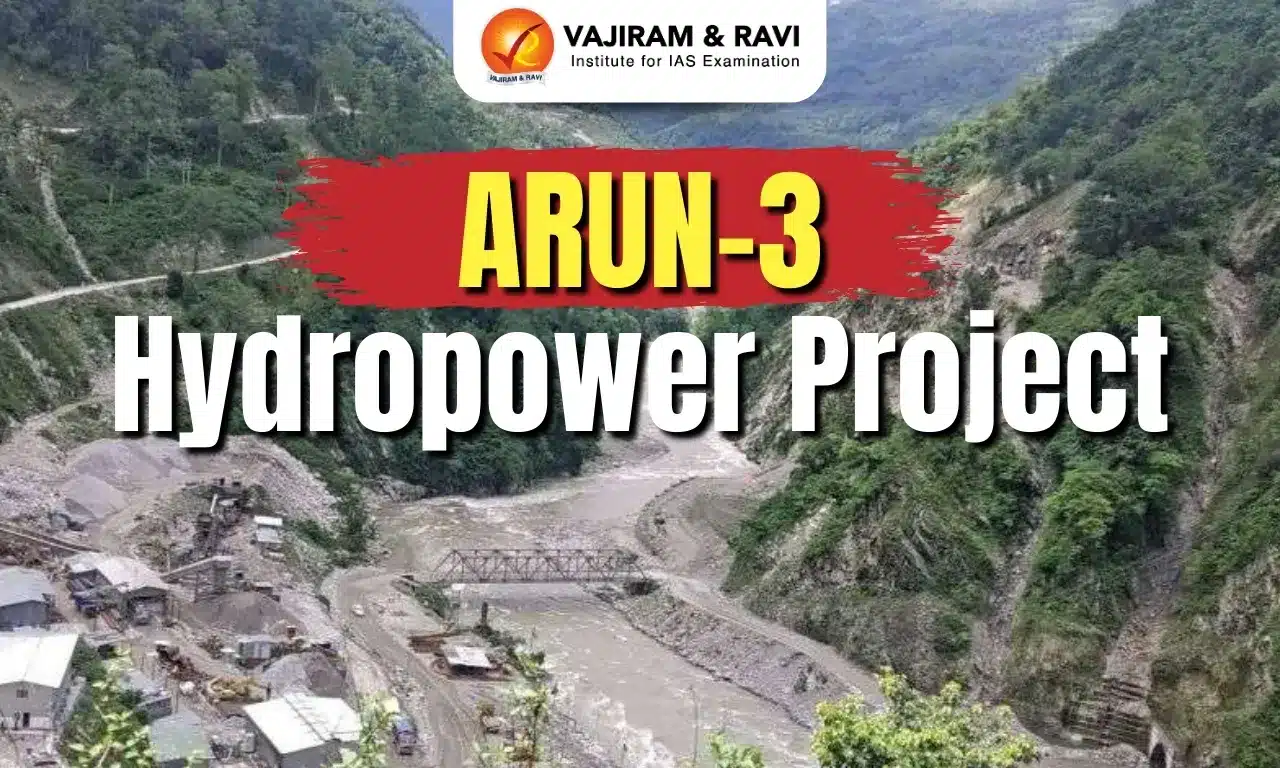
Arun-3 Hydroelectric Project

Arun-3 Hydropower Project

Arun-3 Hydroelectric Project Latest News

The Power Secretary recently reviewed the progress of SJVN's 900 MW Arun-3 Hydroelectric Project in Nepal.

About Arun-3 Hydroelectric Project

  • It is a 900 MW run-of-the-river hydropower project being developed on the Arun River in the Sankhuwasabha District of Eastern Nepal. 
    • Arun is a tributary of the Koshi River in Nepal.
  • It envisages a concrete gravity dam about 70m high and a Head Race Tunnel (HRT) of 11.74 km with an underground power house containing four generating units of 225 MW each on the left bank.
  • Estimated to cost more than $1.6 bn, the hydropower plant will produce 4,018.87 million units of electricity a year.
  • Once completed, it will be the biggest hydroelectric facility in Nepal.
  • It is being developed on a build-own-operate and transfer (BOOT) basis by Satluj Jal Vidyut Nigam (SJVN) Arun 3 Power Development Company (SAPDC), a joint venture of the Government of India and the Government of Himachal Pradesh. 
  • SAPDC will operate the facility for a period of 25 years, excluding the construction period of five years, before transferring ownership to the Nepal government.
  • Nepal will receive 21.9% of the electricity generated at the power plant as free power during these initial 25 years of commercial operations.
  • The project will provide surplus power to India, strengthening economic linkages with Nepal. 
  • The power from the project shall be exported from Dhalkebar in Nepal to Muzaffarpur in India.

News: PSU

Arun-3 Hydroelectric Project FAQs

Q1: Where is the Arun-3 Hydroelectric Project locaed?

Ans: It being developed on the Arun River in the Sankhuwasabha District of Eastern Nepal.

Q2: What is the installed capacity of the Arun-3 Hydroelectric Project?

Ans: 900 MW.

Q3: Which company is developing the Arun-3 Hydroelectric Project?

Ans: Satluj Jal Vidyut Nigam (SJVN) Arun 3 Power Development Company (SAPDC), a joint venture of the Government of India and the Government of Himachal Pradesh.

Border Roads Organisation

Border Roads Organisation

Border Roads Organisation Latest News

Addressing the Border Roads Organisation (BRO) Strategic Infrastructure Conclave in New Delhi recently, Defence Minister underscored the enduring importance of strategic infrastructure in modern warfare.

About Border Roads Organisation

  • BRO is the government of India’s premier border infrastructure agency.  
  • Establishment: It was formed on 7 May 1960 to secure India’s borders and develop infrastructure in remote areas of the north and northeastern states of the country.
  • Since 2015–16, BRO has been functioning fully under the Ministry of Defence. Earlier, it was partially under the Ministry of Road Transport and Highways. 
  • Motto: Shramena Sarvam Sadhyam (everything is achievable through hard work).
  • It develops and maintains road networks in India’s border areas and friendly neighboring countries.
  • This includes infrastructure operations in 19 states and three union territories (including Andaman and Nicobar Islands) and neighboring countries such as Afghanistan, Bhutan, Myanmar, Tajikistan, and Sri Lanka.
  • Over the years, the organisation has diversified into the construction of steel bridges, airfields, townships, tunneling works, and hydroelectric projects. 
  • Beyond building roads, the BRO is often India’s first line of defence against disasters. From the Himalayas to the North East and the Andaman & Nicobar Islands, its teams restore lifelines when calamity strikes. 
  • It has an operational role during national emergencies and the outbreak of hostilities, when it provides direct support to the Army in the maintenance of roads in the forward zones and executes other functions specified by the government.
  • It also provides the workforce for the rehabilitation of certain forward airfields of the Indian Air Force during operations.
  • BRO is also included in the Order of Battle of the Armed Forces, ensuring their support at any time.
  • In order to ensure coordination and expeditious execution of projects, the Government of India set up the Border Roads Development Board (BRDB) with the Prime Minister as Chairman of the Board and the Defence Minister as Deputy Chairman.
  • The executive head of the BRO is the Director General of Border Roads (DGBR), who holds the rank of Lieutenant General. 
  • The BRO is staffed by officers and troops drawn from the Indian Army’s Corps of Engineers, Electrical and Mechanical Engineers, Army Service Corps, Military Police, and army personnel on extra-regimental employment. 
  • Engineering Service and personnel from the General Reserve Engineer Force (GREF) form the parent cadre of the Border Roads Organisation. 
  • BRO also employs more than two lakh (200,000) local workers in the task of ensuring employment in far-flung areas.

News: DDI

Border Roads Organisation FAQs

Q1: What is the Border Roads Organisation (BRO)?

Ans: It is the Government of India's premier border infrastructure agency.

Q2: Why was the Border Roads Organisation established?

Ans: To secure India's borders and develop infrastructure in remote border areas.

Q3: What is the motto of the Border Roads Organisation?

Ans: Shramena Sarvam Sadhyam (Everything is achievable through hard work).

Q4: What does the Border Roads Organisation primarily develop and maintain?

Ans: Road networks in India's border areas and friendly neighbouring countries.

Koala

Koala

Koala Latest News

Scientists in Australia are deep-freezing koala eggs and sperm as a "genetic backup" to save the wild population from future extinction.

About Koala

  • It is an iconic Australian animal. 
  • Often called the koala “bear,” this tree-climbing animal is a marsupial—a mammal with a pouch for the development of offspring.
  • Scientific Name: Phascolarctos cinereus
  • It is the only extant representative of the family Phascolarctidae, and its closest living relatives are the wombats.

Koala Habitat and Distribution

  • The koalas live in eastern Australia and range from northern Queensland to southwestern Victoria. 
  • They are primarily found in regions with abundant eucalyptus trees, which are essential for food and shelter.  
  • Koalas are arboreal, remaining mostly in the branches of the eucalyptus trees, where they are able to feed and stay out of reach of their predators. 
  • Generally solitary, individuals move within a home range of more than a dozen trees, one of which is favoured over the others. 

Koala Features

  • It is about 60 to 85 cm long and weighs up to 14 kg in the southern part of its range (Victoria and South Australia) but only about half that in subtropical Queensland to the north.
  • In both areas, they exhibit sexual dimorphism, with the males being larger. 
  • Virtually tailless, the body is stout and gray, with a pale yellow or cream-coloured chest and mottling on the rump
  • The broad face has a wide, rounded, leathery nose, small yellow eyes, and big fluffy ears.
  • The feet are strong and clawed.
  • They are slow-moving and sleep up to 18 hours a day.

Koala Conservation Status

It is classified as 'Vulnerable' under the IUCN Red List.

News: LS

Koala FAQs

Q1: What is koala?

Ans: It is an iconic Australian animal.

Q2: Why is the koala classified as a marsupial?

Ans: Because it carries and develops its young in a pouch.

Q3: Which type of trees are essential for the survival of koalas?

Ans: Eucalyptus trees.

Q4: What is the IUCN Red List status of the koala?

Ans: Vulnerable.

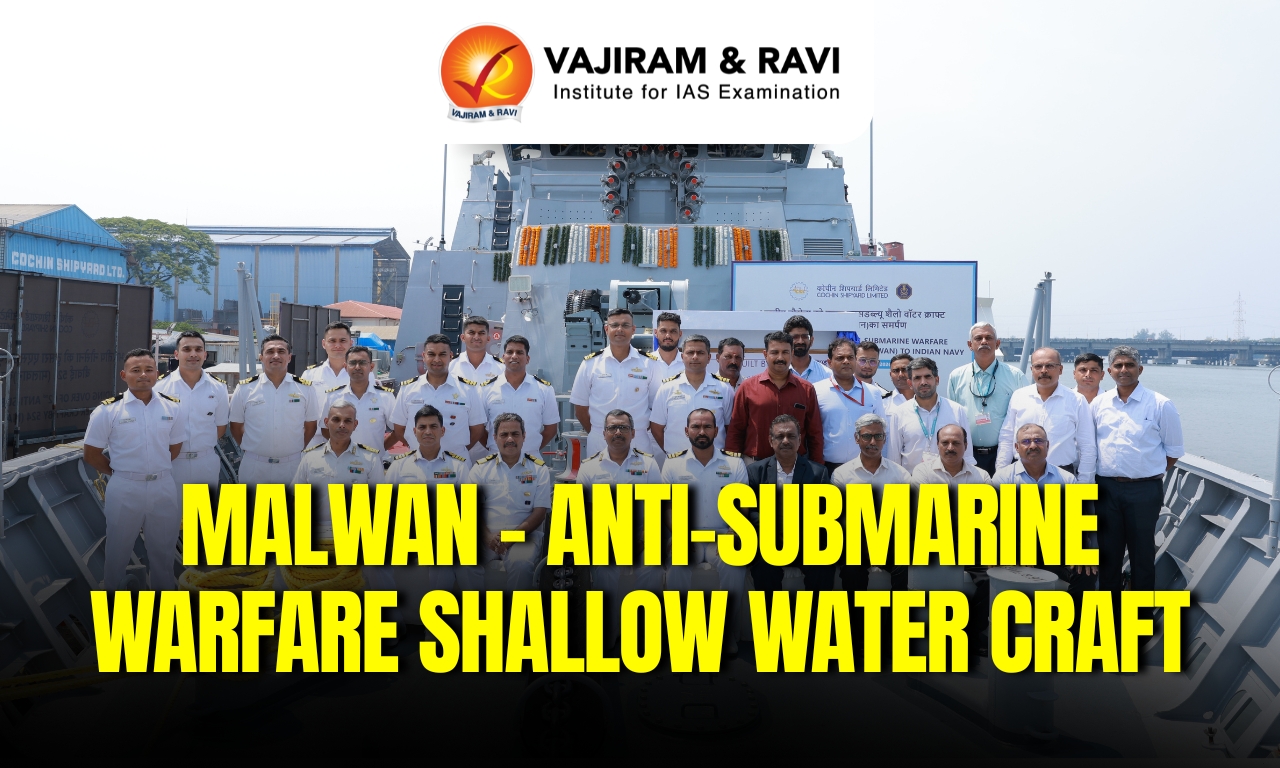
Malvan- Anti-Submarine Warfare Shallow Water Craft

Malwan - Anti-Submarine Warfare Shallow Water Craft

Malvan- Anti-Submarine Warfare Shallow Water Craft Latest News

The Indian Navy is set to commission the Malvan Anti-Submarine Warfare Shallow Water Craft (ASW-SWC).  

About Malvan- Anti-Submarine Warfare Shallow Water Craft

  • It is the second of the Mahe-class Anti-Submarine Warfare Shallow Water Craft (ASW-SWC).
  • It has been indigenously designed and constructed by Cochin Shipyard Limited.
  • It draws its name from the historic coastal town of Malwan in Maharashtra,
  • The ship also encapsulates the legacy of the erstwhile INS Malwan, an Indian Naval Minesweeper which remained in service till 2003.

Features of Malwan – Anti-Submarine Warfare Shallow Water Craft

  • Capacity: It has displacing capacity of 1,100 tons.
  • Propulsion: It is Waterjets propelled ASW SWCs
  • Armaments: It is equipped with torpedoes, multifunctional anti-submarine rockets, and state-of-the-art sensors including advanced radars and sonar systems.
  • The ship is equipped for underwater surveillance, Anti-Submarine Warfare (ASW) operations in coastal waters, Low Intensity Maritime Operations (LIMO) along with mine warfare capabilities.
  • It has over 80% indigenous content and marks a milestone in indigenous warship construction and reaffirms the Government of India’s vision of ‘Aatmanirbhar Bharat’.

Source: PIB

Malvan- Anti-Submarine Warfare Shallow Water Craft FAQs

Q1: What is the Primary role of Malvan?

Ans: Anti-submarine operations in coastal waters and Low Intensity Maritime Operations

Q2: The ASW SWC ships are equipped with which weapon?

Ans: Lightweight torpedoes, ASW rockets, 30mm guns

Finland

Key Facts about Finland

Finland Latest News

Recently, India and Finland discussed strengthening economic and financial cooperation, enhancing trade and investment ties, and expanding collaboration in digitalisation and emerging sectors. 

About Finland

  • Location: It is located in Northern Europe.
  • Bordering Countries: Norway (north), Sweden (northwest) and Russia (east).
  • Bordering water bodies: It is bounded by the Gulf of Finland (south), Gulf of Bothnia (southwest) and Baltic Sea.
  • Capital City: Helsinki
  • It is a member of the European Union (EU) and NATO.

Geographical Features of Finland

  • Climate: Finland has a severe climate due to its northern location. Winter is the longest season, with temperatures in the north falling as low as -22 °F (-30 °C). 
  • Terrain: It is heavily forested and contains some 56,000 lakes, numerous rivers, and extensive areas of marshland.
  • It has one of the highest concentrations of lakes of any country in the world. The largest lake of Finland is Lake Saimaa.
  • Highest Point: Mount Halti (1,328 m).
  • Natural Resources: The country consists of copper, iron ore, nickel, cobalt, and chromium.

Source: News On Air

Finland FAQ's

Q1: Finland shares the longest border with which country?

Ans: Russia

Q2: What is the Capital of Finland?

Ans: Helsinki

RBI’s New SNFA Framework – Explained

SNFA Network

SNFA Network Latest News

  • The Reserve Bank of India (RBI) has introduced a new prudential framework for Specified Non-Financial Assets (SNFAs), prescribing uniform rules for banks acquiring and disposing of immovable assets from defaulting borrowers.

Specified Non-Financial Assets (SNFAs)

  • The Specified Non-Financial Asset (SNFA) is a new category introduced by the RBI under the Commercial Banks - Resolution of Stressed Assets Directions, 2025 (Third Amendment Directions, 2026).
  • SNFAs refer to immovable properties acquired by banks in full or partial settlement of loans that have turned into Non-Performing Assets (NPAs).
  • These assets are not part of banks' normal business operations but are acquired as a recovery mechanism when borrowers fail to repay loans.
  • Examples of SNFAs
    • Residential buildings
    • Commercial properties
    • Industrial land
    • Warehouses
  • Other immovable assets were transferred to banks in settlement of outstanding loans. 

Need for the New Framework

  • Banks occasionally acquire immovable properties while recovering bad loans. However, the absence of a comprehensive regulatory framework resulted in:
    • Inconsistent valuation practices
    • Prolonged holding of non-core assets
    • Lack of transparency in disposal
    • Divergent accounting treatment across banks
  • The new framework seeks to ensure that banks focus on banking activities rather than real estate ownership, while improving recovery, governance, and financial reporting.

Key Features of the RBI's SNFA Framework

  • Eligibility for Acquisition
    • The borrower's account has already been classified as a Non-Performing Asset (NPA). 
    • The property is transferred through full or partial extinguishment of the outstanding loan. 
    • Where only part of the outstanding loan is settled through transfer of property, the remaining exposure will continue to be treated as a restructured loan, attracting the applicable prudential norms.
    • The RBI has clarified that an asset will be considered an SNFA only after its legal title has been transferred to the bank.
  • Valuation Norms
    • To prevent overvaluation and improve transparency, RBI has prescribed conservative valuation standards.
    • Every SNFA must be recorded at the lower of:
    • The net book value of the extinguished loan; or 
    • The distress sale value, determined independently by at least two external valuers
    • This approach ensures realistic asset valuation and reduces the possibility of inflated balance sheets.
  • Acquisition and Disposal Policy
    • Every commercial bank must formulate a Board-approved SNFA policy covering:
    • Eligibility criteria
    • Delegation of approval powers
    • Recovery measures before acquisition
    • Maximum permissible exposure to SNFAs
    • Disposal strategy and timelines
    • The policy should ensure that acquisition of immovable assets remains an exceptional recovery measure rather than a regular business activity.
  • Time Limit for Disposal
    • The RBI has imposed a strict time limit on banks for holding such assets. Banks must:
    • Make all reasonable efforts to dispose of SNFAs at the earliest
    • Complete disposal within seven years from the date of acquisition. 
    • The objective is to prevent banks from accumulating large portfolios of non-core real estate assets.
  • Disposal Through Public Auction
    • The framework provides that disposal should primarily take place through public auction.
    • Banks must follow the auction principles laid down under the Securitisation and Reconstruction of Financial Assets and Enforcement of Security Interest (SARFAESI) Act, 2002.
    • Public auctions are intended to ensure:
    • Transparency
    • Fair price discovery
    • Competitive bidding
    • Reduced scope for favouritism
  • Restriction on Sale to Borrowers
    • One of the most significant provisions is the prohibition on resale of SNFAs to:
    • The original borrower
    • Related parties, as defined under the Insolvency and Bankruptcy Code (IBC), 2016
    • The RBI introduced this safeguard to prevent misuse of the recovery process and ensure that defaulting borrowers do not regain ownership of seized assets through indirect arrangements.
  • Accounting and Disclosure Norms
    • The RBI has clarified that SNFAs will:
    • Not form part of Gross NPAs
    • Not form part of Net NPAs
    • Not be included in stressed assets
    • Not affect the Provisioning Coverage Ratio (PCR)
    • Instead, banks must disclose them separately in their balance sheets under:
    • "Non-banking assets acquired in satisfaction of claims."
    • Banks are also required to submit annual information on SNFAs through the RBI's Centralised Information Management System (CIMS), including:
    • Number of acquisitions
    • Disposals
    • Age-wise classification
    • Assets retained for own use
  • Implementation Timeline
    • The revised framework will come into force on 1 October 2026.
    • For legacy SNFAs already held by banks as on 30 September 2026, compliance must be achieved by 30 September 2027.
    • This provides banks with a one-year transition period to align existing assets with the new framework.

Significance of the New Framework

  • The framework is expected to strengthen India's banking system by:
    • Standardising the treatment of immovable assets acquired from defaulters
    • Improving transparency in valuation and disposal
    • Preventing misuse of repossessed properties
    • Enhancing governance and financial reporting
    • Encouraging quicker recovery of stressed assets
    • Allowing banks to remain focused on their core lending activities rather than managing real estate
  • The reforms also complement broader initiatives aimed at strengthening the resolution of stressed assets under the SARFAESI Act, the Insolvency and Bankruptcy Code (IBC), and RBI's prudential regulations.

Source: IE | BS

SNFA Framework FAQs

Q1: What are Specified Non-Financial Assets (SNFAs)?

Ans: SNFAs are immovable properties acquired by banks from defaulting borrowers in full or partial settlement of NPAs.

Q2: Under which law must SNFAs primarily be sold?

Ans: They should primarily be disposed of through public auctions following the principles of the SARFAESI Act, 2002.

Q3: Within how many years must banks dispose of SNFAs?

Ans: Banks must dispose of SNFAs within a maximum period of seven years.

Q4: Can banks sell SNFAs back to the original borrower?

Ans: No. The RBI prohibits sale of SNFAs to the original borrower or related parties.

Q5: Are SNFAs included in Gross NPAs?

Ans: No. SNFAs are disclosed separately under "non-banking assets acquired in satisfaction of claims" and are excluded from Gross NPAs, Net NPAs, and stressed assets.

FIFA Political Neutrality: Understanding the Falklands Banner Controversy

FIFA Political Neutrality

FIFA Political Neutrality Latest News

  • After defeating England 2-1 in the 2026 FIFA World Cup semi-final in Atlanta, Argentine players held up a banner reading "Las Malvinas son Argentinas" ("The Falkland Islands [Malvinas] are Argentine"). 
  • The banner appeared to have first been shown by supporters in the crowd before reaching the players, though how it entered the stadium remains unclear, especially since Argentine fans had reportedly been barred from carrying Falklands-related flags and banners into the venue.
  • The gesture has triggered a political controversy and raised the possibility of disciplinary action against Argentina by FIFA, just days before the team's final against Spain.

Why the Banner Is Controversial

  • Falkland Islands, are an archipelago in the South Atlantic Ocean that is the subject of a long-standing territorial dispute between Argentina and the United Kingdom.
  • The controversy stems from a nearly two-century-old sovereignty dispute:
    • Britain reasserted control over the islands - known as the Falkland Islands to Britain and Islas Malvinas to Argentina - in 1833.
    • Argentina claims it inherited sovereignty from Spain after gaining independence in 1816, and considers British control illegal.
    • Britain argues the islands were uninhabited when discovered and settled, and that its claim is legitimate.

The 1982 Falklands War

  • The dispute escalated when Argentina's military dictatorship invaded the islands in 1982. 
  • Britain responded by sending its fleet across the Atlantic, leading to a 74-day war. 
  • The conflict resulted in over 900 deaths, including around 649 Argentine military personnel, 255 British soldiers, and a small number of Falkland Islanders.

Present status

  • Britain continues to administer the islands and maintains a military presence there. 
  • A 2013 referendum saw the majority of Falkland residents vote to remain a British Overseas Territory. Argentina continues to pursue its claim through diplomatic channels, including the United Nations. 
  • The issue remains deeply tied to Argentine national identity, with journalists and citizens describing it as central to "who we are."

FIFA's Rules on Political Gestures

  • FIFA and the International Football Association Board (IFAB), football's law-making body, maintain a strict stance against political messaging in football:
    • IFAB rules prohibit equipment from carrying political, religious, or personal slogans, statements, or images.
    • FIFA's Stadium Code of Conduct bans banners, flags, and paraphernalia of a "political, offensive, and/or discriminatory nature" inside stadiums.
    • Political banners or flags are prohibited before, during, and after a match, in and around the venue.
    • Violations can lead to sanctions against the player and/or the team by the competition organiser, national football association, or FIFA itself.
  • FIFA is reportedly reviewing the Atlanta incident under these rules, though no punishment had been confirmed so far.

Precedent: Has This Happened Before?

  • Argentina has raised the Malvinas issue on the football pitch before:
    • In a 2014 friendly against Slovenia, Argentine players displayed an identical banner. 
    • FIFA imposed a non-sporting sanction, fining the Argentine Football Association (AFA) either 30,000 Swiss francs or roughly £19,540 (reported figures vary slightly across sources).
  • Other instances of political gestures at World Cups include:
    • 2018 World Cup: Switzerland's Xherdan Shaqiri and Granit Xhaka were fined 10,000 Swiss francs each for making an Albanian eagle gesture linked to Kosovo, while playing against Serbia.
    • 2022 World Cup: Serbia was fined 20,000 Swiss francs for a "No surrender" banner showing Kosovo as part of Serbia. 
    • Germany's players covered their mouths in protest against FIFA's warning on OneLove armbands (opposing Qatar's criminalisation of same-sex relationships), but were not sanctioned.

Conclusion

  • The Falklands banner episode shows how deep historical wounds can resurface even in sport. 
  • With FIFA's political-neutrality rules well established and past precedent pointing to fines, Argentina may face sanctions, but the incident underscores that for Argentina, the Malvinas remain inseparable from national identity, on and off the field.

Source: IE | FP

FIFA Political Neutrality FAQs

Q1: Why has the Falklands banner incident raised questions about FIFA Political Neutrality?

Ans: The Falklands banner incident tests FIFA Political Neutrality by examining whether political messages displayed during international football competitions violate FIFA's disciplinary regulations.

Q2: What do FIFA Political Neutrality rules prohibit?

Ans: FIFA Political Neutrality rules prohibit players, teams and supporters from displaying political, religious or discriminatory slogans, banners and symbols during official competitions.

Q3: Why is the Falklands issue politically sensitive despite FIFA Political Neutrality rules?

Ans: The Falklands dispute remains a long-standing sovereignty issue between Argentina and the United Kingdom, making it highly sensitive under FIFA Political Neutrality regulations.

Q4: Has FIFA previously enforced its Political Neutrality rules in similar situations?

Ans: Yes. FIFA Political Neutrality rules have previously resulted in fines and disciplinary action against teams and players for politically sensitive gestures during international tournaments.

Q5: What broader challenge does the Falklands controversy pose for FIFA Political Neutrality?

Ans: The Falklands controversy illustrates the continuing challenge of balancing freedom of expression, national identity and FIFA Political Neutrality in global sporting events.

Mobile Phone Manufacturing Scheme: India’s Push for Homegrown Smartphone Brands

Mobile Phone Manufacturing Scheme

Mobile Phone Manufacturing Scheme Latest News

  • The Union Cabinet has approved the Mobile Phone Manufacturing Scheme (MPMS) with an outlay of ₹62,500 crore. 
  • The scheme aims to move India beyond assembly-line manufacturing toward deeper value addition, indigenous technology, and globally competitive Indian smartphone brands.

What Is the New Scheme?

  • The MPMS will run for five years, from FY 2026-27 to FY 2030-31, as a follow-on to the Production Linked Incentive (PLI) Scheme for Large Scale Electronics Manufacturing, which concluded on March 31, 2026.

Incentive structure

  • Manufacturers get incentives ranging from 2.25% to 5% on eligible sales.
  • An additional incentive of up to 1.5% applies for sourcing key components and sub-assemblies domestically.
  • Indian brands investing in product design and R&D get an extra 3% incentive.
  • The scheme focuses on local sourcing to boost domestic value addition, along with design, R&D, and export incentives for Indian brands.

Targets Set Under the Scheme

  • Cumulative mobile phone production is expected to reach approximately ₹39 lakh crore over five years, with a significant rise in exports.
  • The scheme is projected to generate around 60,000 direct jobs.
  • It aims to strengthen India's position in global electronics supply chains.

Why Build an Indian Smartphone Brand?

  • India manufactures nearly every smartphone sold domestically, yet Indian company names are largely absent from the market. 
  • Manufacturing alone does not guarantee control over an industry: a phone assembled in India can still be designed abroad, use foreign intellectual property, and be sold under a foreign brand.
  • The scheme's stated objectives are to:
    • Achieve technological sovereignty;
    • Capture a larger share of the economic value generated by the sector;
    • Create Indian patents in design and R&D;
    • Encourage Indian companies to move deeper into the value chain, into design, R&D, intellectual property, component ecosystems, and brand ownership.
  • Bridging the cost gap: Four or five Indian companies are expected to build competitive smartphone brands, but may face an initial cost disadvantage of 10-15% compared to established players. The scheme aims to bridge at least 5-6% of that gap through subsidies.

Why Indian Brands Failed Earlier

  • Companies like Micromax, Karbonn, and Lava had established themselves in the feature-phone and low-cost handset segment but struggled to transition to smartphones as the market grew more technologically demanding.
  • Chinese brands, by contrast, combined aggressive pricing, frequent product launches, heavy marketing, and expanding distribution networks. 
  • Companies like Xiaomi, Vivo, Oppo, and Realme offered competitive specifications and invested in retail networks, after-sales service, and brand-building, allowing them to dominate beyond just low pricing.

India's Mobile Manufacturing Success Story So Far

  • The new scheme builds on a decade of growth under the Make in India initiative:
    • Mobile phone production rose from ₹18,900 crore in 2014-15 to ₹6.27 lakh crore in 2025-26, a 33-fold increase.
    • Mobile phone exports rose from ₹1,566 crore in 2014-15 to ₹2.60 lakh crore in 2025-26, a jump of more than 165 times.
    • India is now the world's second-largest mobile phone manufacturer by volume, with nearly 99.2% of mobiles used domestically manufactured within the country.
    • Smartphones have become India's largest export product category, surpassing traditional leaders like diesel fuel and cut diamonds.
  • The PLI legacy: The preceding PLI Scheme attracted over ₹20,600 crore in investments, generated production worth more than ₹11.62 lakh crore, and drove exports exceeding ₹6.53 lakh crore, laying the groundwork for the MPMS.

Broader Significance

  • A stronger electronics manufacturing sector can help India reduce import dependence, attract global investment, create high-skilled jobs, and strengthen its position in global supply chains. 
  • Industry experts note that the scheme's focus on domestic value addition and design-led manufacturing provides the long-term policy certainty needed to attract fresh investment and position India as a preferred hub for advanced mobile manufacturing. 
  • If successful, the scheme could support India's broader ambition of becoming a global electronics powerhouse, aligned with the vision of a Viksit Bharat.

Conclusion

  • The MPMS signals India's ambition to move beyond being the world's assembly line for smartphones toward owning their design, technology, and brand value. 
  • Its success will depend on whether Indian companies can close the cost and innovation gap that let Chinese brands dominate the domestic market for over a decade.

Source: IE | N18

Mobile Phone Manufacturing Scheme FAQs

Q1: What is the objective of the Mobile Phone Manufacturing Scheme?

Ans: The Mobile Phone Manufacturing Scheme seeks to develop globally competitive Indian smartphone brands by promoting domestic manufacturing, design, research, innovation and local component sourcing.

Q2: How does the Mobile Phone Manufacturing Scheme improve domestic value addition?

Ans: The Mobile Phone Manufacturing Scheme offers incentives for sourcing components locally, investing in R&D and developing indigenous intellectual property to deepen India's electronics value chain.

Q3: Why is the Mobile Phone Manufacturing Scheme important despite India's manufacturing success?

Ans: The Mobile Phone Manufacturing Scheme aims to move India beyond contract manufacturing by creating Indian-owned smartphone brands, patents and globally recognised technology companies.

Q4: Why did earlier Indian smartphone brands struggle despite market presence?

Ans: The Mobile Phone Manufacturing Scheme addresses challenges that earlier Indian brands faced, including limited R&D, weaker branding, inadequate after-sales service and intense competition from Chinese companies.

Q5: How does the Mobile Phone Manufacturing Scheme support India's economic goals?

Ans: The Mobile Phone Manufacturing Scheme strengthens exports, creates skilled employment, attracts investment and advances India's ambition to become a global electronics manufacturing powerhouse.

Daily Editorial Analysis 17 July 2026

Daily-Editorial-Analysis

Beyond Political Reshuffles, Renew Education in India

Context

  • India's educational future is presented as a question of national importance rather than political convenience.
  • Against the backdrop of Sonam Wangchuk's indefinite fast, the focus shifts from ministerial accountability to the urgent need for systemic reform.
  • The central argument is that only a transformed education system can convert India's demographic dividend into long-term national progress through quality education, innovation, and responsible citizenship.

The Symbolism of Sonam Wangchuk's Fast

  • Sonam Wangchuk's hunger strike symbolizes personal sacrifice for a larger public cause.
  • His weakening health represents a moral appeal to awaken the nation's conscience.
  • Inspired by non-violent ideals, the fast calls for meaningful educational transformation instead of temporary political responses, making it a test of India's collective responsibility.

Critique of Political Short-Termism

  • Replacing an Education Minister may satisfy immediate political demands but cannot resolve deep-rooted institutional problems.
  • Institutions shape generations, whereas political leaders are temporary.
  • Sustainable progress depends on long-term accountability, consistent policymaking, and structural reforms rather than changes in leadership.

Education and the Demographic Dividend

  • A true demographic dividend is achieved by nurturing critical thinkers, innovators, ethical leaders, researchers, skilled teachers, and responsible citizens.
  • While access to education has expanded, learning quality has not improved proportionately.
  • National development requires excellence in education rather than merely increasing enrolment.

The Path Forward Toward Long-Term Reform

  • Reforming the Examination and Coaching System
    • The present examination system encourages rote learning, making memorization more valuable than understanding.
    • Competency-based assessments should promote conceptual understanding, creativity, analytical reasoning, ethical judgement, and problem-solving.
    • Simultaneously, reducing dependence on coaching through redesigned entrance examinations and greater importance to school performance can restore confidence in formal education.
  • Strengthening Teachers and Public Education
    • No education system can exceed the quality of its teachers.
    • A National Teacher Excellence Mission should improve teacher preparation, continuous professional development, research opportunities, and professional respect.
    • Equally important is strengthening government schools with quality infrastructure, laboratories, libraries, digital facilities, sanitation, and adequate staffing to ensure equal educational opportunities for every child.
  • Academic Freedom, Transparency, and Investment
    • Educational institutions require greater academic freedom to innovate in teaching, curriculum, and research while remaining accountable for learning outcomes.
    • A national education dashboard can improve transparency by tracking performance indicators such as learning outcomes, infrastructure, teacher vacancies, and employability.
    • Sustained investment is equally important. Increasing public expenditure to 6% of GDP for education and 2% of GDP for research funding would strengthen schools, universities, laboratories, and India's transition into a knowledge economy.
  • Education Beyond Politics
    • Educational reform should remain above political ideologies and electoral cycles.
    • An independent National Education Reform Commission can establish measurable benchmarks, monitor implementation, publish progress reports, and ensure policy continuity.
    • A bipartisan approach would enable education to become a genuine national mission.

Conclusion

  • India stands at a crucial moment where reform, renewal, and a true educational renaissance can shape the future of coming generations.
  • Sonam Wangchuk's sacrifice serves as a powerful reminder that lasting change demands collective commitment rather than temporary political action.
  • By strengthening institutions, investing in education, empowering teachers, ensuring equal opportunities, and pursuing long-term reforms, India can build an education system worthy of its aspirations and unlock its full national potential.

Beyond Political Reshuffles, Renew Education in India FAQs

Q1. What does Sonam Wangchuk's fast symbolize?
Ans. Sonam Wangchuk's fast symbolizes personal sacrifice and a moral appeal for comprehensive educational reform.

Q2. Why is institutional reform more important than changing ministers?
Ans. Institutional reform is more important because strong institutions ensure long-term educational progress beyond political changes.

Q3. How can the examination system improve learning?
Ans. The examination system can improve learning by assessing conceptual understanding, creativity, and problem-solving instead of rote memorization.

Q4. Why are teachers considered the foundation of educational excellence?
Ans. Teachers are the foundation of educational excellence because the quality of education depends largely on the quality of teaching.

Q5. Why should education remain above politics?
Ans. Education should remain above politics to ensure continuous reforms and long-term national development regardless of changes in government.

Source: The Hindu


Securing Connected Battery Systems - Strengthening India's Cyber-Physical Security Framework

Context

  • The recent incident in Delhi, where certain e-rickshaws were remotely disabled through vulnerabilities in their Battery Management Systems (BMS), has highlighted a new dimension of cyber-physical security.
  • While the controversy initially centred on Chinese-origin applications, the episode underscored a deeper challenge—the cybersecurity of software-defined, connected battery systems.
  • As batteries increasingly power critical infrastructure, India requires a comprehensive regulatory framework to ensure their digital resilience.

Why the Incident Matters

  • Certain diagnostic applications exploited weak authentication and default Bluetooth credentials in BMS, enabling unauthorised access.
  • The apps were originally designed for battery diagnostics, maintenance and health monitoring, but poor access controls allowed misuse.
  • This represents India's first prominent cyber-physical security incident involving connected battery systems.
  • The core concern is insecure system design, not merely the country of origin of the software.

Growing Importance of Connected Battery Systems

  • Modern batteries are no longer passive storage devices but software-controlled, network-connected systems used in -
    • EVs and e-rickshaws
    • Grid-scale Battery Energy Storage Systems (BESS)
    • Telecom towers
    • Warehouses and ports
    • Industrial automation
    • Defence platforms
  • A successful cyberattack on such systems could disrupt essential services, threaten public safety and undermine critical infrastructure.

Current Institutional Framework in India

  • Indian Computer Emergency Response Team (CERT-In)
    • It issues cybersecurity advisories and incident response guidelines.
    • Promotes secure software development frameworks, coordinated vulnerability disclosure, Software Bills of Materials (SBOMs), and security guidance for AI-assisted software vulnerabilities.
    • Limitation: Guidelines remain largely non-binding and do not prescribe cybersecurity standards specifically for connected BMS.
  • National Critical Information Infrastructure Protection Centre (NCIIPC)
    • Protects critical sectors such as power, transport, and telecommunications.
    • Covers battery storage systems only when integrated into designated critical infrastructure.
    • Limitation: Consumer batteries, EVs, commercial storage systems and e-rickshaws remain largely outside its jurisdiction.
  • Sectoral regulators
    • Central Electricity Authority (CEA): Focuses on organisational cybersecurity and functional safety.
    • Department of Telecommunications (DoT) and MeitY: Introduced security assurance mechanisms for connected devices, including authentication, secure software updates, and vulnerability disclosure.
    • Gap: Existing standards do not explicitly address Bluetooth-enabled BMS or battery-management applications.
  • Automotive safety standards
    • Following EV fire incidents, India introduced AIS-156 and AIS-038 Rev.2.
    • These primarily address battery fires, thermal propagation, electrical abuse, and mechanical safety.
    • Recently introduced AIS-189 establishes vehicle cybersecurity management requirements throughout the vehicle lifecycle.
    • Limitation: Its coverage does not adequately extend to many electric two-wheelers and e-rickshaws using connected BMS.

Regulatory Gaps and Importance of Digital Supply Chain Security:

  • Major regulatory gaps
    • Absence of a unified cybersecurity framework for connected battery systems. Weak authentication and access-control mechanisms in BMS.
    • Limited oversight of software vulnerabilities in battery products. Fragmented institutional responsibilities.
    • Insufficient regulation of digital supply chains involved in battery manufacturing.
  • Importance
    • Modern batteries involve globally distributed components - hardware, firmware, Cloud services, and software libraries maintained by multiple developers.
    • Therefore, battery security depends not only on physical components but also on the integrity, traceability and security of the digital supply chain.

Global Best Practices

  • US: Secure Software Development Framework (SSDF); Software Bills of Materials (SBOMs); emphasis on software provenance, lifecycle security and vulnerability management.
  • EU: Cyber Resilience Act; Digital Battery Passport; focuses on firmware integrity, software traceability and lifecycle monitoring.
  • United Kingdom: The Product Security and Telecommunications Infrastructure (PSTI) Act mandates ban on default passwords, responsible vulnerability disclosure, and transparency regarding software security support.

Way Forward for India

  • Rather than creating an entirely new regulatory regime, India can strengthen its existing framework by -
    • Integrating CERT-In guidelines into battery standards.
    • Mandating Software and Hardware Bills of Materials (SBOM/HBOM) for battery products.
    • Enforcing secure software development practices throughout battery manufacturing.
    • Requiring rigorous testing and verification of imported hardware, firmware and software.
    • Strengthening authentication, encryption and access-control mechanisms for BMS.
    • Establishing lifecycle cybersecurity audits for connected battery products.
    • Promoting coordinated vulnerability disclosure and timely software updates.

Conclusion

  • The Delhi e-rickshaw incident illustrates that India's expanding digital infrastructure faces emerging cyber-physical risks.
  • Therefore, a comprehensive framework will strengthen India's technological resilience while ensuring that digital trust—not geopolitical origin—becomes the foundation of battery security.

Securing Connected Battery Systems FAQs

Q1. Why do connected BMS pose a new cyber-physical security challenge for India?

Ans. Because vulnerabilities in software-defined battery systems can disrupt critical infrastructure.

Q2. What are the major gaps in India's regulatory framework for connected battery systems?

Ans. Fragmented institutional oversight, non-binding cybersecurity guidelines, weak authentication standards, etc.

Q3. How do global regulatory frameworks strengthen the cybersecurity of connected battery systems?

Ans. They mandate secure software development, Software Bills of Materials (SBOMs), supply-chain traceability, etc.

Q4. Why is digital supply chain security crucial for modern battery systems?

Ans. Because batteries rely on globally sourced hardware, firmware, software and cloud services.

Q5. What should be India's approach to securing connected battery systems?

Ans. India should mandate secure software practices and SBOMs, strengthen authentication, etc.

Source: IE

Daily Editorial Analysis 2026 FAQs

Q1: What is editorial analysis?

Ans: Editorial analysis is the critical examination and interpretation of newspaper editorials to extract key insights, arguments, and perspectives relevant to UPSC preparation.

Q2: What is an editorial analyst?

Ans: An editorial analyst is someone who studies and breaks down editorials to highlight their relevance, structure, and usefulness for competitive exams like the UPSC.

Q3: What is an editorial for UPSC?

Ans: For UPSC, an editorial refers to opinion-based articles in reputed newspapers that provide analysis on current affairs, governance, policy, and socio-economic issues.

Q4: What are the sources of UPSC Editorial Analysis?

Ans: Key sources include editorials from The Hindu and Indian Express.

Q5: Can Editorial Analysis help in Mains Answer Writing?

Ans: Yes, editorial analysis enhances content quality, analytical depth, and structure in Mains answer writing.

Enquire Now