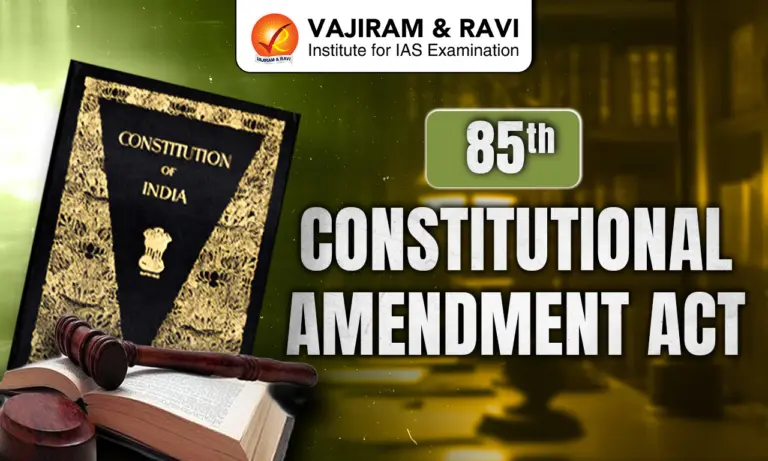
The 85th Constitutional Amendment Act is an important amendment to the Constitution of India that deals with reservation in promotion for Scheduled Castes (SCs) and Scheduled Tribes (STs) in government services. This amendment introduced the concept of “consequential seniority” for SC/ST employees who are promoted through reservation in public employment.
85th Constitutional Amendment Act Background
The 85th Constitutional Amendment Act was introduced to address issues related to reservation in promotion for Scheduled Castes (SCs) and Scheduled Tribes (STs) in government services. Earlier court judgments created uncertainty regarding the seniority of SC/ST employees promoted through reservation.
To resolve this issue and protect their service rights, the amendment modified Article 16 by introducing the concept of consequential seniority.
- The Indra Sawhney v. Union of India judgment limited reservation in promotions, creating concerns about representation of SC/ST employees in higher government posts.
- The government introduced earlier amendments such as the 77th Constitutional Amendment Act, 81st Constitutional Amendment Act, and 82nd Constitutional Amendment Act to address reservation issues.
- Despite these measures, seniority disputes continued, leading to the enactment of the 85th Constitutional Amendment Act in 2001 with retrospective effect from 17 June 1995.
85th Constitutional Amendment Act Objectives
The major objectives of the 85th Constitutional Amendment Act are:
- To provide consequential seniority to SC/ST employees promoted through reservation.
- To ensure adequate representation of SC/ST communities in higher government posts.
- To protect the service rights and career progression of SC/ST employees.
- To strengthen the reservation policy in public employment and promote social justice.
- To maintain the constitutional principle of equal opportunity in government services.





85th Constitutional Amendment Act Provisions
The amendment modified Article 16, particularly Article 16(4A), to provide reservation in promotion with consequential seniority for SC/ST employees.
- Amendment to Article 16(4A): The amendment added the words “with consequential seniority” to Article 16(4A) of the Constitution.
- Reservation in Promotion: It allows the government to provide reservation in promotions for SC/ST employees in government services.
- Consequential Seniority: SC/ST employees promoted through reservation will retain seniority over general category employees promoted later.
- Retrospective Effect: The amendment came into force retrospectively from 17 June 1995.
- Applicability: The provisions apply to government services and public sector employment where reservation policies are implemented.
- Strengthening Social Justice: The amendment aims to ensure fair representation of historically disadvantaged communities in higher administrative positions.
85th Constitutional Amendment Act Case Laws
Several important judgments of the Supreme Court of India have interpreted and clarified the provisions related to the 85th Constitutional Amendment Act and other amendments dealing with reservation in promotions for Scheduled Castes (SCs) and Scheduled Tribes (STs).
- M. Nagaraj v. Union of India: In this landmark judgment, the Supreme Court examined the constitutional validity of the 77th, 81st, 82nd, and 85th Constitutional Amendments. The Court upheld these amendments but stated that the government must collect quantifiable data before providing reservation in promotions. The data should prove the backwardness of the class, inadequate representation in services, and maintenance of administrative efficiency.
- 2. Jarnail Singh v. Lachhmi Narain Gupta: In this case, the Supreme Court partly modified the earlier judgment in the M. Nagaraj case. The Court ruled that the government does not need to prove the backwardness of SC/ST communities again, as they are already recognized as backward under the Constitution. However, the government must still show inadequate representation and ensure administrative efficiency while implementing reservation in promotions.

 Last updated on March, 2026
→ UPSC Final Result 2025 is now out.
→ UPSC has released UPSC Toppers List 2025 with the Civil Services final result on its official website.
→ Anuj Agnihotri secured AIR 1 in the UPSC Civil Services Examination 2025.
→ UPSC Marksheet 2025 is now out.
→ UPSC Notification 2026 & UPSC IFoS Notification 2026 is now out on the official website at upsconline.nic.in.
→ UPSC Calendar 2026 has been released.
→ Check out the latest UPSC Syllabus 2026 here.
→ UPSC Prelims 2026 will be conducted on 24th May, 2026 & UPSC Mains 2026 will be conducted on 21st August 2026.
→ The UPSC Selection Process is of 3 stages-Prelims, Mains and Interview.
→ Prepare effectively with Vajiram & Ravi’s UPSC Prelims Test Series 2026 featuring full-length mock tests, detailed solutions, and performance analysis.
→ Enroll in Vajiram & Ravi’s UPSC Mains Test Series 2026 for structured answer writing practice, expert evaluation, and exam-oriented feedback.
→ Join Vajiram & Ravi’s Best UPSC Mentorship Program for personalized guidance, strategy planning, and one-to-one support from experienced mentors.
→ Shakti Dubey secures AIR 1 in UPSC CSE Exam 2024.
→ Also check Best UPSC Coaching in India
85th Constitutional Amendment Act FAQs
Q1. What is the 85th Constitutional Amendment Act?+
Q2. Which Article was amended by the 85th Amendment?+
Q3. When did the 85th Constitutional Amendment come into force?+
Q4. What is consequential seniority?+
Q5. Why was the 85th Constitutional Amendment introduced?+
Tags: 85th constitutional amendment act