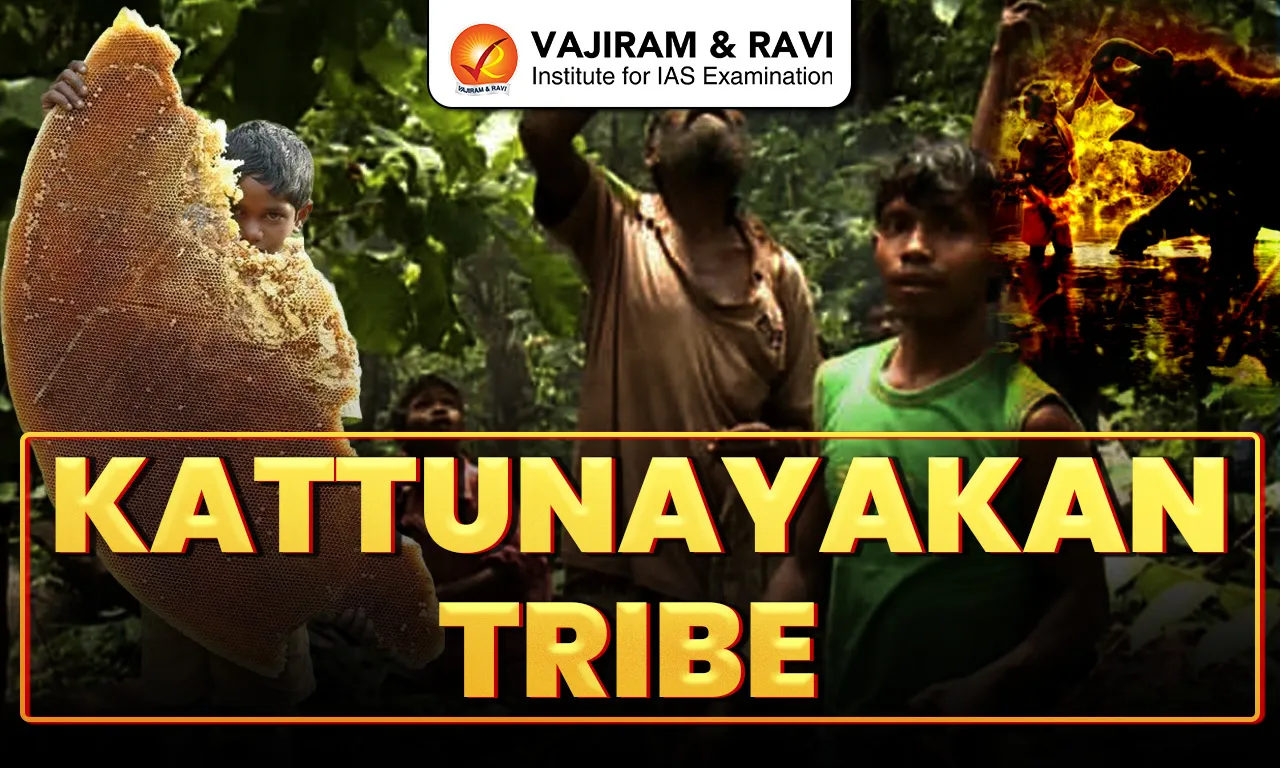
Kattunayakan Tribe is one of the oldest forest dwelling communities of South India. It is known for deep ecological knowledge and dependence on natural resources. The Kattunayakan Tribe lives mainly in the Western Ghats and is recognized as a Particularly Vulnerable Tribal Group (PVTG). Their lifestyle reflects hunting gathering traditions, strong cultural beliefs and close interaction with forests, making the Kattunayakan Tribe important for understanding indigenous knowledge systems.
Kattunayakan Tribe
The Kattunayakan Tribe is an ancient forest dependent community of the Western Ghats, known for honey collection, hunting practices and distinct cultural traditions rooted in nature.
- Origin: The term Kattunayakan means “king of the jungle” in Tamil and Malayalam, reflecting their identity as forest rulers.
- Historical Background: The Kattunayakan Tribe is considered among the earliest inhabitants of the Western Ghats, historically living as forest based hunter gatherers and maintaining continuity of traditional practices, ecological knowledge and cultural identity over centuries.
- Distribution: The Kattunayakan Tribe is found in the regions like Tamil Nadu, Kerala, Karnataka and Andhra Pradesh, with local names like Cholanaickan in Nilambur interiors and Pathinaickans in plains regions.
- Population Status: With an approximate population of 20,251, the Kattunayakan Tribe is officially recognized as a Scheduled Tribe and categorized among the 75 Particularly Vulnerable Tribal Groups in India.
- Livelihood Practices: The tribe depends on forest produce such as honey, wax, roots and bark, along with fishing and trapping small animals, maintaining a hunter gatherer lifestyle with minimal agricultural activity.
- Language: Their language is a mixture of Dravidian languages including Tamil, Kannada and Malayalam, reflecting cultural interactions while retaining distinct tribal identity and oral traditions.
- Social Structure: The Kattunayakan Tribe follows a patrilineal system with monogamy as a norm and marriages usually occur after puberty, replacing earlier child marriage practices.
- Religion and Beliefs: They follow Hinduism blended with animism, worshipping Lord Shiva as Bhairava along with animals, trees, rocks, snakes and ancestors, showing strong ecological spirituality.
- Culture: Music, dance and oral storytelling are integral, while traditional medicine and rituals, including belief in magic and sorcery, continue to shape their social and spiritual life.
- Cultural Recognition: The Oscar winning documentary “The Elephant Whisperers” highlighted Bomman and Bellie from the Kattunayakan Tribe, showcasing their role in nurturing orphaned elephants in Mudumalai.
Kattunayakan Tribe and Mudumalai Protected Areas
The Kattunayakan Tribe has a deep association with Mudumalai landscapes, where their traditional knowledge supports wildlife conservation and elephant care systems.
- Mudumalai National Park Location: Located in the Nilgiri Hills of Tamil Nadu, it borders Kerala and Karnataka and forms part of the Nilgiri Biosphere Reserve, one of India’s key biodiversity hotspots.
- Mudumalai Tiger Reserve: Declared a tiger reserve in 2007, Mudumalai hosts species like Bengal tiger, Indian leopard, elephant and sloth bear within a large contiguous forest ecosystem.
- Mudumalai Elephant Habitat: The region represents one of the largest habitats for Asian elephants, supported by grasslands, bamboo forests and water sources like the Moyar River and its tributaries.
- Theppakadu Elephant Camp: Established in 1927, it is among the oldest elephant camps in Asia, housing around 28 elephants and relying on tribal mahouts, mainly from the Kattunayakan Tribe.
- Role of Tribe Conservation: Members of the Kattunayakan Tribe serve as caretakers and mahouts, using traditional knowledge to manage elephants and assist in forest conservation activities.


Particularly Vulnerable Tribal Groups (PVTGs)
Particularly Vulnerable Tribal Groups are the most vulnerable tribal groups in India, identified based on socio-economic and demographic criteria, requiring focused protection, development policies and targeted welfare schemes.
- Definition: Particularly Vulnerable Tribal Groups are characterized by declining or stagnant population, low literacy, pre agricultural technology and high dependence on forests and natural resources.
- Distribution: India has 75 PVTGs across 18 states and one Union Territory, with Odisha having the highest number, while Punjab and Haryana have no identified PVTGs.
- Identification Criteria: Criteria include economic backwardness, technological simplicity, low literacy and demographic vulnerability, with proposals submitted by states and approved by the central government.
- Development Schemes: The PVTG Development Scheme launched in 2008 focuses on housing, land development, agriculture, social security and infrastructure through Conservation-cum-Development Plans.
- Governance Framework: The Ministry of Tribal Affairs implements policies, while expert committees approve plans, ensuring targeted funding for survival, protection and socio-economic development.
- Kattunayakan Tribe: As a PVTG, the Kattunayakan Tribe represents traditional ecological knowledge systems and highlights the need for balancing conservation with livelihood security in forest regions.

 Last updated on Oct, 2026
→ UPSC 2027 Notification will be released on 13 January 2027 at upsconline.nic.in.
→ Check Nobel Prize 2026 Winners List here.
→ Download PIB PRiSM Monthly Magazine 2026 here.
→ Check UPSC Monthly Current Affairs Magazine The Recitals here.
→ Check out the latest UPSC Syllabus here.
→ Download UPSC Model Answers for Mains 2026
→ UPSC Mains Question Paper 2026 is out now for Essay & GS Paper 1, 2, 3 & 4.
→ UPSC Calendar 2027 has been released.
→ Enroll in Vajiram & Ravi’s UPSC Mains Test Series 2027 for structured answer writing practice, expert evaluation, and exam-oriented feedback.
→ Join Vajiram & Ravi’s UPSC Mentorship Program 2027 for personalized guidance, strategy planning, and one-to-one support from experienced mentors.
→ Go through the UPSC Mains Previous Year Papers to enhance your preparation.
→ UPSC has released UPSC Toppers List 2025 with the Civil Services final result on its official website.
→ Also check Best UPSC Coaching in India
Kattunayakan Tribe FAQs
Q1. What is the Kattunayakan Tribe known for?+
Q2. Where is the Kattunayakan Tribe found?+
Q3. Why is the Kattunayakan Tribe classified as a PVTG?+
Q4. What language do the Kattunayakan people speak?+
Q5. What is the role of the Kattunayakan Tribe in Mudumalai?+
Tags: geography indian society kattunayakan tribe