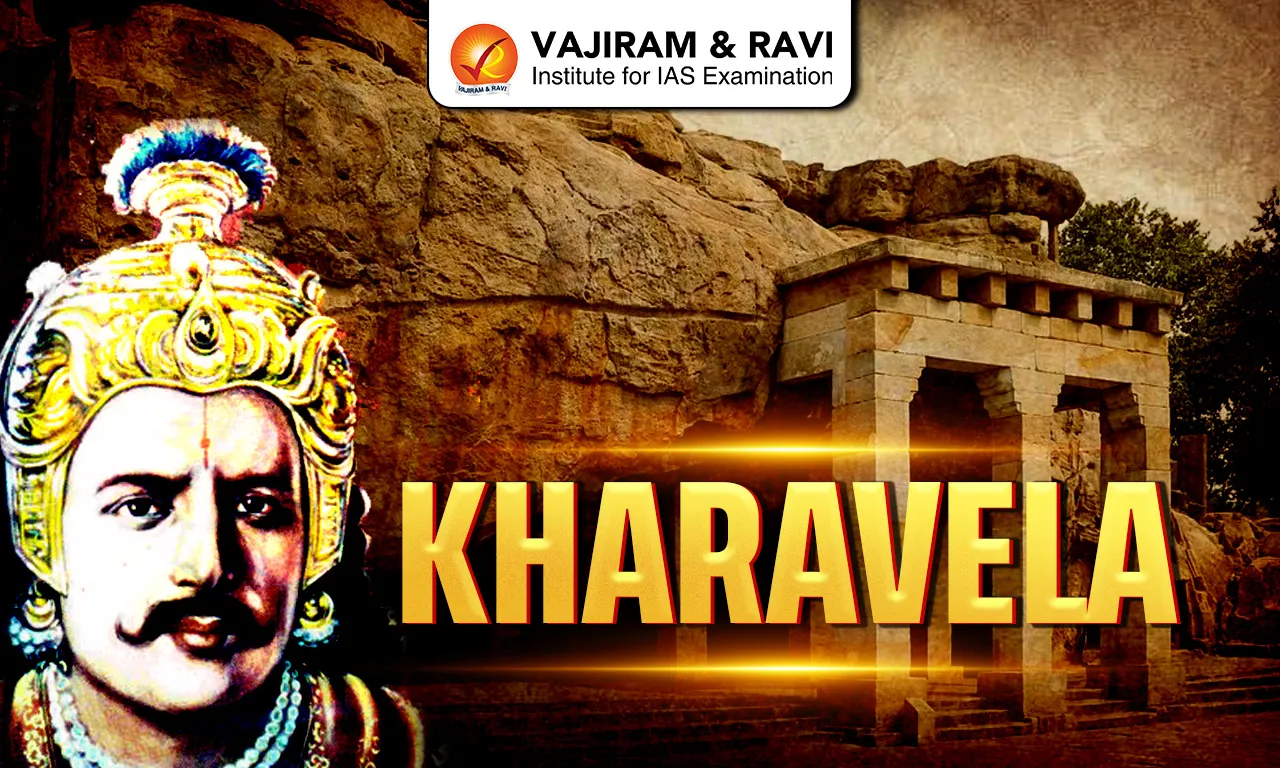
Kharavela was a powerful ruler of Kalinga in the 2nd century BCE who rebuilt and expanded the kingdom after Mauryan decline. The Kharavela reign is mainly known from the Hathigumpha inscription, which records his military victories, welfare works and administration. He emerged as an able conqueror and administrator, making Kalinga a strong regional power through strategic campaigns, economic growth and public welfare initiatives.
King Kharavela
Kharavela’s biography is reconstructed mainly from the Hathigumpha inscription, which narrates his life, training, accession and achievements as ruler.
- Early life and training: Kharavela was trained in writing, finance, law, administration, music and warfare. He became crown prince at 15 and gained administrative experience before ascending the throne at 24.
- Dynasty and lineage: He belonged to the Mahameghavahana dynasty of Kalinga and is described as enhancing the glory of the Chedi lineage, indicating royal ancestry and established political authority.
- Coronation: After coronation, he assumed the title Kalingadhipati and focused on strengthening the capital Kalinganagara, repairing fortifications damaged by natural calamities and improving urban infrastructure.
- Military campaigns: The Hathigumpha inscription records campaigns against Satavahanas, Magadha, Kosala and southern confederacies, showing his expansion from northern India to southern regions including Pandya territories.
- Major achievements: He defeated Magadha rulers like Bruhaspati Mitra, recovered the Kalinga Jina image and constructed the Mahavijaya Prasada, celebrating victories and asserting political dominance across regions.
Kharavela Contributions
The contributions of Kharavela highlights his role as a conqueror, welfare oriented ruler and promoter of culture, making Kalinga a prosperous and powerful state.
- Military expansion: Kharavela expanded Kalinga’s territory through successful campaigns against Magadha, Kosala and southern kingdoms, establishing political supremacy and strengthening Kalinga’s position in post Mauryan India.
- Public welfare works: He constructed canals, gardens, tanks, rest houses and temples, spending large sums like thirty five lakh coins, which improved living conditions and urban infrastructure across the kingdom.
- Religious patronage: Kharavela supported Jainism by building caves and donating wealth to monks, while also respecting other religions and maintaining religious harmony in his kingdom.
- Cultural development: He promoted music, dance and festivals, organizing public performances that entertained citizens and contributed to cultural growth and social cohesion.
- Restoration of heritage: He brought back the sacred Kalinga Jina image taken earlier by Nanda rulers, restoring religious pride and political prestige of Kalinga.


Administration under Kharavela
Administration under Kharavela was organised with structured bureaucracy, territorial divisions and efficient governance supported by officials and local authorities.
- Central administration: Key officials included Mahamatyas as advisors, Senapatis commanding the army, Dandanayakas maintaining law and order and Bhogadhyakshas managing finance and revenue systems.
- Provincial administration: The kingdom was divided into mandalas, rashtras and visayas, governed by Mahamatras, Rastrapathis and Visayapatis who implemented policies and maintained administration at regional levels.
- Municipal administration: Urban governance was handled by officials like Nagaradhyakshas who managed civic amenities, collected taxes and ensured law and order in towns and cities.
- Military organisation: Kharavela maintained a strong army with infantry, cavalry, elephants and chariots, which helped him conduct large scale campaigns and protect territorial integrity.
- Welfare governance: Administrative machinery supervised construction of public works like canals, temples and parks, reflecting focus on public welfare and development financed by war booty and revenue.
Society under Kharavela
Society, culture and religion under Kharavela were marked by diversity, tolerance, welfare measures and interaction with foreign regions through trade.
- Religious tolerance: Though a follower of Jainism, Kharavela respected all sects and repaired temples of different religions, ensuring peaceful coexistence of Jainism, Buddhism and Brahmanical traditions.
- Social structure: Society included rulers, officials, merchants, artisans and labourers, indicating occupational diversity and a structured social hierarchy supporting administration and economy.
- Role of women: Inscriptions mention queens and royal women, suggesting respectable positions in society, though their role remained largely within domestic and ceremonial spheres.
- Cultural interactions: Trade with regions like Rome and Greece brought new cultural influences, enhancing artistic traditions, crafts and social practices within Kalinga.
- Public welfare society: Construction of wells, tanks, gardens and rest houses improved quality of life, reflecting a welfare oriented society focused on public benefit and collective prosperity.
Art and Architecture under Kharavela
Art, literature and architecture under Kharavela flourished through royal patronage, especially visible in cave architecture and inscriptions.
- Hathigumpha inscription: This Prakrit inscription in Brahmi script on Udayagiri hills provides detailed accounts of Kharavela’s reign, including military campaigns, administration and cultural activities.
- Cave architecture: Kharavela excavated numerous caves at Udayagiri and Khandagiri, including around 117 caves for Jain monks, showing advancement in rock cut architecture and religious patronage.
- Artistic expression: Sculptures of Tirthankaras, royal scenes, trees and decorative motifs in caves reflect artistic excellence and religious symbolism during his rule.
- Literature and language: Use of Ardha Magadhi Prakrit indicates development of regional language traditions alongside Sanskrit, making inscriptions accessible to common people.
- Cultural monuments: Construction of palaces like Mahavijaya Prasada and public structures demonstrates architectural innovation and emphasis on commemorating victories and achievements.
Economy under Kharavela
The economy under Kharavela was prosperous, supported by agriculture, trade, industries and state sponsored infrastructure development.
- Agriculture base: Fertile land and irrigation systems like canals and dams improved agricultural output, producing crops such as rice, sugarcane, pulses and sesame.
- Trade and commerce: Inland and maritime trade flourished with centres like Tosali and Kosambi, attracting foreign traders from Rome, Greece and West Asia.
- Revenue system: Land revenue formed a major income source, while wealth from military campaigns added to the treasury, enabling large scale public spending.
- Industries and crafts: Metalwork, textiles and shipbuilding industries developed, with artisans producing goods for domestic use and export markets.
- Public expenditure: Investment in infrastructure such as tanks, roads, temples and gardens generated employment, stimulated economic growth and improved overall prosperity of Kalinga.

 Last updated on Oct, 2026
→ UPSC 2027 Notification will be released on 13 January 2027 at upsconline.nic.in.
→ Asian Games 2026 are being held in Aichi-Nagoya, Japan, from 19 September to 4 October.
→ Check Nobel Prize 2026 Winners List here.
→ Download PIB PRiSM Monthly Magazine 2026 here.
→ Check UPSC Monthly Current Affairs Magazine The Recitals here.
→ Check out the latest UPSC Syllabus here.
→ Download UPSC Model Answers for Mains 2026
→ UPSC Mains Question Paper 2026 is out now for Essay & GS Paper 1, 2, 3 & 4.
→ UPSC Calendar 2027 has been released.
→ Enroll in Vajiram & Ravi’s UPSC Mains Test Series 2027 for structured answer writing practice, expert evaluation, and exam-oriented feedback.
→ Join Vajiram & Ravi’s UPSC Mentorship Program 2027 for personalized guidance, strategy planning, and one-to-one support from experienced mentors.
→ Go through the UPSC Mains Previous Year Papers to enhance your preparation.
→ UPSC has released UPSC Toppers List 2025 with the Civil Services final result on its official website.
→ Also check Best UPSC Coaching in India
Kharavela FAQs
Q1. Who was Kharavela?+
Q2. What is the main source of information about Kharavela?+
Q3. Which dynasty did Kharavela belong to?+
Q4. What religion did Kharavela follow?+
Q5. What were the major achievements of Kharavela?+
Tags: ancient history