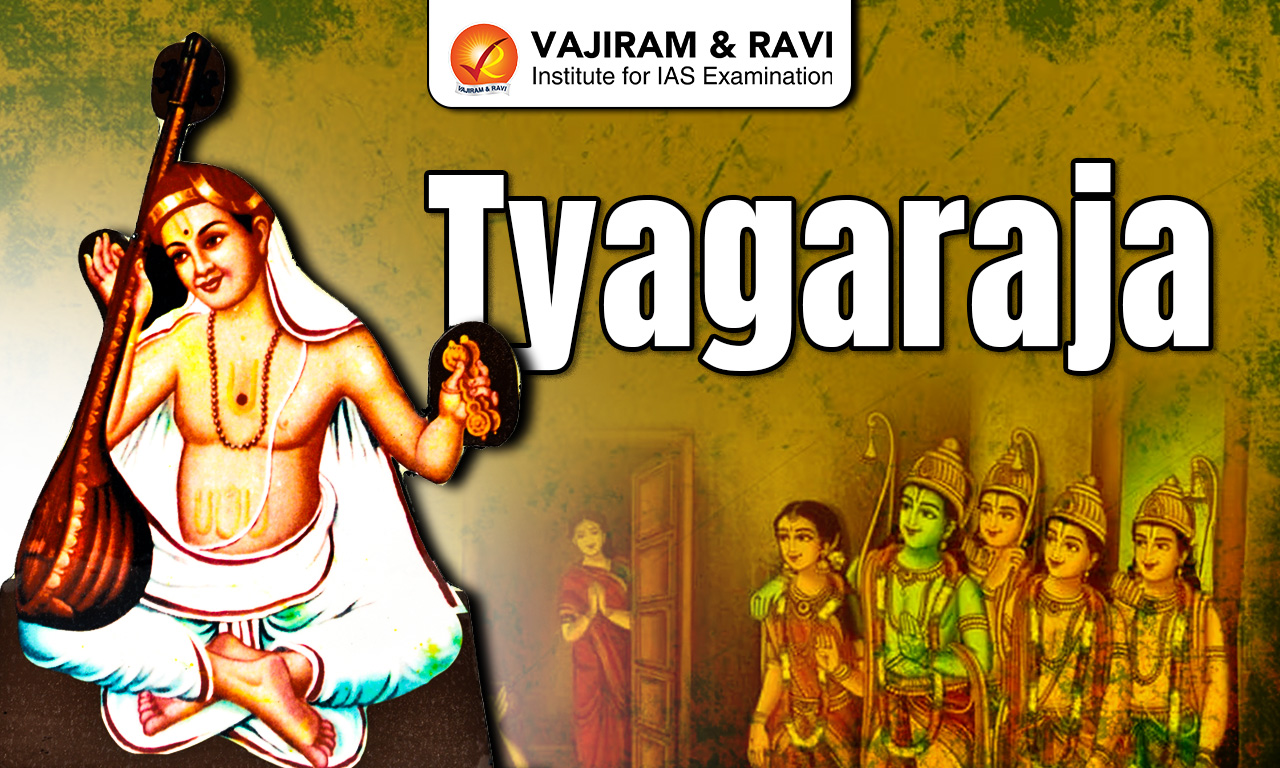
Tyagaraja was one of the greatest composer-saints of South India and a central figure in the tradition of Carnatic music. A devoted follower of Lord Rama, he used music as a means of spiritual expression and liberation. He is regarded as one of the Trinity of Carnatic Music, along with Muthuswami Dikshitar and Syama Sastri.
Tyagaraja Birth and Early Background
- Tyagaraja was born on 14 May 1767 in the village of Thiruvaiyaru, located in the Thanjavur region of present-day Tamil Nadu.
- His father, Kakarla Ramabrahmam, and his mother, Sitamma, belonged to the Telugu-speaking Mulakanadu Smartha Brahmin community.
- The family originally came from the Prakasam region of present-day Andhra Pradesh and later migrated to the Tamil-speaking cultural region of Thanjavur.
- At the time of his birth, he was named Tyagabrahmam. This name was given in honour of Lord Shiva, who is worshipped as Tyagaraja at the temple in his birthplace.
- This early religious environment played an important role in shaping his spiritual outlook and devotion, which later became the foundation of his musical compositions.
Tyagaraja and the Carnatic Trinity
Tyagaraja is widely recognised as one of the three great composers of Carnatic music, collectively known as the Trinity. The other two members of this Trinity are Muthuswami Dikshitar and Syama Sastri.
- All three composers lived and worked in the Thanjavur region during the late eighteenth and early nineteenth centuries and made lasting contributions to the development of Carnatic music.
- They laid the foundation of modern Carnatic music.
- Among them, Tyagaraja is particularly known for the large number of compositions he created and for the devotional depth present in his music.


Tyagaraja Devotional Philosophy
- The central theme of Tyagaraja’s compositions is devotion to Lord Rama, who is believed to be an incarnation of Vishnu.
- It is believed that he composed thousands of kritis, most of which praise Lord Rama and express a deep personal connection with the divine.
- His compositions express deep devotion and a personal relationship with God. They include emotions such as love, surrender, longing and spiritual reflection.
- His music reflects the Bhakti tradition, where devotion to God is seen as the path to spiritual liberation.
- He also rejected royal patronage and material wealth, preferring a life of devotion to Lord Rama. When invited by King Serfoji II, he declined and composed “Nidhi Chala Sukhama”, highlighting that true happiness lies in devotion rather than wealth or royal honor.
Tyagaraja Musical Contribution and Innovations
Carnatic music evolved as a highly structured classical tradition in South India under strong Bhakti influence. By the eighteenth century, it had reached a mature stage but lacked standardisation in composition and performance. Tyagaraja played a crucial role in systematising and refining this tradition into its modern form.
- He introduced sangatis, which are small variations in a musical line. This made his compositions more expressive and allowed singers to improvise.
- He helped establish the kriti as the main form of Carnatic music by giving it a clear and fixed structure.
- His Pancharatna Kritis are considered masterpieces and are still widely performed in music concerts and festivals.
- He composed many ragas and helped develop them by showing their full beauty and emotional expression.
- He also wrote musical operas such as Prahlada Bhakti Vijayam and Nauka Charitam.
- His compositions are simple, devotional, and emotionally rich, mainly dedicated to Lord Rama.
Tyagaraja Compositions
- Tyagaraja’s compositions, known as kritis, are famous for their quality, variety and depth. They combine meaningful lyrics with rich musical structure.
- A well-known example is the composition “Koluvaiyunnade” in the raga Devagandari, which shows how he used multiple sangatis to enrich a musical piece.
- Apart from kritis, he also composed Uthsava Sampradaya Kirtanas for festivals and Divyanama Sankirtanas for devotional singing in groups. This shows that his music was closely connected to religious and social practices.
- Among his many compositions, the Pancharatna Kritis are the most famous. These five compositions are still sung together by Carnatic musicians across the world as a tribute to him.
Tyagaraja Aradhana Festival
Every year, musicians gather at Thiruvaiyaru to celebrate the Tyagaraja Aradhana festival.
- It is held during January or February and marks the day of his samadhi, known as Pushya Bahula Panchami.
- During this festival, hundreds of musicians perform together, and the group singing of the Pancharatna Kritis is an important part of the celebration.
Tyagaraja Death
Tyagaraja passed away on 6 January 1847. This day is remembered as Pushya Bahula Panchami. Not much information is available about his final days.

 Last updated on Sep, 2026
→ UPSC Mains Question Paper 2026 is out now for Essay & GS Paper 1, 2, 3 & 4.
→ UPSC Mains GS Paper 1 2026 is out now.
→ UPSC Mains GS Paper 2 2026 is out now.
→ UPSC Mains GS Paper 3 2026 is out now.
→ UPSC Mains GS Paper 4 2026 is out now.
→ UPSC Mains Indian Language Paper & English Compulsory Paper are out now.
→ Check out the latest UPSC Syllabus 2026 here.
→ UPSC Mains Admit Card 2026 is now out.
→ Enroll in Vajiram & Ravi’s UPSC Mains Test Series 2027 for structured answer writing practice, expert evaluation, and exam-oriented feedback.
→ Join Vajiram & Ravi’s UPSC Mentorship Program 2027 for personalized guidance, strategy planning, and one-to-one support from experienced mentors.
→ Go through the UPSC Mains Previous Year Papers to enhance your preparation.
→ Download UPSC Mains Essay Paper 2025, UPSC Mains GS Paper-I 2025, UPSC Mains GS Paper-II 2025, UPSC Mains GS Paper-III 2025, UPSC Mains GS Paper-IV 2025, UPSC Mains English (Compulsory) Paper 2025, UPSC Mains Hindi (Qualifying) Paper 2025 here.
→ UPSC has released UPSC Toppers List 2025 with the Civil Services final result on its official website.
→ UPSC Calendar 2027 has been released.
→ Also check Best UPSC Coaching in India
Tyagaraja FAQs
Q1. Who was Tyagaraja?+
Q2. What are Tyagaraja’s most famous compositions?+
Q3. What was the main theme of Tyagaraja’s music?+
Q4. Which language did Tyagaraja use in his compositions?+
Q5. Why is Tyagaraja important in Carnatic music?+
Tags: tyagaraja