NSO Health Survey Latest News
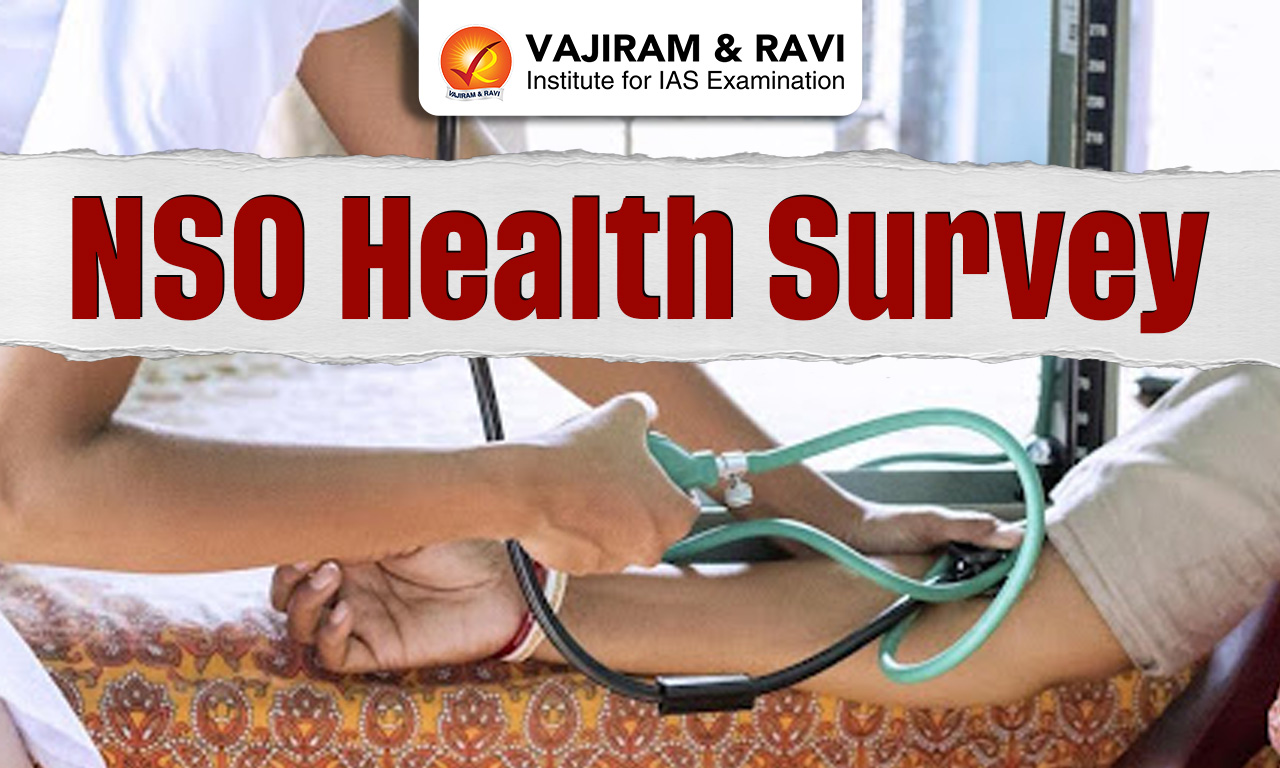
- The National Statistical Office recently released findings from its 80th round survey on Household Social Consumption: Health (2025).
- The report reveals a paradox in India’s healthcare trend wherein health insurance coverage has expanded significantly, yet financial distress persists for many households.
Overview of the 80th Round NSO Health Survey
- The 80th round survey conducted from January to December 2025 provides a comprehensive picture of healthcare access, utilisation, and financial protection in India.
- Compared to the 75th round conducted in 2017-18, insurance coverage, healthcare access, and institutional deliveries have improved substantially.
- However, the survey also reveals that higher coverage has not necessarily translated into lower out-of-pocket expenditure (OOPE) or increased hospitalisation in public facilities.


Rising Insurance Coverage in India
- According to the latest data, 47.4% of rural and 44.3% of urban households are now covered under some form of health insurance.
- This is a significant increase, largely driven by an expansion of Government-Financed Health Insurance (GFHI) schemes such as Ayushman Bharat – Pradhan Mantri Jan Arogya Yojana (PMJAY) and various State-level initiatives.
- Government records show a more than two-and-a-half-fold rise in GFHI coverage between 2017-18 and 2025.
- Schemes like the Employees’ State Insurance Scheme (ESIS), Central Government Health Scheme (CGHS), and state employee schemes are also part of this growth.
- The combined effect indicates India’s rapid movement toward universal health assurance.
Expanding Access and Government Interventions
- The Union Health Ministry has hailed the survey results as evidence of improved healthcare access across India.
- Initiatives such as the Free Drugs and Diagnostics Initiatives (FDSI and FDI), launched in 2015, have expanded the availability of essential medicines and tests even in remote areas.
- The creation of 1.84 lakh Ayushman Arogya Mandirs (AAMs) has strengthened India’s network for comprehensive primary healthcare, focusing on preventive, promotive, and curative services.
- Schemes like the Affordable Medicines and Reliable Implants for Treatment (AMRIT), offering up to 50% discounts on 6,500 medicines through 220 pharmacies, have also bolstered affordability.
- These reforms have supported early detection and management of chronic illnesses such as diabetes and cardiovascular conditions, reflecting a clear epidemiological transition toward non-communicable diseases.
Persisting Gaps: Hospitalisation and Expenditure Patterns
- Despite expanded coverage, the hospitalisation rate has not risen notably since 2017-18 and remains below 2014 levels.
- Utilisation of public institutions for hospitalisation and childbirth has declined, while demand for private sector care has surged, especially in urban areas.
- Contrary to government claims of declining expenditure, independent analysis of NSO data shows OOPE on hospitalisation has more than doubled between 2017-18 and 2025.
- Average hospitalisation expenses in private hospitals have increased by 70% in rural areas and 80% in urban areas.
- Even in public hospitals, patients often face costs for medicines, diagnostics, transport, and incidental charges due to systemic shortages.
- Official data indicate a median OOPE of Rs. 11,285 per hospitalisation in 2025, with substantially lower costs in public facilities (median Rs. 1,100).
- However, many high-cost cases, particularly specialised treatments sought in private care, push the average far higher.
Inequities in Utilisation and the Role of GFHI
- Government-financed insurance schemes such as PMJAY are designed to protect vulnerable families from catastrophic health expenditures. However, utilisation trends suggest uneven benefits:
- 57% of insured individuals sought hospital care in private facilities.
- Among urban beneficiaries using insurance-linked hospitalisation, only 13% belonged to the poorest income group.
- The better-off classes disproportionately benefit from the system, while state governments bear heavy fiscal burdens, up to 15% of health budgets in states like Haryana and West Bengal.
- The structure of these insurance models channels substantial public funds to the private healthcare sector, which operates largely on profit-driven principles.
- Despite GFHI reimbursements, many hospitals impose additional charges on patients, undermining the schemes’ promise of “free” treatment.
Financial Protection and Public Health Equity
- From a macro perspective, the survey presents mixed outcomes. While coverage and access indicators have improved, financial risk protection remains inadequate.
- In rural India, the bottom two income quintiles have shown some decline in OOPE, but in urban areas, the financial strain persists due to heavy reliance on private providers.
- The AAMs, envisioned as the primary care backbone under Ayushman Bharat, demonstrate potential for sustainable UHC.
- Yet, underfunding of AAMs and the National Health Mission (NHM) continues to limit their impact.
Way Forward
- India’s experience illustrates that insurance-led healthcare models alone cannot achieve equitable health outcomes.
- Strengthening the public health infrastructure, ensuring consistent drug and diagnostic availability, and rationalising private sector regulation are crucial for protecting citizens from medical impoverishment.
- The focus must shift towards preventive and primary care, robust data systems for monitoring, and outcome-based financing that prioritises value over volume.
- A well-functioning public health system remains the cornerstone of inclusive development and social justice.

 Last updated on Sep, 2026
→ UPSC 2027 Notification will be released on 13 January 2027 at upsconline.nic.in.
→ Check out the latest UPSC Syllabus here.
→ Download UPSC Model Answers for Mains 2026
→ UPSC Mains Question Paper 2026 is out now for Essay & GS Paper 1, 2, 3 & 4.
→ UPSC Calendar 2027 has been released.
→ Enroll in Vajiram & Ravi’s UPSC Mains Test Series 2027 for structured answer writing practice, expert evaluation, and exam-oriented feedback.
→ Join Vajiram & Ravi’s UPSC Mentorship Program 2027 for personalized guidance, strategy planning, and one-to-one support from experienced mentors.
→ Go through the UPSC Mains Previous Year Papers to enhance your preparation.
→ UPSC has released UPSC Toppers List 2025 with the Civil Services final result on its official website.
→ Also check Best UPSC Coaching in India
NSO Health Survey FAQs
Q1. What is the recent NSS 80th round survey about?+
Q2. How much health insurance coverage does India have now?+
Q3. What is the median out-of-pocket expenditure per hospitalisation?+
Q4. Which schemes have contributed most to rising insurance coverage?+
Q5. What remains India’s biggest healthcare challenge?+
Tags: mains articles NSO Health Survey upsc current affairs upsc mains current affairs