Ambedkar Labour Laws Latest News
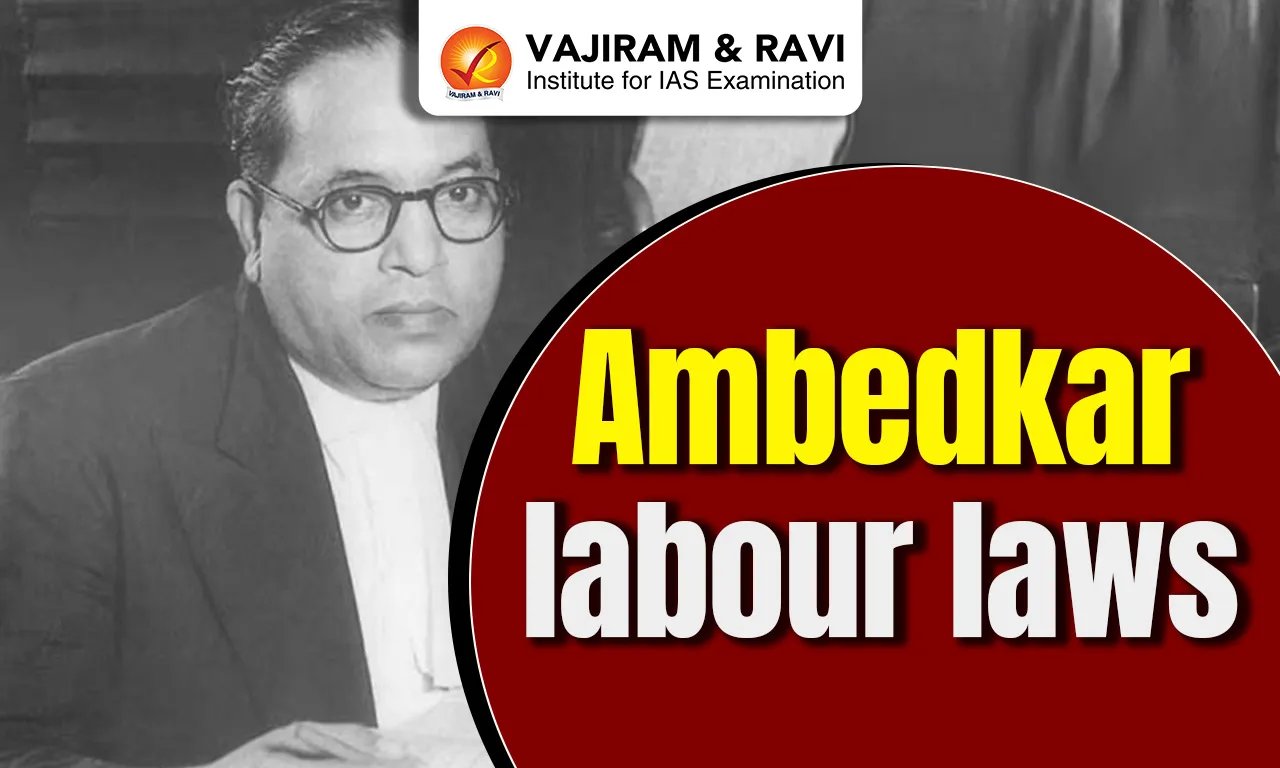
- As India observed Dr. B.R. Ambedkar’s birth anniversary on April 14, this article highlights a lesser-known but profoundly important dimension of his legacy — his transformative contributions to labour rights and welfare in colonial India.
Ambedkar’s Vision for Labour — Beyond Survival
- Ambedkar began his political journey by organising the Independent Labour Party to address the issues of the working classes in colonial India. However, his vision went far beyond material conditions.
- For Ambedkar, labour must be able to live a life of self-development of their human, cultural, and spiritual personalities — not merely survive.
- This philosophical foundation shaped every labour reform he pursued.


Ambedkar as Labour Member (1942-46) — A Watershed Moment
- The early 1940s were a turbulent period.
- Industrialisation was expanding across the Global South — including colonial India — pushing vast masses from agrarian, feudal setups into a labour-driven capitalist economy.
- Little to no attention was paid to labour rights, on the assumption that early industrialisation could not afford to accommodate worker protections.
- Against this backdrop, Ambedkar’s appointment as Labour Member in the Viceroy’s Executive Council in 1942 — nearly a month before the launch of the Quit India Movement — marked a watershed moment for Indian labour.
Key Labour Reforms Introduced by Ambedkar
- Ambedkar introduced a remarkable range of pathbreaking legislation during his four-year tenure:
- Reduction of working hours from 12 hours to 8 hours per day — moving India toward the global norm of a 48-hour workweek.
- Maternity benefits for women workers — ensuring women did not have to choose between livelihood and childbirth.
- Provident Fund for workers.
- Paid leave and Dearness Allowance (DA).
- Compulsory recognition of trade unions.
- Housing and medical facilities for workers.
- Creation of Employment Exchanges.
- Employee State Insurance (ESI) — laying the foundation for social security in India.
- Ambedkar made clear that reducing working hours was not just about health and dignity — it could also address unemployment by distributing work more evenly, without any reduction in wages or dearness allowance.
Tripartite Labour Conference, 1942 — A Historic First
- In 1942, Ambedkar chaired the first-ever Tripartite Labour Conference in India — bringing together the government, employers, and employees to discuss common problems jointly.
- Ambedkar ensured that labour and management were brought face-to-face as equals — a new paradigm in India’s industrial relations.
- The conference also raised an important debate about placing labour legislation in the Concurrent List of the Constitution, ensuring national uniformity in labour laws rather than allowing individual provinces to enact varying laws driven by local interests.
- Ambedkar warned that without central legislation, “Provincial considerations” would dominate over national importance.
- These conferences met regularly from 1942 to 1946 and shaped the future of India’s labour policy.
Labour Investigation Committee, 1944
- Under Ambedkar’s initiative, the Labour Investigation Committee was formed in early 1944 — the first fact-finding body of its kind in India.
- It examined critical aspects of labour life including wages, working conditions, housing, and broader social realities — going beyond industries like coal and cotton to sectors that had been previously neglected.
Sector-Specific Welfare Measures
- Ambedkar’s 1943 visit to Chota Nagpur to witness the lives of mine workers directly translated into policy.
- He introduced a Bill that led to the establishment of the Mica Mines Labour Welfare Fund in 1946 — the first of its kind.
- This model was subsequently extended to workers in coal, iron ore, manganese, limestone, dolomite, and the beedi industry.
Dignity in the Workplace
- In 1946, Ambedkar pushed for an amendment requiring mine owners to provide separate bathing facilities for male and female workers — arguing that miners deserved to return home clean and with a sense of self-respect and dignity, not merely hygiene.
- This reflected his belief that labour rights were inseparable from human dignity.
Ambedkar’s Labour Legacy in the Constitution
- Key constitutional provisions reflecting his vision include:
- Article 39 — Directs the State to ensure adequate means of livelihood for all citizens and equal pay for equal work for men and women.
- Article 43 — Directs the State to secure for all workers — agricultural, industrial, or otherwise — a living wage, decent working conditions, and full enjoyment of leisure, social and cultural opportunities.
- Article 39(b) and (c) — Seeks to eliminate economic inequality by ensuring that ownership and control of material resources serve the common good, and that concentration of wealth does not occur to the common detriment.
Ambedkar’s Broader Philosophy on Labour Rights
- Ambedkar was clear on one fundamental point — labour rights cannot survive on reforms alone.
- Trade unionism, while important, was not sufficient. He strongly believed that for workers to sustain the rights they had achieved, they must have representation in the politics of the country.
- Labour must enter political life and find solutions beyond the workplace — a vision that was far ahead of its time.
Source: IE

 Last updated on Oct, 2026
→ UPSC 2027 Notification will be released on 13 January 2027 at upsconline.nic.in.
→ Check Nobel Prize 2026 Winners List here.
→ Download PIB PRiSM Monthly Magazine 2026 here.
→ Check UPSC Monthly Current Affairs Magazine The Recitals here.
→ Check out the latest UPSC Syllabus here.
→ Download UPSC Model Answers for Mains 2026
→ UPSC Mains Question Paper 2026 is out now for Essay & GS Paper 1, 2, 3 & 4.
→ UPSC Calendar 2027 has been released.
→ Enroll in Vajiram & Ravi’s UPSC Mains Test Series 2027 for structured answer writing practice, expert evaluation, and exam-oriented feedback.
→ Join Vajiram & Ravi’s UPSC Mentorship Program 2027 for personalized guidance, strategy planning, and one-to-one support from experienced mentors.
→ Go through the UPSC Mains Previous Year Papers to enhance your preparation.
→ UPSC has released UPSC Toppers List 2025 with the Civil Services final result on its official website.
→ Also check Best UPSC Coaching in India
Ambedkar Labour Laws FAQs
Q1. What are Ambedkar labour laws?+
Q2. Why are Ambedkar labour laws significant?+
Q3. What reforms were included in Ambedkar labour laws?+
Q4. How do Ambedkar labour laws influence the Constitution?+
Q5. What was Ambedkar’s philosophy behind labour laws?+
Tags: ambedkar labour laws mains articles upsc current affairs upsc mains current affairs