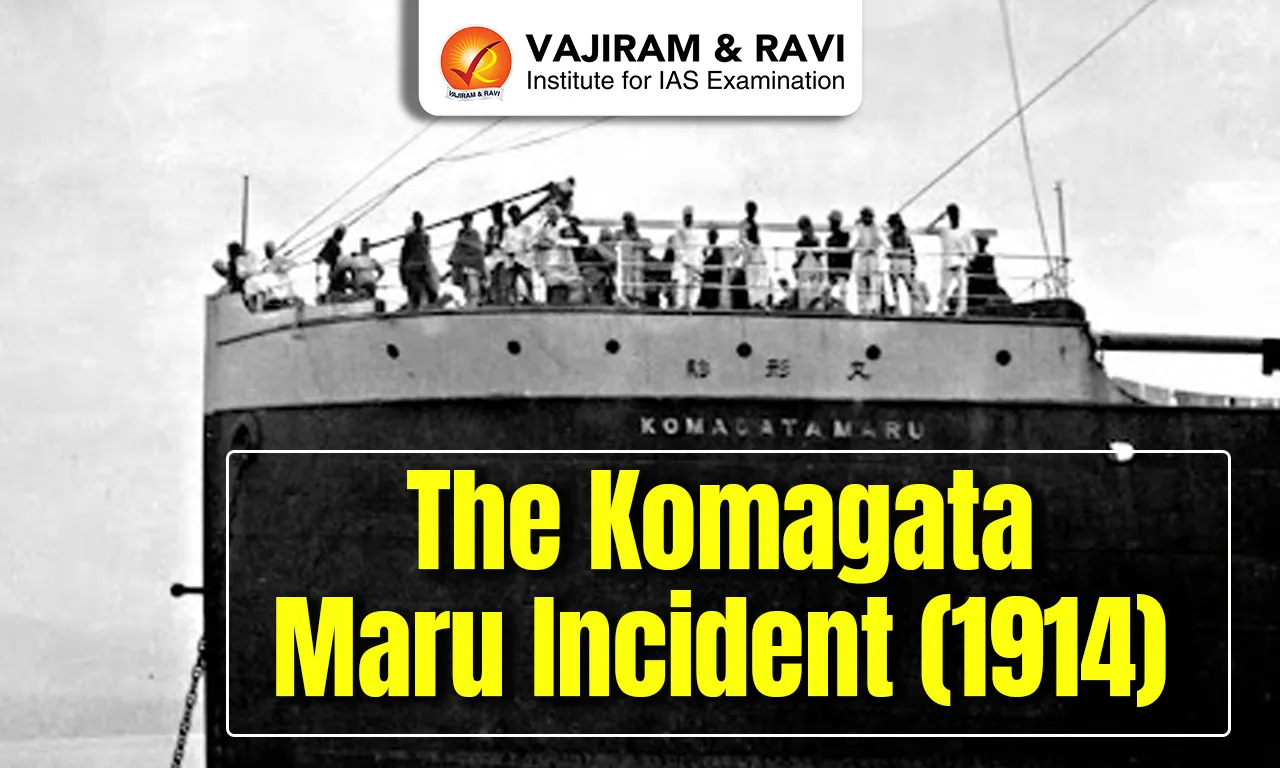
The Komagata Maru Incident (1914) Latest News
- In the early twentieth century, thousands of Punjabis sought to emigrate abroad to escape the twin crises of rural indebtedness and epidemic disease back home.
- As British subjects, they believed they held the right to settle anywhere within the Empire.
- The Komagata Maru incident (1914) shattered that illusion — and in doing so, became a defining moment in India’s anticolonial consciousness.
Punjab – The Socio-Economic and Political Backdrop
- By 1914, Punjab had been systematically cultivated by the British as a “martial race” province — the backbone of the British Indian Army.
- Yet beneath this loyalty lay deep structural exploitation –
- Rapid agricultural expansion, combined with predatory credit systems, had pushed rural families into a spiral of debt.
- Epidemics of malaria and plague in the early 1900s compounded the misery, forcing emigration as the only viable escape.
- It was from this social soil that the Ghadar Movement emerged — founded in 1913 among expatriate Punjabis on the U.S. West Coast, it was openly committed to the armed overthrow of British rule in India.
- The Komagata Maru voyage was thus never merely an immigration dispute; it was saturated in anticolonial politics from the very beginning.


The Voyage and the Standoff
- The voyage:
- It was deliberately organised as a legal challenge to racial exclusion.
- Gurdit Singh, a Punjabi entrepreneur based in Singapore, chartered the Japanese steamship Komagata Maru and set sail from Hong Kong in the spring of 1914.
- It had 376 passengers — 340 Sikhs, 24 Muslims, and 12 Hindus — all British subjects from Punjab.
- Their destination was Vancouver, British Columbia, Canada, where they encountered systematic state hostility.
- Institutional racism in immigration law: Canada had enacted the Continuous Journey Regulation of 1908, a law crafted specifically to block South Asian immigration without explicitly naming race.
- The two-month standoff (May–July 1914):
- The ship reached Vancouver (May 23, 1914), but passengers were denied docking, and isolated with restricted food and water.
- The legal challenge failed in British Columbia courts. Violent confrontation when authorities tried to board the ship.
- Only 22 passengers — those who could prove prior Canadian residence — were permitted to enter.
- Then Canadian PM Robert Borden ordered the ship’s expulsion using naval force. The ship departed under armed escort on July 23.
The Brutal Return – Budge Budge Massacre
- British colonial authorities, deeply suspicious of the passengers’ political leanings, refused the ship permission to dock in Hong Kong or Singapore.
- When the Komagata Maru finally anchored near Calcutta in late September 1914, British authorities attempted to forcibly deport passengers to Punjab. The passengers refused.
- They marched toward the city — and were fired upon by police. 20 passengers were killed; many more were imprisoned.
- Gurdit Singh escaped and remained a fugitive for years before surrendering in 1920, serving five years in prison.
Impact on Indian National Movement
- Boost to revolutionary politics:
- The incident intensified support for the Ghadar movement.
- In 1915, Ghadar activists attempted an armed uprising in Punjab — it was crushed due to informers, and dozens were hanged.
- Yet the movement’s martyrs became symbols of resistance in nationalist memory.
- Exposure of colonial hypocrisy: Revealed that “British subjecthood” did not ensure equal rights across the Empire. Strengthened anti-colonial consciousness and distrust of imperial promises.
- Diaspora politics and anticolonial nationalism: The Ghadar movement represents an important strand of overseas Indians contributing to India’s independence struggle.
Canada’s Delayed Reckoning
- Canada’s acknowledgement of its role was painfully delayed.
- In 2008, Prime Minister Stephen Harper offered an apology at a community festival — widely rejected as inadequate.
- It was only in 2016 that Prime Minister Justin Trudeau delivered a formal apology on the floor of the House of Commons, more than a century after the events.
- The episode is now seen as a critical moment in Canada’s journey toward acknowledging systemic racism and exclusion.
Conclusion
- The Komagata Maru incident is more than a story of a failed migration—it is a powerful indictment of colonial injustice and racial exclusion.
- For modern governance and global migration debates, it remains a cautionary tale about equality, dignity, and the limits of legal rights without social justice.
Source: TH

 Last updated on August, 2026
→ UPSC Mains Question Paper 2026 is out now for Essay & GS Paper 1, 2, 3 & 4.
→ UPSC Mains GS Paper 1 2026 is out now.
→ UPSC Mains GS Paper 2 2026 is out now.
→ UPSC Mains GS Paper 3 2026 is out now.
→ UPSC Mains GS Paper 4 2026 is out now.
→ UPSC Mains Indian Language Paper & English Compulsory Paper are out now.
→ Check out the latest UPSC Syllabus 2026 here.
→ UPSC Mains Admit Card 2026 is now out.
→ Enroll in Vajiram & Ravi’s UPSC Mains Test Series 2027 for structured answer writing practice, expert evaluation, and exam-oriented feedback.
→ Join Vajiram & Ravi’s UPSC Mentorship Program 2027 for personalized guidance, strategy planning, and one-to-one support from experienced mentors.
→ Go through the UPSC Mains Previous Year Papers to enhance your preparation.
→ Download UPSC Mains Essay Paper 2025, UPSC Mains GS Paper-I 2025, UPSC Mains GS Paper-II 2025, UPSC Mains GS Paper-III 2025, UPSC Mains GS Paper-IV 2025, UPSC Mains English (Compulsory) Paper 2025, UPSC Mains Hindi (Qualifying) Paper 2025 here.
→ UPSC has released UPSC Toppers List 2025 with the Civil Services final result on its official website.
→ UPSC Calendar 2027 has been released.
→ Also check Best UPSC Coaching in India
The Komagata Maru Incident (1914) FAQs
Q1. How did the Komagata Maru incident expose the contradictions of British imperial citizenship?+
Q2. What is the role of Punjab’s socio-economic conditions in shaping the Komagata Maru episode?+
Q3. What is the significance of the Komagata Maru incident in the growth of revolutionary nationalism in India?+
Q4. What is the role of colonial laws in shaping migration patterns during the early 20th century?+
Q5. What lessons does the Komagata Maru incident offer for contemporary migration and multicultural policies?+
Tags: komagata maru incident mains articles upsc current affairs upsc mains current affairs