The Bangladesh Liberation War 1971 was a major armed conflict in South Asia that led to the birth of Bangladesh as an independent nation. It was fought from 26 March 1971 to 16 December 1971. This war emerged from political discrimination, economic exploitation, cultural suppression and military violence in East Pakistan. The conflict transformed regional geopolitics, involved India and Pakistan directly and caused one of the largest humanitarian crises of the twentieth century.
Bangladesh Liberation War 1971
The Bangladesh Liberation War 1971 was rooted in decades of inequality between East Pakistan and West Pakistan after the creation of Pakistan in 1947. Although both regions formed one country, they were divided by nearly 1,600 km of Indian territory, and had different languages, cultures, economies and political priorities.
The war permanently changed the geopolitical map of South Asia and established Bangladesh as a sovereign nation after decades of inequality and violence.
Bangladesh Liberation War 1971 Historical Background
The Bangladesh Liberation War 1971 Timeline has been detailed below:
- Partition of Bengal 1905: The British partitioned Bengal in 1905 on religious lines, deepening Hindu-Muslim political divisions. This event shaped Muslim political mobilisation and later influenced the formation of separate Muslim political identity in eastern Bengal.
- Creation of Pakistan in 1947: British India was partitioned in 1947, creating Pakistan with West Pakistan and East Pakistan. Despite being one country, the two wings were geographically separated and culturally distinct.
- Demographic imbalance: East Pakistan had a larger population than West Pakistan, but political power remained concentrated in western provinces, particularly among Punjabi and military elites.
- Language conflict of 1948: In 1948, Muhammad Ali Jinnah declared Urdu as Pakistan’s sole national language. Bengali speaking East Pakistan strongly opposed this decision because Bengali was spoken by the majority.
- Language Movement 1952: Student protests in Dhaka against Urdu imposition intensified in February 1952. Police firing killed several students on 21 February 1952, making it a historic day later recognised as International Mother Language Day by UNESCO.
- Cultural suppression: Bengali culture faced marginalisation. Traditional Bengali identity, literature, music and symbols were viewed suspiciously by West Pakistani rulers. The works of Rabindranath Tagore were restricted.
- 1954 provincial election: The Awami League gained major support in East Pakistan. However, the central government repeatedly undermined democratic authority in the eastern wing.
- Constitution of 1956: Pakistan became the Islamic Republic of Pakistan in 1956. Although East Pakistan got formal representation, actual control remained with military and bureaucratic elites in the west.
- Military coup of 1958: General Mohammad Ayub Khan took power in 1958. His rule increased centralisation and widened economic inequalities between East and West Pakistan.
- Economic exploitation: East Pakistan produced major export goods such as jute, Pakistan’s largest foreign exchange earner. However, much of the revenue was spent in West Pakistan.
- Underrepresentation in state institutions: Bengalis remained underrepresented in the military, civil administration and foreign policy structures despite forming a large share of the population.
- Six Point Movement 1966: Sheikh Mujibur Rahman introduced the Six Points in 1966 demanding autonomy for East Pakistan. These included separate currency arrangements, fiscal control, trade independence and regional military structure.
- Agartala Conspiracy Case 1968: Mujibur Rahman was accused of conspiring with India for secession. The case increased his popularity among Bengalis.
- Yahya Khan’s rule 1969: General Yahya Khan replaced Ayub Khan in 1969 and promised elections, but his administration remained dominated by West Pakistan.
- Bhola Cyclone 1970: The cyclone killed around 300,000 to 500,000 people in East Pakistan. Poor central government relief deepened Bengali anger.
- 1970 General Elections: The Awami League won 167 out of 169 East Pakistan seats and secured majority in Pakistan’s National Assembly, giving Sheikh Mujibur Rahman the right to form government.
- Denial of democratic transfer: Zulfikar Ali Bhutto and Yahya Khan refused to transfer power to Mujib, triggering widespread protests and civil disobedience.
- Historic 7 March Speech: On 7 March 1971, Sheikh Mujibur Rahman delivered his famous speech at Dhaka Race Course Ground, preparing Bengalis for resistance.
- First Bangladesh flag raising: On 23 March 1971, the flag of Bangladesh was publicly raised, symbolising the move toward independence.
- Beginning of repression: Political talks collapsed by late March, leading directly to military action and the start of the Bangladesh Liberation War 1971.


Bangladesh Liberation War 1971 Reasons
The Bangladesh Liberation War 1971 began because East Pakistan’s people faced sustained political exclusion, economic discrimination and cultural suppression. The major causes of the war has been discussed here:
- Political exclusion: Despite majority population, Bengalis lacked real political influence. Decision making remained dominated by West Pakistan’s military bureaucratic structure.
- Economic disparity: East Pakistan generated major export earnings through jute, yet development investment remained concentrated in West Pakistan.
- Language discrimination: Urdu imposition ignored Bengali identity and created early resistance.
- Cultural hostility: Bengali dress, literature and social identity were often treated as weak Islamic markers by western rulers.
- Military underrepresentation: Bengalis had low representation in Pakistan Army and administration.
- Autonomy demands ignored: The Six Point Programme was rejected by the central government.
- Bhola Cyclone neglect: Failure to provide adequate relief increased anti state sentiment.
- Election denial: Awami League’s 1970 democratic mandate was blocked.
- Operation Searchlight: Military crackdown directly transformed political conflict into war.
- Mass refugee crisis: Millions fled to India, internationalising the conflict.
- Rise of Bengali nationalism: Shared language and identity created a strong liberation movement.
- Indian strategic interests: India sought to reduce two front military threat and manage refugee pressure.
- Cold War alignment: The Indo-Soviet Treaty of August 1971 strengthened India’s position.
- Humanitarian catastrophe: Atrocities created global pressure and resistance.
Bangladesh Liberation War 1971 Events
The major events that took place during the Bangladesh Liberation War 1971 has been highlighted below:
- Political crisis and mass mobilisation (March 1971): On 1 March 1971, President Yahya Khan postponed the National Assembly session, denying power to the Awami League. This triggered widespread protests, civil disobedience and administrative paralysis across East Pakistan. On 7 March, Sheikh Mujibur Rahman delivered his historic speech at Dhaka, effectively calling for resistance and preparing the population for independence.
- Operation Searchlight and declaration of independence (25-26 March 1971): On the night of 25 March, the Pakistan Army launched Operation Searchlight, targeting Dhaka University, intellectuals, students and civilians using heavy weapons. Mass killings began immediately. In the early hours of 26 March, Sheikh Mujibur Rahman declared independence before being arrested and taken to West Pakistan. This marked the formal beginning of the Bangladesh Liberation War 1971.
- Spread of violence and early resistance (late March-April 1971): Following the crackdown, widespread massacres occurred in places like Chittagong, Rangpur and Syedpur. Bengali soldiers, police and civilians began organised resistance. Major Ziaur Rahman announced independence from Chittagong on behalf of Mujib, strengthening morale. Large numbers of civilians began fleeing to India due to escalating violence.
- Formation of government in exile and command structure (April 1971): On 10 April, Awami League leaders formed a provisional government in exile, formally sworn in on 17 April at Mujibnagar. Tajuddin Ahmad became Prime Minister, while M. A. G. Osmani was appointed Commander in Chief, organising the resistance into sectors.
- Rise of Mukti Bahini and guerrilla warfare (April-June 1971): The Mukti Bahini emerged as the main resistance force, consisting of defected soldiers, students and civilians. Guerrilla tactics such as ambushes, sabotage and intelligence operations weakened Pakistani positions. India began providing training camps, arms and logistical support along the border, strengthening the insurgency.
- Mass atrocities and humanitarian crisis (May-August 1971): Pakistani forces and allied militias carried out systematic massacres, including the Chuknagar and Jinjira killings. Sexual violence affected an estimated 200,000-400,000 women. US diplomat Archer Blood sent the “Blood Telegram,” describing a “reign of terror.” By mid 1971, around 10-15 million refugees had fled into India.
- International awareness and cultural mobilisation (mid 1971): The Swadhin Bangla Betar Kendra broadcast resistance messages, while global awareness increased through diplomatic channels and media. On 1 August 1971, George Harrison and Ravi Shankar organised the Concert for Bangladesh in New York, raising funds and international sympathy.
- Strategic alignment and Indo-Soviet Treaty (August 1971): India signed the Indo-Soviet Treaty of Peace, Friendship and Cooperation with the Soviet Union, securing diplomatic backing against possible US or Chinese intervention. This agreement strengthened India’s position and ensured strategic balance during the conflict.
- Expansion of guerrilla operations and military organisation (July-November 1971): The Mukti Bahini intensified operations through coordinated attacks like Operation Jackpot, targeting ports, communication lines and supply chains. Bangladesh’s naval and air units began limited operations. Sector commanders coordinated resistance, weakening Pakistani administrative and military control across rural regions.
- Escalation into full scale India-Pakistan war (3 December 1971): Pakistan launched Operation Chengiz Khan, carrying out pre-emptive air strikes on Indian airbases in the western sector. In response, India formally entered the war on both eastern and western fronts, transforming the Bangladesh Liberation War 1971 into a full scale interstate conflict.
- Rapid Indian advance and key battles (December 1971): Indian forces, in coordination with Mukti Bahini, achieved swift victories in battles such as Garibpur, Hilli and Dhalai. The Tangail airdrop cut off Pakistani retreat routes, while the Meghna heli bridge operation enabled rapid troop movement. Indian Navy established dominance in the Bay of Bengal, isolating East Pakistan.
- Recognition of Bangladesh and fall of Dhaka (December 1971): On 6 December, India officially recognised Bangladesh as an independent state. Indian and Bangladeshi forces advanced rapidly toward Dhaka, capturing key towns and cutting supply lines, making Pakistani defence unsustainable.
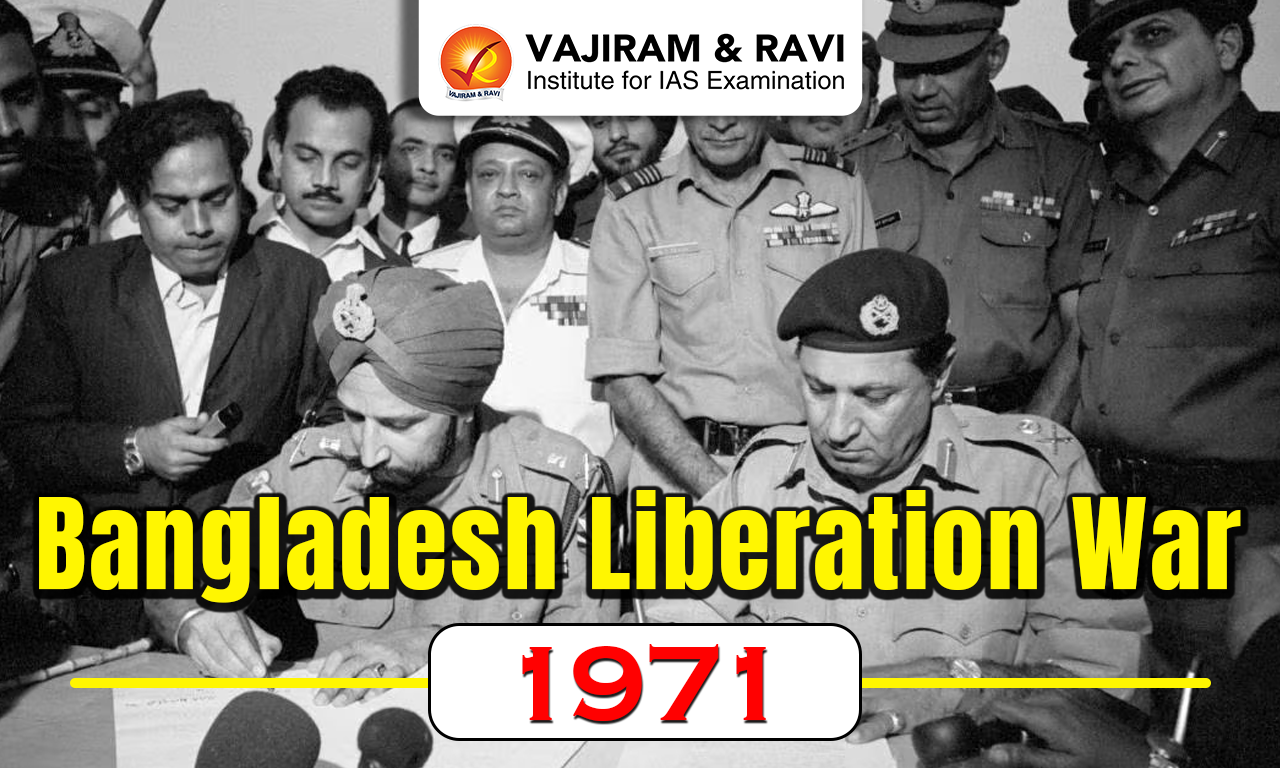
- Surrender and end of war (16 December 1971): On 16 December, A. A. K. Niazi signed the Instrument of Surrender before Jagjit Singh Aurora in Dhaka. Around 93,000 Pakistani troops surrendered, marking the end of the Bangladesh Liberation War 1971 and the birth of an independent Bangladesh.
Bangladesh Liberation War 1971 Consequences
The Bangladesh Liberation War 1971 changed South Asia’s political structure and created Bangladesh. The war had deep humanitarian, diplomatic and military consequences.
- Creation of Bangladesh (December 1971): East Pakistan officially became the independent People’s Republic of Bangladesh..
- Humanitarian crisis aftermath (late 1971-early 1972): The war left between 300,000 and 3,000,000 dead, with tens of millions displaced and around 10-15 million refugees returning from India, creating immediate rehabilitation and reconstruction challenges.
- Recognition of war survivors (1972): The Bangladesh government honoured women subjected to sexual violence as Birangona and initiated rehabilitation programs, acknowledging the suffering of an estimated 200,000 to 400,000 survivors.
- Bihari refugee crisis (early 1970s): Many Bihari muhajirs faced violence and displacement for alleged collaboration with Pakistan, with hundreds of thousands placed in camps and many remaining as “stranded Pakistanis” for decades.
- Shimla Agreement (2 July 1972): India and Pakistan signed this agreement to normalise relations, return captured territory, repatriate prisoners of war and commit to peaceful resolution of disputes including Kashmir.
- Shift in regional power balance (1970s): India emerged as a dominant military and political power in South Asia, while Pakistan faced strategic and psychological setbacks after losing its eastern wing.
- India-Bangladesh Relations (post 1971): Strong bilateral ties developed, with Bangladesh becoming an important regional partner for trade, connectivity and security cooperation.
- End of two front threat for India: The separation of East Pakistan removed the strategic risk of simultaneous eastern and western attacks on India in future conflicts.
- Global recognition of Bangladesh (1972 onwards): Many countries gradually recognised Bangladesh as an independent state, strengthening its international legitimacy.
Bangladesh Liberation War 1971 Leaders
The Bangladesh Liberation War 1971 was shaped by political, military and diplomatic leadership across Bangladesh, India and Pakistan.
- Sheikh Mujibur Rahman: Leader of the Awami League who declared independence on 26 March 1971 and mobilised mass support for autonomy through the Six Point Movement, becoming the central symbol of Bengali nationalism.
- Tajuddin Ahmad: Prime Minister of the provisional government who organised administration in exile, coordinated international support and ensured effective functioning of resistance leadership during the war.
- M. A. G. Osmani: Commander in Chief of Bangladesh Forces who structured the Mukti Bahini into organised sectors and led coordinated guerrilla warfare against Pakistani military forces.
- Ziaur Rahman: Military officer who announced independence from Chittagong on behalf of Mujibur Rahman and played an active operational role in resistance efforts.
- Indira Gandhi: Prime Minister of India who provided diplomatic backing, mobilised global opinion, supported refugees and authorised military intervention in December 1971.
- Jagjit Singh Aurora: Indian Eastern Command chief who led the final military campaign in East Pakistan and accepted the Instrument of Surrender on 16 December 1971.
- Sam Manekshaw: Chief of Army Staff of India who planned and executed military strategy, ensuring coordinated operations across eastern and western fronts.
- Yahya Khan: President of Pakistan who ordered Operation Searchlight and directed military suppression of Bengali movement, leading to escalation into full scale war.
- Zulfikar Ali Bhutto: Political leader of West Pakistan who opposed transfer of power to Mujibur Rahman after 1970 elections, contributing to political deadlock.
- A. A. K. Niazi: Commander of Pakistan Eastern Command who led Pakistani forces in East Pakistan and signed the Instrument of Surrender before Indian and Bangladeshi forces.
- Archer Blood: United States diplomat in Dhaka who highlighted atrocities through the “Blood Telegram,” bringing international attention to human rights violations.
- George Harrison and Ravi Shankar: Organised the Concert for Bangladesh in August 1971, raising global awareness and humanitarian support for war victims.

 Last updated on August, 2026
→ UPSC Mains Question Paper 2026 is out now for Essay & GS Paper 1, 2, 3 & 4.
→ UPSC Mains GS Paper 1 2026 is out now.
→ UPSC Mains GS Paper 2 2026 is out now.
→ UPSC Mains GS Paper 3 2026 is out now.
→ UPSC Mains GS Paper 4 2026 is out now.
→ UPSC Mains Indian Language Paper & English Compulsory Paper are out now.
→ Check out the latest UPSC Syllabus 2026 here.
→ UPSC Mains Admit Card 2026 is now out.
→ Enroll in Vajiram & Ravi’s UPSC Mains Test Series 2027 for structured answer writing practice, expert evaluation, and exam-oriented feedback.
→ Join Vajiram & Ravi’s UPSC Mentorship Program 2027 for personalized guidance, strategy planning, and one-to-one support from experienced mentors.
→ Go through the UPSC Mains Previous Year Papers to enhance your preparation.
→ Download UPSC Mains Essay Paper 2025, UPSC Mains GS Paper-I 2025, UPSC Mains GS Paper-II 2025, UPSC Mains GS Paper-III 2025, UPSC Mains GS Paper-IV 2025, UPSC Mains English (Compulsory) Paper 2025, UPSC Mains Hindi (Qualifying) Paper 2025 here.
→ UPSC has released UPSC Toppers List 2025 with the Civil Services final result on its official website.
→ UPSC Calendar 2027 has been released.
→ Also check Best UPSC Coaching in India
Bangladesh Liberation War 1971 FAQs
Q1. When did the Bangladesh Liberation War 1971 begin and end?+
Q2. What was the main cause of the Bangladesh Liberation War 1971?+
Q3. What was Operation Searchlight?+
Q4. What role did India play in the Bangladesh Liberation War 1971?+
Q5. What was the outcome of the Bangladesh Liberation War 1971?+
Tags: bangladesh liberation war 1971 geography