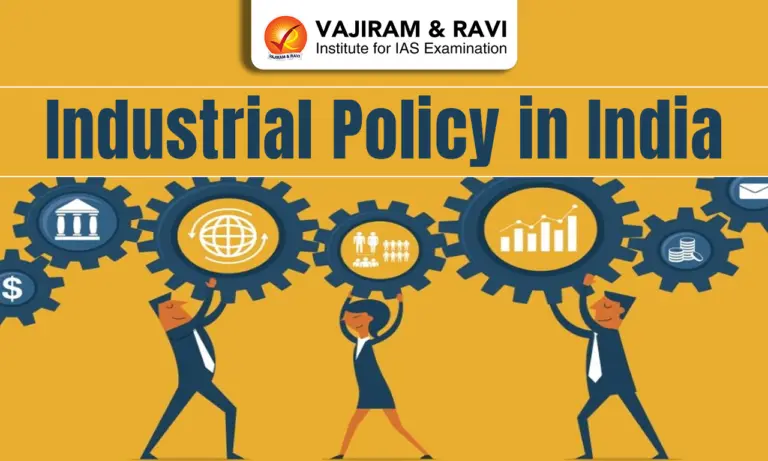
Industrial policy in India refers to the set of government measures that guide the development and growth of industries in the country. It decides the role of the state and private sector in industrial development and aims to promote economic growth, employment, and self-reliance. Over time, it has shifted from a state-controlled approach after independence to a more liberal and market-oriented approach after 1991.
Evolution of Industrial Policy in India
India’s industrial policy has evolved through multiple phases, reflecting shifts in development strategy from state-led industrialization to market-oriented reforms.
Industrial Policy Resolution, 1948
The Industrial Policy Resolution of 1948 was the first official industrial policy of independent India. It aimed to ensure a steady rise in industrial production along with equitable distribution of resources, while clearly stating that the state would play an increasingly important role in industrial development. It laid the foundation of a mixed economy, where both public and private sectors would operate together.
It classified the industries into broadly four categories based on whether government or private sector will play a major role in the establishment of these industries:
- State Monopolies: Industries such as defence production, atomic energy, and railways were kept entirely under government control due to their strategic importance.
- Basic Industries: Sectors like coal, iron and steel, shipbuilding, aircraft manufacturing, telecommunications, and mineral oils were placed under state control, but existing private firms were allowed to continue operations.
- Regulated Industries: Industries such as automobiles, cement, fertilizers, chemicals, and textiles were left to private participation but subject to government regulation in terms of production, pricing, and distribution.
- Private Industries: All remaining industries were open to private enterprises and cooperatives without direct state control.
The government assumed responsibility for planning, coordination, and regulation to ensure balanced industrial growth.
Industrial Policy Resolution, 1956
The Industrial Policy Resolution of 1956 marked a decisive shift towards state-led industrialization in India. It was adopted in line with the objective of establishing a socialistic pattern of society and is often referred to as the Economic Constitution of India. The policy was closely aligned with the Second Five-Year Plan and emphasized long-term industrial growth through heavy industries. Key Features include:
-
- Public Sector Dominance: The state assumed a leading role in industries of strategic and basic importance, especially those requiring large capital investment and long gestation periods.
- Classification of Industries into Three Schedules:
-
- Schedule A: Seventeen industries reserved exclusively for the public sector, such as defence production, atomic energy, railways, iron and steel, heavy machinery, and mining.
- Schedule B: Industries where both public and private sectors could operate, but with the state expected to gradually expand its role.
- Schedule C: Remaining industries left primarily to the private sector, subject to government regulation.
- Emphasis on Heavy and Capital Goods Industries: Focus on building a strong base in sectors like steel, machine tools, and heavy engineering to support long-term industrial growth.
- Import Substitution: Aim to reduce dependence on foreign goods by promoting domestic production of capital goods and intermediate products.
- Industrial Licensing System: Private enterprises required government approval for setting up, expanding, or diversifying industries, leading to administrative control over industrial investment.
- Promotion of Balanced Regional Development: Policies were designed to reduce regional disparities by encouraging industries in backward areas.
- Support to Small-Scale Industries: Certain products were reserved for small-scale industries to promote employment and decentralized production. For example, items such as garments, footwear, simple engineering goods, toys, wooden furniture, and hand tools were reserved exclusively for production by small-scale units.
Industrial Policy, 1977
The Industrial Policy of 1977 marked a shift from heavy-industry bias towards a strategy focused on employment generation, decentralization, and promotion of small-scale industries, primarily due to the coming to power of the Janata Party government, which emphasized Gandhian principles of rural development, self-reliance, and distributive justice over centralized, capital-intensive industrialization. Key Features include:
- Emphasis on Small-Scale and Cottage Industries: Expanded the role of small-scale, village, and cottage industries as engines of employment and equitable growth.
- Reservation of Products for Small-Scale Sector: A large number of items (around 800) were reserved exclusively for production by small-scale units to protect them from competition by large firms.
- District Industries Centres (DICs): Establishment of DICs to provide single-window support for small entrepreneurs, including credit, raw materials, training, and marketing assistance.
- Promotion of Decentralization: Focus on spreading industries to rural and backward areas to reduce regional disparities.
- Restrictions on Large Industrial Houses: Large business groups were discouraged from expanding into areas reserved for small-scale industries and faced tighter regulatory scrutiny.
- Focus on Labour-Intensive Production: Encouragement of industries that could generate maximum employment with relatively low capital investment.
Industrial Policy, 1980
The Industrial Policy of 1980 marked a corrective shift from the excessive emphasis on small-scale industries in 1977 towards restoring industrial growth, efficiency, and modernization. It was introduced in the context of industrial stagnation and low productivity during the late 1970s. Key Features include :
- Economic Federalism: The government promoted a model where big industries (nucleus plants) are set up in a region. These big units would help small industries grow around them by providing demand, raw materials, and support.
- Easy Expansion for Industries: Industries that were performing well were allowed to increase production capacity without taking long government approvals.
- Extra Production: If a factory was producing more than its approved limit, the government legalized this excess production instead of penalizing it.
- Support to Small Industries: The definition of small industries was changed by increasing investment limits, so they could grow bigger and modernize.
- Revival of Sick Units: Industries that were failing financially were supported through mergers or restructuring, so that resources and jobs were not wasted.
Industrial Policy, 1991
The Industrial Policy of 1991 was introduced in the backdrop of a severe Balance of Payments crisis. This economic emergency compelled India to adopt Liberalisation, Privatisation, and Globalisation reforms, aimed at restructuring the industrial and economic framework to ensure long-term stability, efficiency, and global integration. Key features of Industrial Policy, 1991 were:
- De-reservation of Industries: The policy significantly reduced the list of industries reserved for the public sector. At present, the private sector is allowed in all industries except two strategic areas, namely: atomic Energy and railway Operations
This marked a major shift towards private sector participation in industrial development.
- De-licensing of Industries: Industrial licensing was largely abolished to reduce bureaucratic control and promote ease of doing business. At present, only four industries require compulsory industrial licensing, which include: Cigarettes, Electronic aerospace and defence equipment, Industrial explosives and Specified hazardous chemicals. This reform enabled faster industrial expansion and investment decisions.
- Autonomy and Restructuring of Public Sector Enterprises: The role of Public Sector Undertakings was redefined to improve efficiency and competitiveness. This included:
- Introduction of disinvestment, where government equity in public enterprises was reduced
- Categorisation of PSUs into Maharatna, Navaratna, and Miniratna, granting varying levels of financial and operational autonomy
This aimed to make public enterprises more commercially viable and less dependent on the government.
- Liberalised Foreign Direct Investment Regime: The policy opened the Indian economy to foreign investment by simplifying approval procedures and allowing higher foreign equity participation in several sectors. The objective was to attract foreign capital, advanced technology and managerial expertise. This helped integrate India with global production networks.
- Abolition of Monopolies and Restrictive Trade Practices Act: The Monopolies and Restrictive Trade Practices Act was repealed and replaced by a competition-oriented framework. This reduced restrictions on large industrial houses and promoted market competition, higher efficiency and consumer welfare.
Impact of Industrial Policy, 1991: The Industrial Policy of 1991 brought a structural transformation in the Indian economy by shifting it from a controlled regime to a market-oriented system. Its impact can be understood across economic, industrial, and social dimensions.
Positive Impact:
- Higher Economic Growth: The policy triggered a sustained rise in industrial output and overall economic growth by improving efficiency, investment, and productivity.
- Increase in Foreign Investment: Liberalised foreign direct investment norms led to a significant inflow of foreign capital, technology, and managerial expertise, strengthening industrial capacity.
- Expansion of Private Sector: The removal of licensing and reduction in public sector dominance encouraged private enterprises to expand into new industries and sectors.
- Integration with Global Economy: India became more integrated with global markets through trade liberalisation, foreign investment, and technology collaboration.
- Development of Modern Sectors: Sectors such as information technology, telecommunications, and services expanded rapidly, contributing to structural transformation of the economy.
Negative Impact:
- Rising Inequality: Economic gains were unevenly distributed, leading to widening income and regional disparities.
- Pressure on Small Industries: Small-scale and traditional industries faced intense competition from large domestic and foreign firms, resulting in closures and reduced competitiveness in some sectors.
- Regional Imbalance: Industrial growth became concentrated in developed states, while backward regions lagged behind due to uneven investment flows.
- Employment Concerns: Industrial modernisation and automation led to jobless growth in certain capital-intensive sectors, limiting employment generation.
- Dependence on External Factors: Increased reliance on foreign investment and global markets exposed the economy to external shocks and fluctuations.
Post-1991 Developments in Industrial Policy in India
After the Industrial Policy of 1991, India did not follow one single industrial policy document. Instead, industrial reforms have taken place in a continuous and phased manner through laws, schemes, and sectoral initiatives. The overall direction has moved from licensing and control → liberalisation → competition-based regulation → incentive-driven and strategic industrial policy.
Early Liberalisation Phase (1991 onwards):
- The first major change after 1991 was the end of the licensing system. Industrial licensing was abolished for almost all industries. At present, only a very small number of sectors require licences, such as alcohol distillation and defence aircraft and warship manufacturing. This reduced government control and made it easier to set up industries.
- Foreign direct investment rules were liberalised. The automatic approval route was introduced, which allowed foreign investors to invest in many sectors without prior government approval. Over time, foreign investment was allowed in sectors like insurance, retail, telecommunications, and defence manufacturing. This helped India connect with global markets and increased capital inflow significantly.
- Another important reform was disinvestment in public sector enterprises. The government started selling its stake in public companies and in some cases transferred full control to private companies through strategic disinvestment.
Regulatory and Structural Reforms (2000–2010):
- In 2002, the Monopolies and Restrictive Trade Practices Act was replaced by the Competition Act. This shifted focus from controlling big companies to preventing unfair trade practices. The Competition Commission of India was set up to regulate cartels, monopolies, and mergers. The idea was to ensure fair competition in the market.
- In 2005, the Special Economic Zones policy and later the Special Economic Zones Act were introduced. Special Economic Zones are special industrial areas with tax benefits and simpler rules. They were created to promote exports and attract foreign investment. These zones helped in developing export hubs, especially in information technology and manufacturing, but their benefits remained concentrated in certain regions.
- In 2011, the National Manufacturing Policy was introduced. It aimed to increase the share of manufacturing in the economy from fifteen percent to twenty-five percent and create one hundred million jobs. It also proposed National Investment and Manufacturing Zones, but implementation remained limited.
Reform Acceleration Phase (2010–2020):
- A major initiative in 2014 was Make in India. It aimed to make India a global manufacturing hub. It focused on twenty-seven sectors such as electronics, automobiles, pharmaceuticals, defence, and capital goods. The policy improved ease of doing business and encouraged investment, but manufacturing growth remained moderate.
- In 2016, Startup India was launched to promote entrepreneurship. It provided tax benefits, easier regulations, and funding support through a fund of funds. This helped build a strong startup ecosystem in India.
- In 2017, Goods and Services Tax was introduced. It replaced multiple indirect taxes with a single tax system. This removed inter-state tax barriers and improved logistics and supply chains across India.
Strategic Industrial Policy Phase (2020 onwards);
From 2020 onwards, India moved towards a more strategic industrial policy focused on incentives and self-reliance.
- The Production Linked Incentive Scheme was introduced across fourteen sectors such as electronics, pharmaceuticals, textiles, batteries, and solar energy. Under this scheme, companies receive incentives based on production levels. The aim is to boost domestic manufacturing, attract global companies, and reduce imports.
- In 2021, the Prime Minister Gati Shakti National Master Plan was launched. It is a digital platform that brings together sixteen ministries for infrastructure planning. It aims to coordinate roads, railways, ports, and airports to reduce delays and logistics costs.
- In 2022, the National Logistics Policy was launched. It aims to reduce logistics costs and improve supply chain efficiency in India by using digital systems and better transport integration.
- In 2021, the Semiconductor Mission was introduced with an investment of about seventy-six thousand crore rupees. It aims to develop domestic semiconductor manufacturing and reduce dependence on imports from countries like China and Taiwan.
- India has also focused on defence indigenisation. Certain defence items have been banned from import under positive indigenisation lists. Foreign investment in defence has been increased up to seventy-four percent. Defence industrial corridors have been developed in Uttar Pradesh and Tamil Nadu.


Current Issues in India’s Industrial Sector
India’s industrial sector, despite decades of reforms since 1991, continues to face structural constraints that necessitate a comprehensive and updated industrial policy.
- Stagnant manufacturing share in GDP: Manufacturing contribution has remained broadly around 15-17 percent, indicating weak structural shift.
- Jobless and capital-intensive growth: Industrial expansion is increasingly technology-driven, generating limited employment opportunities.
- High logistics and infrastructure costs: Elevated transport and logistics expenses reduce export competitiveness and industrial efficiency.
- Weak integration into global value chains: India remains largely confined to lower-value assembly rather than high-value production segments.
- Dependence on imported critical inputs: High reliance on imports in electronics, semiconductors, and capital goods creates supply vulnerability.
- Regional industrial imbalance: Industrial growth is concentrated in a few developed states, widening regional disparities.
- Regulatory and compliance bottlenecks: Multiple approvals, land acquisition issues, and regulatory delays still affect ease of doing business.
- Technological backwardness in MSMEs: Small and medium industries face low productivity due to inadequate technology adoption and innovation gaps.
Need for a New Industrial Policy
- Increase manufacturing share in GDP: Achieve a higher contribution of manufacturing by encouraging greater private sector investment and reducing structural bottlenecks.
- Promote labour-intensive industries: Focus on sectors such as textiles, leather, footwear, and food processing to absorb surplus workforce from agriculture and generate large-scale employment.
- Enable scale expansion of firms: Encourage firms to grow beyond small scale through a sunset clause on incentives, along with improved access to credit, technology, and markets, as recommended by the U. K. Sinha Committee.
- Promote service-led manufacturing models: Encourage hybrid models where manufacturing is integrated with services such as design, branding, and customer ecosystems, as seen in firms like Lenskart, in line with the ideas of Raghuram Rajan.
- Increase investment in research and development: Raise research and development expenditure to around 0.7 percent of gross domestic product and strengthen innovation capacity.
- Develop innovation clusters and sunrise sectors: Promote innovation clusters on the lines of global models such as China’s industrial clusters, with focus on sunrise sectors like semiconductors, electric vehicles, and robotics.
- Integrate with global value chains through “Assemble in India” strategy: Leverage the China plus one strategy to attract global firms and integrate India into global manufacturing networks through assembly and value-added production.
- Rationalise trade policy and free trade agreements: Renegotiate free trade agreements to correct inverted duty structures, reduce import dependence, and improve export competitiveness, as highlighted by the Surjit Bhalla Committee.

 Last updated on Sep, 2026
→ UPSC Mains Question Paper 2026 is out now for Essay & GS Paper 1, 2, 3 & 4.
→ UPSC Mains GS Paper 1 2026 is out now.
→ UPSC Mains GS Paper 2 2026 is out now.
→ UPSC Mains GS Paper 3 2026 is out now.
→ UPSC Mains GS Paper 4 2026 is out now.
→ UPSC Mains Indian Language Paper & English Compulsory Paper are out now.
→ Check out the latest UPSC Syllabus 2026 here.
→ UPSC Mains Admit Card 2026 is now out.
→ Enroll in Vajiram & Ravi’s UPSC Mains Test Series 2027 for structured answer writing practice, expert evaluation, and exam-oriented feedback.
→ Join Vajiram & Ravi’s UPSC Mentorship Program 2027 for personalized guidance, strategy planning, and one-to-one support from experienced mentors.
→ Go through the UPSC Mains Previous Year Papers to enhance your preparation.
→ Download UPSC Mains Essay Paper 2025, UPSC Mains GS Paper-I 2025, UPSC Mains GS Paper-II 2025, UPSC Mains GS Paper-III 2025, UPSC Mains GS Paper-IV 2025, UPSC Mains English (Compulsory) Paper 2025, UPSC Mains Hindi (Qualifying) Paper 2025 here.
→ UPSC has released UPSC Toppers List 2025 with the Civil Services final result on its official website.
→ UPSC Calendar 2027 has been released.
→ Also check Best UPSC Coaching in India
Industrial Policy in India FAQs
Q1. What is the significance of Industrial Policy Resolution 1948?+
Q2. Why is Industrial Policy Resolution 1956 important?+
Q3. What was the problem with the pre-1991 industrial licensing system?+
Q4. What were the major reforms under Industrial Policy 1991?+
Q5. What are the main issues in India’s industrial sector?+
Q6. Why is a new industrial policy needed?+
Tags: indian economy indian economy notes industrial policy in india