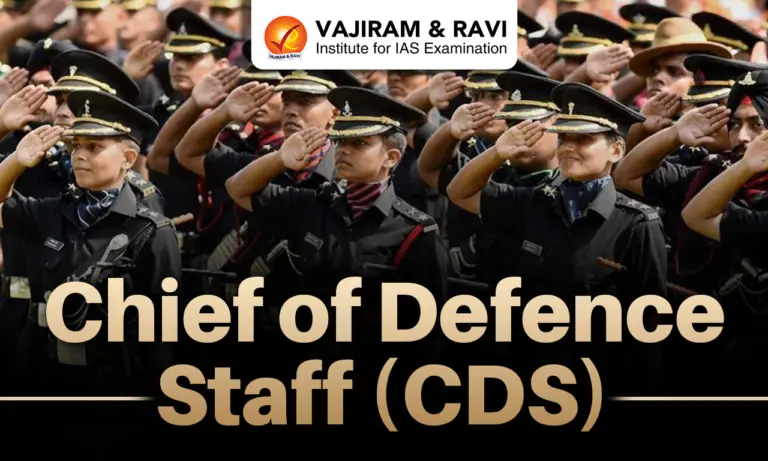
The Centre has appointed Lieutenant General N S Raja Subramani (Retd) as the Chief of Defence Staff (CDS), who shall also function as Secretary to Government of India, Department of Military Affairs. He will be the third person to assume the post after Gen Bipin Rawat and Gen Anil Chauhan.
About Lieutenant General NS Raja Subramani
Lieutenant General NS Raja Subramani is currently Military Adviser, National Security Council Secretariat since September 1, 2025. Before that, he was the Vice Chief of the Army Staff from 01st Jul 2024 to 31st July 2025 and was General Officer Commanding-in-Chief, Central Command from March 2023 till June 2024.
About Chief of Defence Staff (CDS)
The Chief of Defence Staff (CDS) was created by the Government of India in 2019 to promote greater coordination, jointness, and integration among the Army, Navy, and Air Force, and to provide single-point military advice to the civilian leadership.
- The CDS is the highest-ranking military officer in India.
- The CDS is a four-star military officer equivalent in rank to the Chief of Army Staff, Chief of Naval Staff, and Chief of Air Staff.


Need for the Chief of Defence Staff (CDS)
India’s complex security environment marked by a two-front threat, technological warfare, maritime competition, and emerging non-conventional challenges required a single-point military authority capable of integrating the three armed services under a unified strategic framework.
- Absence of Single-Point Military Advice: Earlier, the Army, Navy, and Air Force chiefs independently advised the Defence Minister, often leading to fragmented and inconsistent military recommendations.
- Lack of Jointness Among Armed Forces: The three services functioned through separate operational and administrative structures with limited coordination in logistics, training, communication, and planning.
- Weakness of the Chiefs of Staff Committee (COSC): The COSC operated on a rotational system headed by the seniormost service chief, resulting in lack of continuity, authority, and long-term strategic direction.
- Lessons from the Kargil War: The Kargil War exposed major gaps in intelligence sharing, operational coordination, and higher defence management, strengthening the demand for integrated military leadership.
- Need for Integrated Theatre Commands: Modern warfare requires geography-based and task-based integrated commands instead of isolated service-specific command structures.
- Civil-Military Communication Gap: Service Headquarters functioned largely as “Attached Offices” of the Ministry of Defence, resulting in excessive bureaucratic procedures and delayed decision-making.
- Need for Better Defence Resource Management: Independent budget prioritisation by individual services often led to duplication of expenditure and inefficient allocation of defence resources.
- Growing Nuclear Responsibilities: India’s nuclear doctrine and strategic deterrence architecture required a senior military authority to advise the Nuclear Command Authority on tri-service strategic issues.
- Need to Match Global Military Reforms: Major powers such as the United States, United Kingdom, and China had already established integrated military command systems, making similar reforms necessary for India.
- Rise of New Warfare Domains: Emerging domains such as cyber warfare, space warfare, electronic warfare, and special operations require integrated planning and unified military coordination.
- Need for Integrated Defence Procurement: The absence of a tri-service coordinating authority weakened long-term procurement planning and reduced inter-service prioritisation in defence acquisitions.
- Implementation of Defence Reform Committees: Committees such as the Kargil Review Committee, Group of Ministers Report, and Shekatkar Committee repeatedly emphasised the need for a CDS to modernise India’s defence management system.
Chief of Defence Staff (CDS) Background
The idea of a single-point military adviser for India’s civilian leadership gained importance after the Kargil War exposed major weaknesses in inter-service coordination and intelligence sharing.
- The Kargil Review Committee (1999) headed by K. Subrahmanyam first recommended a CDS-like integrated military structure.
- The Group of Ministers Report (2001) supported the creation of the CDS to improve military coordination and strategic planning.
- The Integrated Defence Staff (IDS) was established in 2002 as an initial step toward military integration.
- The Shekatkar Committee (2016) again recommended the CDS as part of broader defence reforms.
- In 2019, the Government of India officially created the post of Chief of Defence Staff through a Cabinet decision.
- The CDS post was created along with the Department of Military Affairs (DMA), which functions under as the fifth department within the Ministry of Defence to improve military administration and inter-service coordination.
- General Bipin Rawat became India’s first CDS on 1 January 2020.
Chief of Defence Staff (CDS) Appointment, Position
- The CDS is appointed by the Appointments Committee of the Cabinet chaired by the Prime Minister.
- The officer can be selected from the Indian Army, Indian Navy, or Indian Air Force.
- The CDS ranks 12th in the Indian order of precedence, equivalent to the three service chiefs.
- The CDS is not a constitutional office and was created through a Cabinet decision and gazette notification in 2019.
Chief of Defence Staff (CDS) Duties and Functions
The duties and functions of the Chief of Defence Staff (CDS) include the following
- To head the Department of Military Affairs in the Ministry of Defence and function as its Secretary.
- To act as the Principal Military Advisor to Hon’ble Raksha Mantri on all Tri-Service matters.
- To function as the Permanent Chairman of the Chiefs of Staff Committee
- To administer the Tri-Service organizations/agencies/commands.
- To be a member of Defence Acquisition Council chaired by Hon’ble Raksha Mantri.
- To function as the Military Advisor to the Nuclear Command Authority.
- To bring about jointness in operation, logistics, transport, training, support services, communications, repairs and maintenance, etc of the three Services.
- To ensure optimal utilisation of infrastructure and rationalise it through jointness among the Services.
- To implement Five-Year Defence Capital Acquisition Plan and Two-Year roll-on Annual Acquisition Plans, as a follow up of Integrated Capability Development Plan.
- To assign inter-services prioritisation to capital acquisition proposals based on the anticipated budget.
- To bring about reforms in the functioning of three Services with the aim to augment combat capabilities of the Armed Forces by reducing wasteful expenditure.
What the CDS Cannot Do
Although the Chief of Defence Staff is the highest-ranking military adviser in India, the office has important institutional limitations. The CDS was designed primarily as a coordinating and advisory authority rather than an operational military commander.
- No Operational Command Over Armed Forces: The CDS does not directly command the Army, Navy, or Air Force during military operations or wartime situations.
- Service Chiefs Retain Operational Control: The Chief of Army Staff, Chief of Naval Staff, and Chief of Air Staff continue to exercise operational command over their respective services.
- Cannot Issue Independent Combat Orders: The CDS cannot independently deploy troops or conduct military operations without the existing command structures of the three services.
- Limited Role in Defence Procurement: The CDS oversees the revenue expenditure of the armed forces, while capital acquisition and major defence procurement remain under the Defence Secretary and Department of Defence.
- No Absolute Authority Over Theatre Commands: The CDS coordinates and promotes theatre command reforms but does not possess unrestricted command authority over all military formations.
- Primarily an Advisory and Integrative Institution: The office primarily functions as an adviser, coordinator, and integrator rather than a battlefield commander.
Chief of Defence Staff (CDS) Significance
The creation of the Chief of Defence Staff represents one of the most important defence reforms in independent India aimed at strengthening military integration, improving strategic coordination, and modernising higher defence management.
- Ensures Single-Point Military Advice: The CDS provides integrated military advice to the political leadership, replacing the earlier system of separate recommendations from the three service chiefs.
- Promotes Jointness Among Armed Forces: The CDS improves coordination among the Army, Navy, and Air Force in operations, logistics, training, communication, and planning.
- Strengthens Integrated Theatre Commands: The CDS plays a central role in establishing theatre-based unified military commands for better operational efficiency and coordinated warfare.
- Improves Higher Defence Management: The office enhances strategic planning, defence prioritisation, and inter-service coordination within the national security framework.
- Enhances Preparedness for Modern Warfare: The CDS helps India respond effectively to emerging domains such as cyber warfare, space warfare, drone warfare, and electronic warfare.
- Promotes Efficient Use of Defence Resources: Integrated procurement and joint planning help reduce duplication of infrastructure, manpower, and expenditure across the three services.
- Strengthens Civil-Military Coordination: The CDS bridges the gap between the armed forces and civilian bureaucracy within the Ministry of Defence.
- Improves Crisis Response and Strategic Decision-Making: Unified military coordination enables faster and more effective responses during conflicts, border tensions, and national security emergencies.
- Supports Long-Term Defence Reforms: The CDS acts as the institutional driver for military modernisation, integration, and structural reforms recommended by various expert committees.
- Enhances Nuclear and Strategic Coordination: The CDS performs an important advisory role in India’s Nuclear Command Authority and strategic deterrence framework.
- Aligns India with Global Military Practices: The CDS brings India closer to advanced military systems followed by countries such as the United States, United Kingdom, and China that operate integrated defence structures.
Chief of Defence Staff (CDS) Challenges
Despite being a major defence reform, the CDS institution faces several structural and operational challenges that limit its effectiveness.
- No Operational Command: The CDS does not command the Army, Navy, or Air Force, limiting the role mainly to coordination and advisory functions.
- Ambiguity with Defence Secretary: Overlapping responsibilities between the Department of Military Affairs and Department of Defence create administrative and financial confusion.
- Limited Financial Powers: The CDS controls only the revenue budget, while major procurement and capital acquisition remain under the Defence Secretary.
- Resistance to Theatre Commands: The three services have differing views on integrated theatre commands, slowing military integration reforms.
- Lack of Statutory Backing: The CDS post was created through executive action rather than parliamentary legislation, limiting institutional clarity.
- Inter-Service Rivalries: Differences in organisational culture and operational priorities among the services hinder jointness and integration.
- Absence of National Security Strategy: India still lacks a formal National Security Strategy to guide long-term military planning and theatre command reforms.

 Last updated on July, 2026
→ UPSC Prelims Result 2026 is now out.
→ UPSC IFoS Prelims Result 2026 is now out.
→ Enroll in Vajiram & Ravi’s UPSC Mains Test Series 2026 for structured answer writing practice, expert evaluation, and exam-oriented feedback.
→ Join Vajiram & Ravi’s UPSC Mentorship Program 2026 for personalized guidance, strategy planning, and one-to-one support from experienced mentors.
→ Join Vajiram & Ravi’s UPSC Mentorship Program 2027 for personalized guidance, strategy planning, and one-to-one support from experienced mentors.
→ UPSC Prelims Provisional Answer Key 2026 out for GS Paper 1 and CSAT.
→ UPSC Prelims Question Paper 2026 Out, Download GS Paper 1 PDF conducted on 24th May 2026.
→ UPSC Mains 2026 will be conducted from 21st August 2026 onwards, and UPSC Prelims 2027 will be held on 23rd May 2027.
→ UPSC Final Result 2025 is now out.
→ UPSC has released UPSC Toppers List 2025 with the Civil Services final result on its official website.
→ Anuj Agnihotri secured AIR 1 in the UPSC Civil Services Examination 2025.
→ UPSC Notification 2026 & UPSC IFoS Notification 2026 is now out on the official website at upsconline.nic.in.
→ UPSC Calendar 2027 has been released.
→ Check out the latest UPSC Syllabus 2026 here.
→ The UPSC Selection Process is of 3 stages-Prelims, Mains and Interview.
→ Shakti Dubey secures AIR 1 in UPSC CSE Exam 2024.
→ Also check Best UPSC Coaching in India
Chief of Defence Staff FAQs
Q1. What is the Chief of Defence Staff (CDS)?+
Q2. Which committees recommended the creation of the Chief of Defence Staff (CDS)?+
Q3. Who appoints the Chief of Defence Staff (CDS)?+
Q4. What is the rank of the Chief of Defence Staff (CDS)?+
Q5. Who was India’s first Chief of Defence Staff?+
Q6. What is the role of the CDS in the Ministry of Defence?+
Q7. Why is the Chief of Defence Staff (CDS) important for India’s national security?+
Tags: chief of defence staff