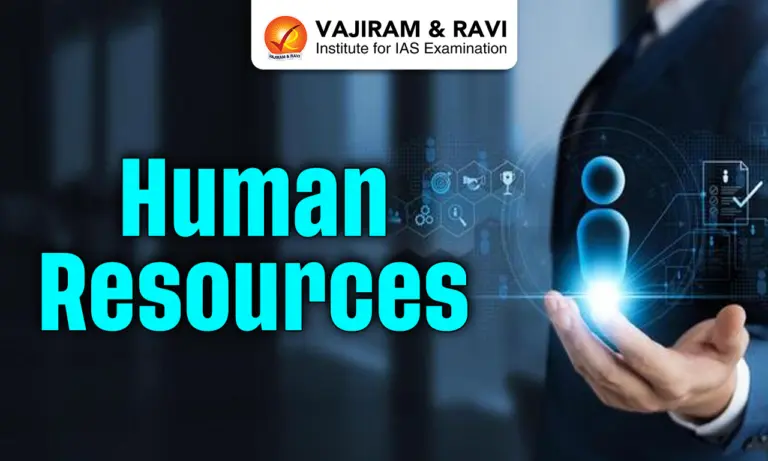
Human Resource is one of the most important assets for the economic and social development of India. With a large young population, India is currently experiencing a Demographic Dividend, where the working-age population is higher than the dependent population. However, challenges such as unemployment, lack of skills, poor education, and inadequate healthcare continue to affect effective Human Resource Development in India.
What is Human Resource?
Human Resource refers to the people who contribute to the economic, social, and industrial development of a country through their skills, knowledge, and abilities. It includes the working population involved in different sectors such as agriculture, industry, education, healthcare, and services. Human resources are considered the most valuable asset of a nation because they help in increasing productivity and economic growth.
Human Resource and Demographic Dividend in India
India’s large young population provides a strong Human Resource base, creating a Demographic Dividend that can boost economic growth, productivity, and national development if properly utilized.
- India has around 62.5% population in the 15–59 years age group.
- The working-age population is expected to peak at nearly 65% by 2036.
- India’s Demographic Dividend period is expected to last from 2005-06 to 2055-56.
- A larger labour force increases productivity and economic activities.
- India has one of the world’s youngest populations with a median age of 28 years.
- Better education, healthcare, and skill development can strengthen Human Resources.
- The Demographic Dividend can help India become a global economic power.
- Proper employment opportunities are necessary to fully utilize the growing workforce.
- Unemployment and lack of skills can turn the demographic advantage into a demographic burden.
- Government schemes like Skill India, Make in India, and NSDC support Human Resource Development.


Human Resource in India Features
The important features of Human Resource in India have been highlighted below:
- Large Population Base: India has one of the world’s largest populations, providing a huge Human Resource pool for economic activities.
- Young Workforce: India has a large working-age population with a median age of around 28 years, making it one of the youngest countries in the world.
- Demographic Dividend: A high share of population in the 15–59 years age group offers significant opportunities for economic growth and development.
- Skilled and Semi-Skilled Labour: India has a growing number of professionals, engineers, doctors, technicians, and skilled workers contributing to different sectors.
- Diversity of Workforce: India’s human resources are engaged in agriculture, manufacturing, services, IT, healthcare, and other industries.
- Rapid Urbanization: Increasing migration toward cities is expanding the urban workforce and industrial employment.
- Growing Education Sector: Expansion of schools, colleges, universities, and technical institutions is improving the quality of human resources.
- Increasing Women Participation: More women are joining education and employment sectors, strengthening the workforce.
- Strong IT and Service Sector Talent: India is globally recognized for its skilled manpower in the Information Technology and service sectors.
Importance of Human Resource in Economic Development
Human Resource plays a vital role in the economic development of a country because skilled, educated, and healthy people increase productivity, innovation, and national income.
- Increases Productivity: Skilled and educated workers improve the efficiency and productivity of industries and businesses.
- Promotes Economic Growth: A strong Human Resource base contributes directly to higher GDP growth and national income.
- Supports Industrial Development: Human resources provide the labour and technical skills needed for industrialization and manufacturing growth.
- Encourages Innovation: Educated people contribute to research, technology, and innovation, which help modernize the economy.
- Generates Employment: Development of human resources creates more employment opportunities and reduces poverty.
- Improves Quality of Life: Better education and healthcare improve living standards and social development.
- Boosts Entrepreneurship: Skilled individuals can start businesses and create jobs for others.
- Strengthens Service Sector: India’s growth in sectors like IT, healthcare, banking, and education depends heavily on quality human resources.
- Increases National Competitiveness: A trained workforce helps the country compete in the global market.
Advantages of Strong Human Resources in India
Strong Human Resources are essential for India’s economic growth, industrial development, and social progress.
- Higher Economic Growth: Strong human resources increase productivity and contribute to faster economic development.
- Increase in Labour Force: India’s large working-age population provides a huge workforce for industries, agriculture, and services.
- Improved Productivity: Skilled workers perform tasks more efficiently, improving industrial and economic output.
- Boost to Industrial Development: Human resources support the growth of manufacturing, technology, and infrastructure sectors.
- Growth of IT and Service Sector: India’s skilled manpower has made the country a global leader in the IT and service industries.
- Rise in Innovation and Technology: Educated and trained people contribute to research, innovation, and technological advancement.
- Increase in Savings and Investments: Working-age people generally save more, leading to higher investments and capital formation.
- Women Empowerment: Better education and employment opportunities increase women’s participation in the workforce.
Challenges Facing Human Resource Development in India
Despite having a large population and a strong Demographic Dividend, India faces several challenges in developing quality Human Resources. These problems affect productivity, employment, and overall economic growth.
- Unemployment: Lack of sufficient job opportunities for the growing workforce is a major challenge in Human Resource Development.
- Lack of Skills: Many young people do not possess industry-relevant technical and professional skills required in the modern economy.
- Poor Quality of Education: Weak educational infrastructure, outdated curriculum, and low learning outcomes reduce the quality of human resources.
- Inadequate Healthcare Facilities: Poor healthcare services, malnutrition, and lack of medical infrastructure affect workforce productivity.
- Informal Employment: A large percentage of workers are employed in the informal sector with low wages and no social security benefits.
- Low Female Workforce Participation: Limited employment opportunities and social barriers reduce women’s participation in economic activities.
- Regional Imbalances: Human resource development differs across states due to unequal access to education, healthcare, and infrastructure.
- Poverty and Malnutrition: Poverty limits access to quality education and healthcare, affecting the overall development of human resources.
- Brain Drain: Skilled professionals often migrate to foreign countries for better career opportunities.
- Rapid Population Growth: Increasing population puts pressure on employment, education, healthcare, and natural resources.
Government Initiatives for Human Resource Development
The Government of India has launched several schemes and programmes to improve Human Resource Development through better education, skill development, healthcare, and employment opportunities.
- Skill India Mission: Launched to provide industry-related skills and improve the employability of youth across different sectors.
- Pradhan Mantri Kaushal Vikas Yojana (PMKVY): Provides short-term skill training and certification to young people for better job opportunities.
- National Skill Development Corporation (NSDC): Works to promote vocational training and skill development in partnership with industries and private institutions.
- Make in India: Encourages manufacturing and industrial growth to create employment opportunities for the growing workforce.
- Start-up India: Promotes entrepreneurship, innovation, and startup culture among young people.
- Stand-up India: Supports entrepreneurship among women and socially disadvantaged groups through financial assistance.
- National Education Policy (NEP) 2020: Focuses on quality education, digital learning, vocational training, and skill-based learning.
- Higher Education Finance Agency (HEFA): Helps improve infrastructure in higher educational institutions.
- Ayushman Bharat Scheme: Provides affordable healthcare services to improve the health and productivity of human resources.
- Integrated Child Development Services (ICDS): Focuses on child nutrition, maternal healthcare, and early childhood development.
- Digital India Programme: Promotes digital literacy and technology access to strengthen modern human resources.
- Smart Cities Mission: Improves urban infrastructure and living conditions for the growing workforce in urban areas.
Role of Skill Development in Human Resource Growth
Way Forward
India can fully utilize its Human Resource potential and Demographic Dividend only through proper investment in education, skill development, healthcare, and employment generation.
- Improve Quality Education: Strengthen primary, secondary, technical, and higher education systems to build knowledgeable human resources.
- Focus on Skill Development: Provide industry-oriented training in areas like digital technology, Artificial Intelligence, manufacturing, and entrepreneurship.
- Generate Employment Opportunities: Promote industries, MSMEs, startups, and infrastructure projects to create jobs for the growing workforce.
- Strengthen Healthcare Facilities: Improve healthcare infrastructure, nutrition, and medical services to ensure a healthy workforce.
- Encourage Women Participation: Increase women’s access to education, skill training, and employment opportunities.
- Promote Research and Innovation: Invest in science, technology, and innovation to enhance productivity and competitiveness.
- Improve Urban Planning: Develop smart and sustainable cities with better housing, transport, and public services for migrating populations.
- Reduce Regional Imbalances: Focus on developing backward states through better education, infrastructure, and industrial growth.
- Enhance Digital Literacy: Expand digital education and internet access to prepare youth for the modern economy.

 Last updated on July, 2026
→ UPSC Prelims Result 2026 is now out.
→ UPSC IFoS Prelims Result 2026 is now out.
→ Enroll in Vajiram & Ravi’s UPSC Mains Test Series 2026 for structured answer writing practice, expert evaluation, and exam-oriented feedback.
→ Join Vajiram & Ravi’s UPSC Mentorship Program 2026 for personalized guidance, strategy planning, and one-to-one support from experienced mentors.
→ Join Vajiram & Ravi’s UPSC Mentorship Program 2027 for personalized guidance, strategy planning, and one-to-one support from experienced mentors.
→ UPSC Prelims Provisional Answer Key 2026 out for GS Paper 1 and CSAT.
→ UPSC Prelims Question Paper 2026 Out, Download GS Paper 1 PDF conducted on 24th May 2026.
→ UPSC Mains 2026 will be conducted from 21st August 2026 onwards, and UPSC Prelims 2027 will be held on 23rd May 2027.
→ UPSC Final Result 2025 is now out.
→ UPSC has released UPSC Toppers List 2025 with the Civil Services final result on its official website.
→ Anuj Agnihotri secured AIR 1 in the UPSC Civil Services Examination 2025.
→ UPSC Notification 2026 & UPSC IFoS Notification 2026 is now out on the official website at upsconline.nic.in.
→ UPSC Calendar 2027 has been released.
→ Check out the latest UPSC Syllabus 2026 here.
→ The UPSC Selection Process is of 3 stages-Prelims, Mains and Interview.
→ Shakti Dubey secures AIR 1 in UPSC CSE Exam 2024.
→ Also check Best UPSC Coaching in India
Human Resource FAQs
Q1. What is Human Resource?+
Q2. Why is Human Resource important?+
Q3. What is Human Resource Development (HRD)?+
Q4. What is Demographic Dividend?+
Q5. Why does India have a demographic advantage?+
Tags: commerce e-commerce moratorium human resource