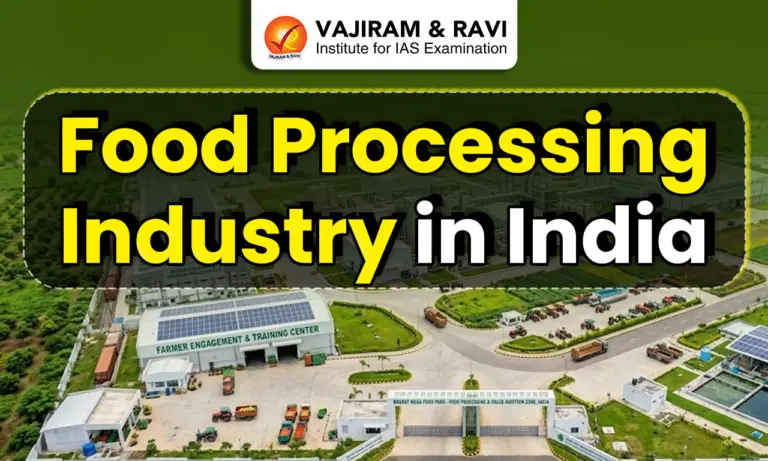
The Food Processing Industry in India is a key agro-based sector that transforms raw agricultural produce into value-added products and plays a vital role in linking agriculture with manufacturing and markets.
Food Processing Meaning
Food processing is a technique of manufacturing, transforming, and preserving food substances in an efficient manner to enhance their shelf life, improve quality, ensure food safety, and make them more useful for consumption and commercial purposes.
- It includes activities such as cleaning, grading, packaging, preservation, storage, and value addition of agricultural products.
- For example, converting milk into cheese, butter, and curd; wheat into flour and biscuits; or tomatoes into ketchup and sauce are forms of food processing.
Supply Chain of Food Processing Industry in India
The Food Processing Industry supply chain in India follows a structured value-addition pathway that connects agricultural production with final consumption through multiple interlinked stages.
- Procurement of Raw Material: Farmers produce agricultural commodities such as fruits, vegetables, milk, etc, which are procured either directly by processors, through mandis, or via intermediaries and Farmer Producer Organisations (FPOs).
- Aggregation, Storage & Transportation: Collected produce is aggregated at collection centres and mandis, followed by storage in warehouses and cold storage facilities. It is then transported through logistics networks, including refrigerated transport for perishable goods, to reduce spoilage and maintain quality.
- Processing: Raw materials are transformed into value-added products through activities such as cleaning, grading, milling, pasteurisation, canning, freezing, drying, and packaging, thereby enhancing shelf life, safety, and market value.
- Marketing, Branding & Retail: Processed products are marketed through branding, advertising, and distribution channels such as organised retail chains, supermarkets, e-commerce platforms, and export networks, ensuring wider market reach and price realisation.
- Consumer: Final products reach consumers in the form of packaged, ready-to-eat, ready-to-cook, or preserved foods, offering convenience, quality assurance, and year-round availability.


Growth of Food Processing Industry in India
The Food Processing Industry (FPI) in India is regarded as a sunrise sector due to its rapid growth and immense future potential.
- With an estimated size of about ₹2.24 lakh crore, the sector contributes nearly 8% to Manufacturing Gross Value Added (GVA) and around 8.5% to Agricultural GVA.
- Over the last nine years, the industry has recorded an Annual Average Growth Rate (AAGR) of approximately 6.5%, which is significantly higher than the agricultural growth rate of about 4.4%.
This faster expansion highlights its growing importance in employment generation, value addition, rural development, and economic transformation.
Scope of Food Processing Industry in India
The scope of the Food Processing Industry (FPI) in India is immense due to the country’s vast agricultural base, rising consumer demand, expanding export opportunities, technological advancements, and strong government support, making it one of the key drivers of agricultural modernization and economic growth.
Scope of Food Processing Industry in India
The Food Processing Industry (FPI) in India possesses immense growth potential and is regarded as one of the most promising sunrise sectors of the economy.
Vast and Underutilised Raw Material Base
India possesses one of the world’s largest agricultural production systems, yet processing levels remain significantly low compared to major economies, creating enormous scope for expansion.
- India produces more than 330 million metric tonnes of fruits and vegetables annually, but only about 2 percent of fruits and vegetables is processed, compared to nearly 65 percent in the United States and around 40 percent in China.
- India is the world’s largest milk producer with more than 230 million metric tonnes annually, yet only around 20 percent of total milk production undergoes organised processing.
- India is the second-largest aquaculture producer with nearly 16 million tonnes of fish production annually, but value-added marine processing remains limited.
- India is also the largest producer and exporter of spices, yet higher-value processing into oleoresins, extracts, and essential oils remains underdeveloped.
Expanding Domestic Market
India’s domestic processed food market is expanding rapidly due to structural socio-economic changes.
- Urbanisation: India’s urban population is expected to reach nearly 600 million by 2031. Urban lifestyles, time constraints, and higher incomes are increasing demand for processed, packaged, and convenience foods.
- Rising Middle Class: India’s growing middle class, projected to exceed 50 percent of the population by 2030, is increasingly shifting toward branded and packaged food products.
- Changing Consumption Patterns: Nuclear families, dual-income households, exposure to global food cultures, and rising health consciousness are increasing demand for ready-to-eat, ready-to-cook, frozen, and health-based food products.
- Youth Demographics: India’s large youth population drives demand for quick-service foods, protein supplements, energy drinks, gourmet snacks, and modern food formats.
- Rural Market Expansion: Rising rural incomes through welfare schemes, better agricultural prices, and improved connectivity are increasing demand for packaged staples, beverages, and processed snacks in rural areas.
Consequently, India’s processed food market, estimated at around USD 263 billion, has substantial long-term growth potential.
Huge Export Potential
India remains underrepresented in global processed food trade despite its large agricultural base.
- Global food trade exceeds USD 1.5 trillion annually, but India’s share remains relatively low.
- Major export opportunities include:
- Value-added marine products such as shrimp and fish fillets.
- Processed spices including oleoresins and essential oils.
- Organic processed foods due to rising global demand.
- Ethnic Indian foods for the Indian diaspora in countries such as the United States, United Kingdom, Australia, and Gulf nations.
- Millet-based foods following the International Year of Millets initiative.
- Nutraceuticals and functional foods based on Ayurveda and natural ingredients.
A stronger food processing sector can significantly enhance export earnings while reducing dependence on volatile raw commodity exports.
Employment Generation Potential
The food processing industry is one of the most labour-intensive manufacturing sectors.
- The sector already employs nearly 7.5 million people directly.
- Every direct job generated creates nearly 8 indirect jobs in logistics, retail, packaging, transportation, and allied sectors.
- The industry has major potential for women’s employment, especially in rural and semi-urban areas.
- India has nearly 25 lakh micro food processing enterprises in the unorganised sector. Formalising and modernising these enterprises can generate massive employment opportunities.
Thus, the sector can play a crucial role in inclusive growth and rural industrialization.
Reduction of Post-Harvest Losses
India suffers annual post-harvest losses estimated at around ₹92,651 crore caused by inadequate storage, transport, and processing facilities, which can be significantly reduced through expansion of cold chains, pack houses, refrigerated transport, and food processing units to convert wastage into value-added output. Therefore, food processing converts agricultural waste into economic opportunity.
Technology and Innovation Opportunities
Technological advancements are opening new frontiers for the sector.
- Food Biotechnology: Advanced fermentation, enzyme engineering, and bio-preservation technologies are improving nutritional quality and shelf life.
- Artificial Intelligence: AI-based grading and quality assessment systems improve efficiency and reduce manual errors.
- Blockchain Technology: Blockchain-based traceability systems improve food safety, transparency, and export credibility.
- Internet of Things (IoT): IoT-enabled cold chains and smart logistics systems help reduce spoilage and improve supply chain efficiency.
- Alternative Proteins and Precision Fermentation: Plant-based proteins, cultivated meat, and functional foods represent emerging global markets where India possesses strong potential.
India’s growing food-tech startup ecosystem in cities such as Bengaluru, Hyderabad, Mumbai, and Delhi further strengthens innovation capacity.
Linkage with Farmers’ Income and Agricultural Transformation
Food processing directly supports the goal of increasing farmers’ income through value addition beyond the farm gate.
- Contract farming arrangements provide assured markets and stable prices.
- Farmer Producer Organisations (FPOs) can act as aggregators and processors, enabling farmers to capture higher value.
- Mega Food Parks and agro-processing clusters create stable demand for agricultural produce.
Thus, the sector acts as a bridge between agriculture and industry.
Emerging High-Growth Niches
Several specialised segments within food processing possess exceptional growth potential.
- Millet-based foods due to growing global demand for healthy grains.
- Organic and clean-label foods with minimal additives.
- Baby and infant nutrition products.
- Senior nutrition and fortified foods.
- Pet food industry due to rising urban pet ownership.
These niche markets offer high-value opportunities for Indian companies.
Supportive Policy and Investment Environment
Government policies have significantly improved the investment climate for food processing.
- 100 percent Foreign Direct Investment (FDI) is permitted under the automatic route.
- The Production Linked Incentive (PLI) Scheme promotes large-scale food manufacturing.
- Pradhan Mantri Kisan SAMPADA Yojana (PMKSY) supports cold chains, Mega Food Parks, and food infrastructure.
- Expansion of highways, Dedicated Freight Corridors, and logistics parks is reducing transportation costs and improving market access.
These measures are creating a strong ecosystem for long-term sectoral growth.
Significance of Food Processing Industry in India
The Food Processing Industry (FPI) is significant for India as it promotes agricultural modernization, value addition, employment generation, food security, rural development, and export growth by linking agriculture with industry.
- Promotes Crop Diversification: The sector encourages farmers to shift toward high-value crops such as fruits, vegetables, millets, spices, dairy, and fisheries based on market demand.
- Reduces Post-Harvest Losses: Processing, storage, and cold-chain facilities help reduce wastage of perishable agricultural produce and improve farmers’ returns.
- Supports Secondary Agriculture: Food processing creates non-farm rural employment and helps reduce disguised unemployment in agriculture.
- Encourages Organised Retail: Growth of processed and packaged foods supports supermarkets, food chains, and e-commerce-based retail systems.
- Increases Shelf Life and Controls Food Inflation: Preservation and storage technologies increase product shelf life, ensure year-round supply, and help stabilize food prices.
- Enhances Nutritional Security: Fortified foods, dairy products, nutraceuticals, and health foods improve nutrition and dietary diversity.
- Strengthens Backward Linkages: Contract farming, direct procurement, and Farmer Producer Organisations (FPOs) improve market access and increase farmers’ income.
- Develops Forward Linkages: The sector connects producers with processors, retailers, exporters, and consumers, ensuring better quality and wider consumer choice.
- Promotes Value Addition and Innovation: Food processing enables development of products such as flavoured makhanas, millet snacks, ready-to-eat foods, and organic packaged products.
- Boosts Agricultural Exports: Processed marine products, spices, dairy products, packaged foods, and value-added products such as flavoured makhanas increase export earnings and foreign exchange.
- Supports “Make in India”: The sector promotes agro-based industries, manufacturing growth, investment, and rural industrialization.
Food Processing Industry in India Challenges
The Food Processing Industry (FPI) in India faces several structural and operational challenges across the entire value chain from production to consumption.
Farm Level Issues
- Lack of crop diversification restricts availability of raw materials suitable for processing industries.
- Low productivity and inconsistent quality of agricultural produce affect steady industrial supply.
- Absence of process-specific varieties reduces processing efficiency (e.g., Alphonso mango has thin skin unsuitable for pulp processing; uneven-sized potatoes are not ideal for chips manufacturing).
Procurement Constraints
- Restrictive APMC Act provisions in several states limit direct procurement by food processors.
- Contract farming is not widely adopted, leading to weak integration between farmers and industry.
- Stockholding limits under the Essential Commodities Act, 1955 create uncertainty in maintaining adequate raw material supply.
Aggregation, Storage & Transportation Bottlenecks
- Lack of adequate primary collection centres and aggregation infrastructure leads to fragmented supply chains.
- Cold storage capacity is insufficient and unevenly distributed (around 7,000 units, with nearly 60% concentrated in Uttar Pradesh, Bihar, and West Bengal).
- Poor refrigerated transport and logistics infrastructure contribute to high post-harvest losses of around ₹90,000 crore annually.
Processing Sector Limitations
- High dominance of unorganised sector (about 75% employment but only 10% output) limits efficiency and scale.
- Limited access to institutional credit, modern technology, and skilled workforce hampers modernization.
- Low capacity utilisation due to seasonal availability of raw materials (e.g., sugarcane-based industries).
- Poor adherence to hygiene standards and limited adoption of Good Manufacturing Practices (GMP).
- Insufficient focus on tertiary and high-value processing activities restricts value addition.
Marketing and Branding Challenges
- Weak branding and marketing capabilities among small and unorganised enterprises.
- Dominance of unorganised retail (~98%) restricts development of modern organised supply chains.
- Limited penetration of private labels and branded processed food products compared to global markets.
Consumer Demand Constraints
- Domestic demand for processed food remains relatively low compared to developed economies.
- Consumption is largely urban-centric with limited rural penetration.
- Socio-cultural preference for fresh food and availability of domestic help reduce reliance on processed foods.
- Indian products often face challenges in meeting stringent international quality and safety standards for exports.
Government Initiatives For Food Processing Industry in India
The Government of India has launched several targeted initiatives to promote the growth of the Food Processing Industry by addressing constraints related to entrepreneurship, capital, labour, land, and procurement, thereby strengthening the entire value chain.
Entrepreneurship Support
- PM Kisan Sampada Yojana (PMKSY) promotes mega food parks, integrated cold chain infrastructure, agro-processing clusters, and value addition infrastructure.
- PM Formalization of Micro Food Processing Enterprises (PMFME) provides financial, technical, and business support to small and micro food units.
- Production Linked Incentive (PLI) Scheme aims to create global champions in processed food manufacturing and enhance export competitiveness.
- Operation Greens focuses on stabilising prices and preventing volatility in fruits and vegetables like tomato, onion, and potato.
Capital Support
- 100% Foreign Direct Investment (FDI) is allowed under the automatic route in food processing industries.
- The sector has been granted Priority Sector Lending status to improve access to institutional credit.
- Cold storage infrastructure has been included in the Harmonised Master List of Infrastructure, enabling easier financing.
Labour and Skill Development
- NIFTEM (National Institute of Food Technology Entrepreneurship and Management) promotes research, innovation, and skill development in food processing.
- Indian Institute of Food Processing Technology (IIFPT), Tamil Nadu, supports technical training, research, and capacity building.
Land and Infrastructure Development
- Mega Food Parks scheme provides common infrastructure facilities such as processing units, cold storage, and logistics hubs in cluster-based models.
Procurement Reforms
- Some states like Karnataka have adopted liberal APMC reforms to enable direct procurement by processors.
- Contract farming is operational in states such as Punjab, improving farmer-industry linkages.
- PM-AASHA scheme promotes diversification of crops and ensures better price realization for farmers.
- Bhavantar Bharpai Yojana in Punjab supports price deficiency payment for fruits and vegetables, stabilising farmer incomes.

 Last updated on Oct, 2026
→ UPSC 2027 Notification will be released on 13 January 2027 at upsconline.nic.in.
→ Check Nobel Prize 2026 Winners List here.
→ Download PIB PRiSM Monthly Magazine 2026 here.
→ Check UPSC Monthly Current Affairs Magazine The Recitals here.
→ Check out the latest UPSC Syllabus here.
→ Download UPSC Model Answers for Mains 2026
→ UPSC Mains Question Paper 2026 is out now for Essay & GS Paper 1, 2, 3 & 4.
→ UPSC Calendar 2027 has been released.
→ Enroll in Vajiram & Ravi’s UPSC Mains Test Series 2027 for structured answer writing practice, expert evaluation, and exam-oriented feedback.
→ Join Vajiram & Ravi’s UPSC Mentorship Program 2027 for personalized guidance, strategy planning, and one-to-one support from experienced mentors.
→ Go through the UPSC Mains Previous Year Papers to enhance your preparation.
→ UPSC has released UPSC Toppers List 2025 with the Civil Services final result on its official website.
→ Also check Best UPSC Coaching in India
Food Processing Industry in India FAQs
Q1. What is the Food Processing Industry in India ? +
Q2. Why is the Food Processing Industry in India called a sunrise sector?+
Q3. How does the Food Processing Industry in India benefit farmers?+
Q4. What are the major challenges of the Food Processing Industry in India?+
Q5. What are the major government initiatives for the Food Processing Industry in India?+
Tags: food processing industry in india