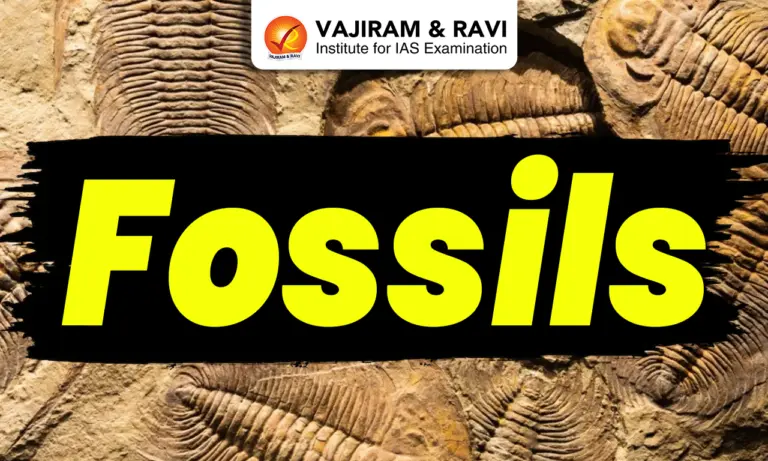
Fossils constitute one of the most significant sources for understanding the long geological and biological history of the Earth. They provide valuable evidence regarding organisms that existed millions of years ago and help scientists reconstruct ancient ecosystems, climatic conditions, patterns of evolution, and geological transformations that shaped the planet over time. The study of fossils enables researchers to understand how life originated, evolved, adapted, and, in many cases, became extinct due to natural environmental changes and catastrophic events.
Fossils Meaning and Characteristics
The term “fossil” is generally used to describe the preserved remains, impressions, or traces of ancient organisms that have survived within rocks or sediments for extremely long geological periods.
- These organisms may include plants, animals, microorganisms, and even primitive forms of life that no longer exist today.
- In most cases, fossils are found in sedimentary rocks because they do not involve the intense heat associated with igneous rock formation or the high pressure associated with metamorphic processes.
- Fossils are generally absent in igneous and metamorphic rocks because the processes involved in their formation usually destroy organic remains.
- Fossils may represent complete body remains, such as bones and shells, or indirect evidence of biological activity, such as footprints, nests, burrows, and feeding marks.
- The scientific study of fossils is known as Paleontology, while the study of fossil plants is called Paleobotany.
Fossilization: Process of Fossil Formation
The process through which organic remains are preserved and transformed into fossils is known as Fossilization.
- The process of fossilization generally begins with the death of an organism in an environment such as a river bed, lake, swamp, sea floor, or desert region.
- After death, the organism must be buried rapidly under sediments like mud, sand, volcanic ash, or silt. Rapid burial is essential because it protects the remains from scavengers, oxygen, and microbial decomposition.
- As layers of sediments continue to accumulate over time, the soft tissues of the organism gradually decay, while hard structures such as bones, shells, or woody tissues remain preserved.
- Mineral-rich groundwater then passes through the buried remains, causing minerals such as silica, calcite, or iron compounds to replace the original organic material. This process gradually converts the remains into stone-like structures while preserving their original shape and details.
- Over millions of years, continued sedimentation and compaction transform the sediments into sedimentary rocks, thereby permanently preserving the fossil.
- Geological processes such as erosion, earthquakes, and tectonic uplift may later expose these fossils near the Earth’s surface, allowing scientists to discover and study them.


Conditions Necessary for Fossilization
Fossilization can occur only when certain environmental and geological conditions are favorable.
- One of the most important requirements is rapid burial, because delayed burial allows decomposition and destruction of organic remains. Fine sediments are especially useful because they preserve delicate structures more effectively.
- A low-oxygen environment is also necessary because oxygen promotes bacterial activity and decay.
- Organisms possessing hard body parts have greater chances of preservation because bones, shells, and teeth are more resistant to destruction than soft tissues.
- Stable geological conditions are equally important because excessive heat and pressure associated with metamorphism may destroy fossils completely.
- The absence of biological disturbance from scavengers and microorganisms enhances the possibility of preservation.
Types of Fossils
Fossils can be classified into different categories depending upon the nature of preservation and the type of evidence they provide regarding ancient organisms.
Body Fossils
Body fossils consist of the actual preserved remains of organisms, such as bones, teeth, shells, leaves, and wood.
- These fossils provide direct information about the physical structure, anatomy, and evolutionary characteristics of extinct species.
- Dinosaur bones, fossilized tree trunks, and preserved shells are common examples of body fossils.
Trace Fossils or Ichnofossils
Trace fossils do not preserve the actual body of an organism but instead preserve evidence of its activities and behavior.
- These fossils include footprints, burrows, nests, feeding marks, crawling trails, and fossilized dung known as coprolites.
- Trace fossils are highly valuable because they help scientists understand the movement, feeding habits, and ecological interactions of ancient organisms.
Mold Fossils
Mold fossils are formed when an organism buried within sediments decomposes completely and leaves behind a hollow impression or cavity. This impression preserves the external shape and structure of the organism.
Cast Fossils
Cast fossils are formed when minerals or sediments fill the hollow cavity left by a mold fossil and subsequently harden. As a result, a three-dimensional replica of the original organism is produced.
Petrified Fossils
Petrified fossils are formed when the original organic material is gradually replaced by minerals. This process preserves the detailed internal structure of the organism while converting it into stone.
- Petrified wood is one of the most common examples of this type of fossil.
Carbon Film Fossils
Carbon film fossils are formed when organisms are compressed under sediments, causing gases and liquids to escape while leaving behind a thin layer of carbon residue.
- Such fossils are commonly associated with plants and soft-bodied organisms.
Amber Fossils
Amber fossils are formed when small organisms such as insects become trapped in sticky tree resin that later hardens into amber.
Frozen Fossils
Frozen fossils are formed when organisms become preserved in ice under extremely cold climatic conditions. In such cases, even soft tissues may remain intact for thousands of years.
- The remains of woolly mammoths discovered in Siberia are important examples of frozen fossils.
Index Fossils
Index fossils are fossils of organisms that existed for a relatively short geological period but were distributed widely across different geographical regions.
- An ideal index fossil should possess certain characteristics, including wide geographical distribution, abundance, easy identification, and a short evolutionary lifespan.
Why Do We Study Fossils? / Importance of Fossils
Fossils are studied because they help us understand the history of life on Earth, the evolution of organisms, ancient environments, and major geological and climatic changes that occurred over millions of years.
- Understanding Evolution: Fossils provide direct evidence regarding the gradual evolution of plants and animals over geological time. By studying fossils found in different rock layers, scientists can trace how simple organisms gradually developed into more complex life forms.
- Knowledge of Extinct Species: Fossils provide information about organisms that lived in the past but no longer exist today.
- For Example, Dinosaur fossils provide information about the size, behavior, and adaptation of dinosaurs that became extinct around 66 million years ago.
- Reconstruction of Ancient Environment: Fossils help scientists understand ancient forests, oceans, deserts, and other ecosystems.
- Determining the Age of Rocks: Fossils help determine the relative age of sedimentary rocks through the method of biostratigraphy. Certain fossils are associated with specific geological periods and therefore help identify the age of rock layers.
- Understanding Earth’s History: Fossils provide information about past geological events and environmental changes. They help scientists understand whether a region was once covered by oceans, forests, glaciers, or deserts.
- For Example, Marine fossils found in the Himalayan region indicate that these mountains were once submerged under the ancient Tethys Sea.
- Evidence for Continental Drift: Similar fossils found on different continents show that continents were once connected.
- For Example, Mesosaurus fossils have been found in both Africa and South America.
- Study of Ancient Climate: Fossils help scientists understand past climatic conditions such as warm, cold, wet, or dry environments.
- Understanding Extinction Events: Fossils provide evidence about mass extinctions such as the extinction of dinosaurs.
- Establishing Geological Time Scale: Fossils help divide Earth’s history into different geological eras, periods, and epochs. The appearance and disappearance of certain organisms help scientists establish a chronological sequence of Earth’s biological and geological history.
- For Example, the dominance of dinosaurs characterizes the Mesozoic Era and the rise of mammals characterizes the Cenozoic Era.
- Study of Human Evolution: Human fossils provide evidence regarding the origin, evolution, migration, and development of early humans. These fossils help scientists understand how humans evolved physically and culturally over time.
- For Example, Fossils of Australopithecus and Homo erectus provide important information regarding human evolution.
- Scientific and Educational Importance: Fossils are important for studies related to geology, biology, geography, and environmental science.
- Conservation of Geological Heritage: Fossils help preserve and protect Earth’s geological and biological history.
Geological Time Scale and Fossils
Fossils play an extremely important role in dividing Earth’s history into different geological eras, periods, and epochs.
- The Paleozoic Era is known for the dominance of marine organisms, fishes, amphibians, and primitive reptiles.
- The Mesozoic Era is commonly referred to as the “Age of Reptiles” because dinosaurs dominated terrestrial ecosystems during this period.
- The Cenozoic Era, often called the “Age of Mammals,” witnessed the rise of mammals and eventually the evolution of humans.
Conservation and Legal Framework for Fossils in India
India has established various legal and institutional mechanisms to conserve and protect its fossil heritage, which represents an important part of the country’s geological and evolutionary history.
Mines and Minerals (Development and Regulation) Act, 1957 (MMDR Act): The MMDR Act provides the broad legal and regulatory framework for the management and conservation of mineral and geological resources in India. Fossil-bearing rock formations are treated as part of the country’s geological heritage and are protected from illegal excavation, destruction, and commercial exploitation without permission.
Ancient Monuments and Archaeological Sites and Remains Act, 1958: Under this Act, the Archaeological Survey of India (ASI) is empowered to protect and manage sites declared to be of national importance. Certain fossil sites and prehistoric remains can be brought under its protection to ensure their scientific preservation and prevent damage due to encroachment or unauthorized activities.
Geological Survey of India (GSI): The Geological Survey of India is the principal organization responsible for the identification, documentation, research, conservation, and management of fossil heritage in India.
- It also declares and maintains National Geological Monuments or Geo-heritage Sites, including important fossil parks and fossil-bearing regions, to preserve India’s geological and paleontological heritage for scientific study and public awareness.
Fossil Parks in India
Fossil parks are protected areas established to preserve important fossil remains and geological heritage. These parks help conserve prehistoric plant and animal fossils, promote paleontological research, and create public awareness regarding Earth’s geological and biological history.
- National Fossil Wood Park, Tamil Nadu: Located at Tiruvakkarai in Tamil Nadu, this park is famous for its large collection of petrified wood fossils that are millions of years old.
- Indroda Dinosaur and Fossil Park, Gujarat: Located near Gandhinagar in Gujarat, this park is known for dinosaur fossils, eggs, and skeletal remains discovered from different parts of the state. It is often referred to as India’s “Jurassic Park” because of its rich dinosaur fossil collection.
- Dinosaur Fossil National Park, Madhya Pradesh: Situated in the Narmada Valley region, this fossil park preserves important dinosaur fossils discovered from central India.
- Akal Wood Fossil Park, Rajasthan: Located near Jaisalmer in Rajasthan, this park contains fossilized tree trunks estimated to be around one hundred and eighty million years old. The fossils indicate that the present desert region once supported dense vegetation and forest ecosystems.
- Ghughua Fossil National Park, Madhya Pradesh: Located in Dindori district of Madhya Pradesh, this park contains fossilized plants, seeds, fruits, and tree trunks. The fossils found here provide evidence regarding tropical vegetation that existed millions of years ago.
- Rajmahal Fossil Park, Jharkhand: The Rajmahal Hills region contains important plant fossils associated with the Gondwana period. These fossils are significant for understanding ancient flora and the geological history of the Indian subcontinent.
Challenges in Fossil Preservation and Research
Despite their immense importance, fossils and fossil sites face several threats.
- Illegal fossil trade and smuggling have emerged as serious problems because rare fossils possess high commercial value.
- Mining activities, quarrying, urbanization, and infrastructure development often destroy fossil-bearing rock formations.
- Many fossil sites in India suffer from poor conservation, lack of public awareness, and inadequate scientific documentation.
- Limited institutional infrastructure and shortage of trained paleontologists hinder systematic fossil research and preservation.
- Natural weathering and erosion also gradually damage exposed fossils over time, making conservation efforts increasingly necessary.
Conservation of Fossils
The protection of fossils and fossil sites is essential for preserving geological heritage and promoting scientific research.
- Governments and scientific institutions should establish protected fossil parks and geo-heritage sites to prevent destruction and illegal excavation.
- Greater investment in paleontological research institutions, museums, and scientific surveys is necessary to improve fossil documentation and conservation.
- Public awareness programs should also be promoted to educate people regarding the scientific importance of fossils.
- Strict legal measures are required to regulate fossil trade and ensure protection of important paleontological resources for future generations.

 Last updated on Oct, 2026
→ UPSC 2027 Notification will be released on 13 January 2027 at upsconline.nic.in.
→ Check Nobel Prize 2026 Winners List here.
→ Download PIB PRiSM Monthly Magazine 2026 here.
→ Check UPSC Monthly Current Affairs Magazine The Recitals here.
→ Check out the latest UPSC Syllabus here.
→ Download UPSC Model Answers for Mains 2026
→ UPSC Mains Question Paper 2026 is out now for Essay & GS Paper 1, 2, 3 & 4.
→ UPSC Calendar 2027 has been released.
→ Enroll in Vajiram & Ravi’s UPSC Mains Test Series 2027 for structured answer writing practice, expert evaluation, and exam-oriented feedback.
→ Join Vajiram & Ravi’s UPSC Mentorship Program 2027 for personalized guidance, strategy planning, and one-to-one support from experienced mentors.
→ Go through the UPSC Mains Previous Year Papers to enhance your preparation.
→ UPSC has released UPSC Toppers List 2025 with the Civil Services final result on its official website.
→ Also check Best UPSC Coaching in India
Fossils FAQs
Q1. What are fossils and why are they important?+
Q2. Why are fossils generally found in sedimentary rocks?+
Q3. What is fossilization?+
Q4. What conditions are necessary for fossilization?+
Q5. What are index fossils and what is their significance?+
Q6. What are the major challenges in fossil preservation in India?+
Q7. What is the role of the Geological Survey of India in fossil conservation?+
Tags: fossils