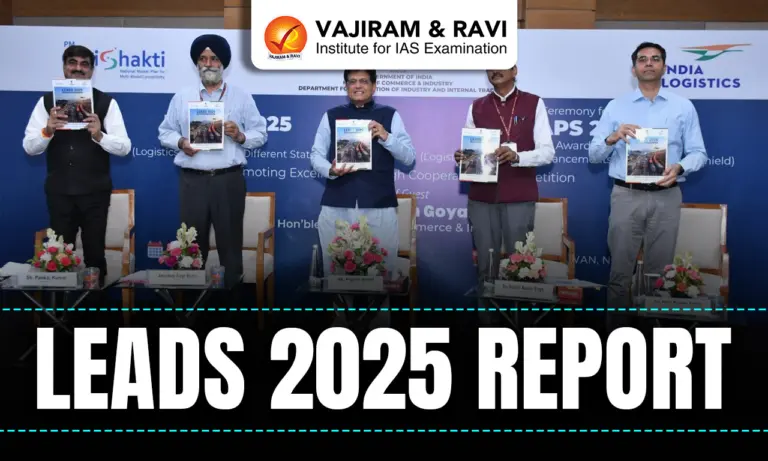
Recently, the Department for Promotion of Industry and Internal Trade (DPIIT) under the Ministry of Commerce and Industry released the Logistics Ease Across Different States (LEADS) 2025 Report during the LEAPS Awards 2025 ceremony in New Delhi. The report assesses logistics performance across States and Union Territories and aims to improve logistics efficiency, reduce logistics costs, and strengthen India’s global competitiveness.
About LEADS
- The Logistics Ease Across Different States (LEADS) is a benchmarking framework launched in 2018 by the Department for Promotion of Industry and Internal Trade (DPIIT) to evaluate logistics performance across States and Union Territories.
- The framework assesses logistics infrastructure, logistics services, regulatory systems, institutional mechanisms, and operational efficiency through objective and perception-based indicators.
- The report also promotes competitive and cooperative federalism by encouraging States to improve logistics performance through targeted reforms.
LEADS 2025 is the seventh edition of the report.
Objectives of LEADS 2025 Report
LEADS 2025 aims to strengthen India’s logistics ecosystem and improve national competitiveness.
- The framework helps States identify gaps in logistics infrastructure and service delivery.
- The report promotes data-driven and evidence-based logistics reforms.
- The framework supports reduction in logistics costs and improvement in supply chain efficiency.
- The report encourages multimodal transport integration and seamless freight movement.
- The framework supports implementation of the PM GatiShakti National Master Plan and the National Logistics Policy.
- The report aims to improve ease of doing business and export competitiveness.


Key Features of LEADS 2025
LEADS 2025 marks an important evolution in India’s logistics assessment framework.
- The report introduced a more rigorous and refined evaluation methodology compared to previous editions.
- Nearly 59% weightage was assigned to objective and measurable indicators.
- The framework shifted from a three-tier classification to a four-tier categorisation system.
The revised structure enables more nuanced assessment of logistics performance across different stages of development.
Four-Tier Categorisation under LEADS 2025
To better reflect the varying levels of logistics development across the country, LEADS 2025 introduced a four-tier classification framework.
Exemplars
Exemplars are the best-performing States and Union Territories demonstrating sustained excellence in logistics infrastructure, policy support, service delivery, and regulatory efficiency.
- Tamil Nadu emerged as the Exemplar among Coastal States.
- Uttar Pradesh emerged as the Exemplar among Landlocked States. The State had consistently remained in the “Achiever” category from 2022 to 2024 before moving to the highest category in 2025. The Uttar Pradesh Warehousing and Logistics Policy 2022 played an important role in strengthening the State’s logistics ecosystem.
- Mizoram emerged as the Exemplar among North-Eastern States.
- Delhi emerged as the Exemplar among Union Territories.
High Performers
High Performers are States and Union Territories demonstrating strong and consistent logistics performance across major indicators.
- Gujarat, Kerala, and Maharashtra were categorised as High Performers among Coastal States.
- Haryana, Telangana, Chhattisgarh, and Bihar were categorised as High Performers among Landlocked States.
- Tripura and Meghalaya were categorised as High Performers among North-Eastern States.
- Jammu and Kashmir and Puducherry were categorised as High Performers among Union Territories.
Accelerators
Accelerators are States and Union Territories that have shown strong improvement momentum and reform orientation in recent years.
- Andhra Pradesh, Odisha, Goa, and Karnataka were categorised as Accelerators among Coastal States.
- Punjab, Jharkhand, Madhya Pradesh, Uttarakhand, and Himachal Pradesh were categorised as Accelerators among Landlocked States.
- Nagaland, Arunachal Pradesh, Manipur, and Assam were categorised as Accelerators among North-Eastern States.
- Dadra and Nagar Haveli and Daman and Diu, Chandigarh, Ladakh, and Lakshadweep were categorised as Accelerators among Union Territories.
Growth Seekers
Growth Seekers are States and Union Territories that are still at a foundational stage of logistics ecosystem development.
- West Bengal was categorised as a Growth Seeker among Coastal States.
- Rajasthan was categorised as a Growth Seeker among Landlocked States.
- Sikkim was categorised as a Growth Seeker among North-Eastern States.
- Andaman and Nicobar Islands was categorised as a Growth Seeker among Union Territories.
India’s Export Performance and Logistics
Reduction in logistics costs is considered essential for achieving long-term export competitiveness. The Government linked logistics reforms with India’s growing export performance.
- India achieved record exports worth USD 863 billion during the financial year ending March 31, 2026.
- Services exports recorded growth of nearly 8.5 to 9%.
- Overall exports increased by nearly 5% despite global economic uncertainties.
- The Government has set an aspirational export target of USD 1 trillion for the current year.
Government Measures to Improve Logistics Efficiency
The Government has introduced several reforms and initiatives to modernise logistics systems, reduce logistics costs, and improve ease of doing business.
- The PM GatiShakti National Master Plan, launched in 2021, promotes integrated infrastructure planning by improving coordination between roads, railways, ports, airports, and logistics networks to strengthen multimodal connectivity and reduce transportation delays.
- The National Logistics Policy, launched in 2022, aims to reduce logistics costs, improve supply-chain efficiency, enhance multimodal transport integration, and create a technology-driven logistics ecosystem.
- The Goods and Services Tax, implemented in 2017, created a unified national market by reducing interstate barriers, minimising check-post delays, and improving the efficiency of freight movement across States.
- The Jan Vishwas Act, enacted in 2023, decriminalised nearly 1,000 minor offences to improve ease of doing business and reduce regulatory burdens on industries and logistics operators.
- The Government has reduced around 42,000 compliance burdens through regulatory simplification and procedural reforms to improve business efficiency and operational ease.
- Increasing digitisation of governance processes, online approvals, database integration, and use of videoconferencing in official processes and trade negotiations are improving transparency, coordination, and operational efficiency.
- Continuous investments in roads, railways, freight corridors, ports, airports, warehousing, and logistics infrastructure are strengthening India’s logistics ecosystem and improving supply-chain connectivity.
Challenges in India’s Logistics Sector
Despite recent reforms and infrastructure expansion, India’s logistics sector continues to face several structural and operational challenges.
- High Logistics Costs: Logistics costs in India remain relatively high at around 7.97 per cent of Gross Domestic Product, affecting industrial competitiveness and export efficiency.
- Overdependence on Road Transport: Freight movement remains heavily dependent on road transport, while railways and waterways continue to remain underutilised despite being more economical and energy-efficient.
- Weak Multimodal Connectivity: Inadequate integration between roads, railways, ports, airports, and inland waterways reduces overall logistics efficiency and increases transit delays.
- Insufficient Warehousing and Cold-Chain Infrastructure: Gaps in modern warehousing and cold-chain facilities continue to affect agricultural supply chains and contribute to post-harvest losses.
- Poor Last-Mile Connectivity: Rural, hilly, and remote regions continue to face weak last-mile connectivity, leading to transportation bottlenecks and delivery delays.
- Fragmented Logistics Ecosystem: The dominance of small and unorganised logistics operators reduces coordination, standardisation, and operational efficiency across the sector.
- Regulatory and Procedural Bottlenecks: Complex regulations and procedural delays continue to increase transaction costs despite recent reforms and digitisation initiatives.
- Uneven Technology Adoption: Limited adoption of digital technologies, automation, and advanced logistics systems affects cargo tracking, forecasting, and supply-chain management efficiency.
- Shortage of Skilled Workforce: Inadequate availability of skilled manpower in logistics analytics, warehousing, transport planning, and supply-chain management affects sectoral modernisation and productivity.
Way Forward
- Reduce logistics costs to improve export competitiveness and strengthen India’s integration with global value chains.
- Accelerate multimodal connectivity to ensure seamless and cost-efficient freight movement across transport networks.
- Increase investment in logistics infrastructure, warehousing, cold chains, and freight corridors to improve supply-chain efficiency.
- Expand digital logistics systems, automation, and real-time tracking to enhance operational efficiency and transparency.
- Strengthen last-mile connectivity and rural logistics networks for balanced regional development.
- Simplify regulatory procedures and compliance systems to improve ease of doing business.
- Promote Public-Private Partnerships to encourage investment, innovation, and technology adoption.
- Expand skill development in logistics, warehousing, and supply-chain management to build a skilled workforce.
- Encourage green and sustainable logistics practices to ensure long-term resilience and efficiency.
- Align State-level logistics reforms with PM GatiShakti and the National Logistics Policy for coordinated implementation.

 Last updated on Sep, 2026
→ UPSC 2027 Notification will be released on 13 January 2027 at upsconline.nic.in.
→ Check out the latest UPSC Syllabus here.
→ Download UPSC Model Answers for Mains 2026
→ UPSC Mains Question Paper 2026 is out now for Essay & GS Paper 1, 2, 3 & 4.
→ UPSC Calendar 2027 has been released.
→ Enroll in Vajiram & Ravi’s UPSC Mains Test Series 2027 for structured answer writing practice, expert evaluation, and exam-oriented feedback.
→ Join Vajiram & Ravi’s UPSC Mentorship Program 2027 for personalized guidance, strategy planning, and one-to-one support from experienced mentors.
→ Go through the UPSC Mains Previous Year Papers to enhance your preparation.
→ UPSC has released UPSC Toppers List 2025 with the Civil Services final result on its official website.
→ Also check Best UPSC Coaching in India
LEADS 2025 Report FAQs
Q1. What is the LEADS Report?+
Q2. Which ministry releases the LEADS Report?+
Q3. What is the objective of the LEADS 2025 Report?+
Q4. What major change was introduced in the LEADS 2025 Report?+
Q5. What are the four categories under LEADS 2025 Report?+
Q6. Which States emerged as Exemplars in the LEADS 2025 Report?+
Tags: leads 2025 report