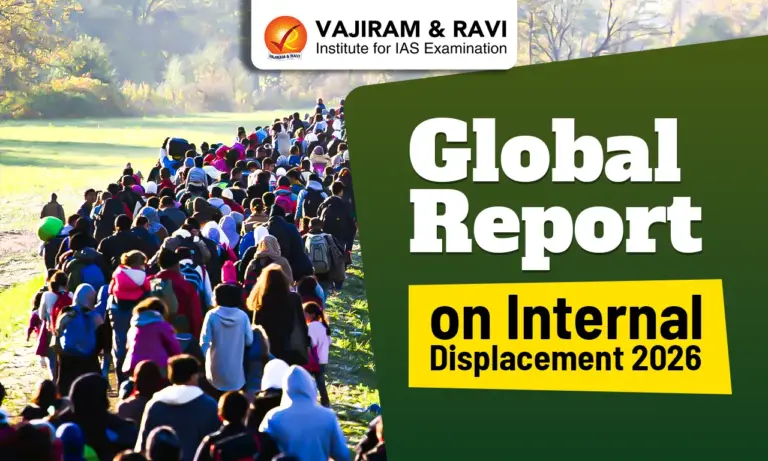
The latest Global Report on Internal Displacement (GRID) 2026, released by the Internal Displacement Monitoring Centre in partnership with the Norwegian Refugee Council, has revealed that more than 82.2 million people were internally displaced across 104 countries and territories by the end of 2025.
The report highlights that conflict and violence displaced more people than natural disasters for the first time on record, signalling a deepening global humanitarian and governance crisis.
What is Internal Displacement?
Internal displacement refers to the forced movement of people from their homes due to conflict, violence, disasters, or other crises, while remaining within the internationally recognised borders of their own country.
People affected by such displacement are known as Internally Displaced Persons (IDPs).
Unlike refugees, internally displaced persons do not cross international borders and therefore continue to remain under the legal protection and jurisdiction of their own state.
The major causes of internal displacement include:
- Armed conflict and civil wars.
- Ethnic and communal violence.
- Terrorism and insurgency.
- Natural disasters such as floods, cyclones, earthquakes, and droughts.
- Climate change-induced extreme weather events.
- Development projects and environmental degradation.
About the Global Report on Internal Displacement (GRID)
The Global Report on Internal Displacement is considered the world’s most authoritative assessment of internal displacement trends. Key Features of the Report:
- The report is prepared annually by the Internal Displacement Monitoring Centre.
- It examines displacement trends across 146 countries and territories.
- It studies displacement caused by conflict, violence, and disasters.
- The report is based on more than 4,500 documents and 630 data sources.
- Two Major Indicators Used in the Report:
- Internally Displaced Persons (IDPs): This refers to the total number of people living in displacement at a particular point in time.
- Internal Displacement Events: This refers to every instance of forced movement during a year. If a person is displaced multiple times, each movement is counted separately.
Global Report on Internal Displacement 2026 Key Findings
The Global Report on Internal Displacement 2026 highlights the unprecedented rise in forced internal displacement caused by conflict, violence, disasters, and climate-related crises across the world.
Global Findings
- 82.2 Million People Living in Internal Displacement: By the end of 2025, more than 82.2 million people were internally displaced across 104 countries and territories, making it the second-highest figure ever recorded globally.
- Internal Displacement Has More Than Doubled in the Last Decade: The number of internally displaced persons increased from 38.9 million in 2016 to 82.2 million in 2025.
- Conflict and Violence Became the Biggest Cause of Displacement: For the first time, wars and violence displaced more people than natural disasters. Armed conflicts, civil wars, communal violence, and political instability forced 68.6 million people to flee their homes.
- Conflict Displacement Increased Sharply in 2025: Conflict-related displacement events reached a record 32.3 million, representing a nearly 60 percent increase compared with 2024 and more than double the decadal average.
- 29.9 Million Disaster-Related Displacements Recorded: Floods, cyclones, storms, earthquakes, landslides, and wildfires triggered large-scale displacement across different regions of the world.
- Disaster Displacement Fell Compared with 2024 but Remained High: Although disaster-related displacement declined by 35 percent from the exceptionally high levels of 2024, it still remained 13 percent above the average of the past decade.
- Displacement Increasingly Used as a Weapon of War: The report warned that forced evacuations, siege tactics, attacks on civilian infrastructure, and restrictions on humanitarian aid are increasingly being used deliberately during conflicts.
- Humanitarian Funding and Monitoring Systems Weakened: Reduced international funding affected humanitarian operations and limited the ability of organisations to assess and respond to displacement crises effectively.
- Unsafe and Fragile Returns Became Common: Many displaced families returned to destroyed homes, insecure regions, and areas lacking basic services because they had no alternative means of survival.
Region-wise findings
- Sudan Continued to Face the World’s Largest Internal Displacement Crisis: Sudan remained the country with the highest number of internally displaced persons for the third consecutive year, with more than 9.1 million people displaced because of prolonged civil war and fighting between the Sudanese Armed Forces and the Rapid Support Forces.
- Sub-Saharan Africa Became the Worst-Affected Region: The region accounted for around 42 percent of global conflict displacement, with more than 31.7 million people living in displacement because of armed conflicts and instability.
- Philippines Recorded the Highest Disaster Displacement Globally: Typhoons and monsoon floods caused approximately 17.43 million displacement movements in the Philippines, accounting for around 36 percent of global disaster displacement.
- Wildfires Emerged as a Major Global Cause of Displacement: Around 694,000 displacement events were caused by wildfires globally, making it the second-highest wildfire displacement figure in the last decade.
- Iran Witnessed the Largest Single Displacement Event in the Report’s History: During the Israel-Iran conflict in June 2025, around 10 million displacement movements were recorded within Iran after evacuation warnings and military operations forced people to flee Tehran and nearby regions.
- Democratic Republic of Congo Experienced Massive Conflict Displacement: Fighting involving the M23 rebel group caused around 9.748 million displacement movements, making it one of the worst humanitarian crises globally.
- Palestine Continued to Witness Severe Humanitarian Suffering: Nearly 2.756 million displacement movements occurred in Palestine during 2025, while around two million Palestinians remained displaced due to repeated conflict, destruction of homes, and humanitarian collapse in Gaza and the West Bank.
- South Asia Witnessed Extraordinary Increase in Conflict Displacement: Cross-border tensions between India and Pakistan and clashes between Afghanistan and Pakistan caused a major increase in displacement across the region.
- India-Pakistan Tensions Triggered Large-Scale Displacement: Armed clashes near Kashmir displaced around 125,000 people in India and approximately 8,000 people in Pakistan, marking the largest cross-border escalation since 2019.
- 78,000 People Continued to Remain Displaced in Manipur: The report highlighted the prolonged humanitarian impact of the Meitei-Kuki violence in Manipur, where thousands continued to live in relief camps and host communities.
- Chile Demonstrated the Importance of Disaster Preparedness: Chile successfully evacuated around 1.5 million people after tsunami warnings following a major earthquake near Russia’s Kamchatka Peninsula, highlighting the effectiveness of strong early-warning systems and preparedness measures.
- Switzerland Highlighted Climate Risks in Developed Countries: The collapse of the Birch Glacier in Switzerland showed that climate change-induced disasters are increasingly affecting even advanced economies and mountainous regions.
- Middle East and North Africa Recorded Historic Levels of Displacement: Conflicts in Iran, Palestine, Sudan, and other regions pushed displacement in the Middle East and North Africa to record levels.
- Ukraine-Russia Conflict Continued to Drive Displacement: Around 3.7 million people remained internally displaced within Ukraine due to the continuing war.
The report concluded that internal displacement is no longer a temporary issue but a long-term challenge linked to conflict, governance failures, humanitarian breakdown, and climate change.


 Last updated on Oct, 2026
→ UPSC 2027 Notification will be released on 13 January 2027 at upsconline.nic.in.
→ Asian Games 2026 are being held in Aichi-Nagoya, Japan, from 19 September to 4 October.
→ Check Nobel Prize 2026 Winners List here.
→ Download PIB PRiSM Monthly Magazine 2026 here.
→ Check UPSC Monthly Current Affairs Magazine The Recitals here.
→ Check out the latest UPSC Syllabus here.
→ Download UPSC Model Answers for Mains 2026
→ UPSC Mains Question Paper 2026 is out now for Essay & GS Paper 1, 2, 3 & 4.
→ UPSC Calendar 2027 has been released.
→ Enroll in Vajiram & Ravi’s UPSC Mains Test Series 2027 for structured answer writing practice, expert evaluation, and exam-oriented feedback.
→ Join Vajiram & Ravi’s UPSC Mentorship Program 2027 for personalized guidance, strategy planning, and one-to-one support from experienced mentors.
→ Go through the UPSC Mains Previous Year Papers to enhance your preparation.
→ UPSC has released UPSC Toppers List 2025 with the Civil Services final result on its official website.
→ Also check Best UPSC Coaching in India
Global Report on Internal Displacement 2026 FAQs
Q1. Which organisation publishes the Global Report on Internal Displacement?+
Q2. How many people were internally displaced globally by the end of 2025?+
Q3. Which country witnessed the world’s largest internal displacement crisis?+
Q4. Which country recorded the largest single displacement event in the report’s history?+
Q5. Which region was the worst affected by conflict displacement?+
Q6. Which country recorded the highest disaster displacement in 2025?+
Tags: global report on internal displacement 2026