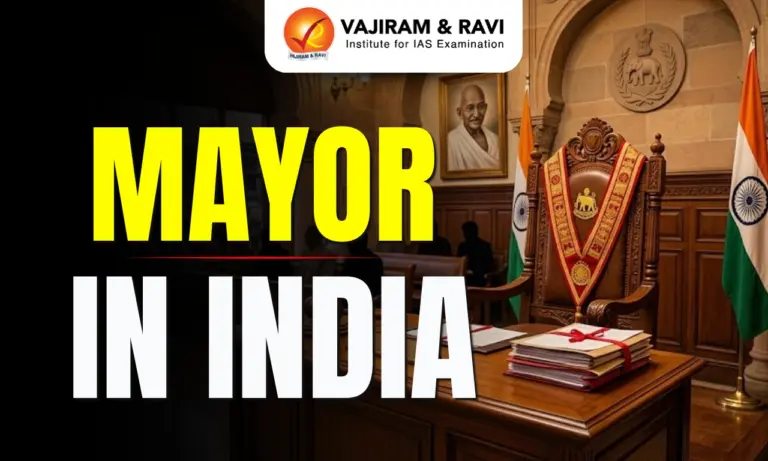
A Mayor is the highest elected representative of a city’s Municipal Corporation and acts as the first citizen of the city. The office of Mayor plays a key role in guiding urban development, civic administration, and local governance. The Mayor oversees meetings of the municipal corporation, coordinates with elected councillors, and represents the interests of citizens.
Mayor in India Constitutional Provisions
The Mayor is the political head and symbolic first citizen of a Municipal Corporation in India. Major cities such as Delhi, Mumbai, Kolkata, Chennai, Bengaluru, and Hyderabad have Municipal Corporations headed by a Mayor.
- The institution of Mayor is part of Urban Local Self-Government under Part IXA of the Constitution.
- It was given constitutional recognition through the 74th Constitutional Amendment Act, 1992.
- Articles 243P to 243ZG provide the framework for municipalities in India.
- Article 243Q provides for three types of urban local bodies: Municipal Corporations (for large cities), Municipal Councils and Nagar Panchayats.
- The Mayor is elected either directly by the people, or indirectly by elected councillors, depending on the state law.
- The tenure varies from state to state, generally ranging from 1 year to 5 years.
- Article 243U fixes the corporation’s term at 5 years; the Mayor’s individual tenure within that varies by state law.
- In many states, the Mayor’s position is largely ceremonial due to short tenure.
Role and Functions of Mayor in India
Although the office of Mayor in India is largely ceremonial in most states, it plays an important role in ensuring democratic deliberation, representation and symbolic leadership in urban governance.
- Presiding over municipal council meetings: The Mayor chairs meetings of the Municipal Corporation and ensures smooth conduct of discussions on budgets, policies and development plans.
- Facilitate deliberation and decision-making: The Mayor plays a key role in enabling debate among elected councillors and guiding discussions on civic issues and urban priorities.
- Casting vote in case of tie: In situations where voting in the council is evenly split, the Mayor exercises a casting vote to resolve the decision-making process.
- Coordination with committees: The Mayor works with various standing committees such as finance, health, education and public works to ensure policy discussions are streamlined.
- Political representation of citizens: As an elected representative, the Mayor articulates the concerns of urban residents before state governments, central agencies and other institutions.
- Coordination with External Stakeholders: The Mayor often acts as a bridge between the city and external actors such as investors, civil society and government departments, improving coordination.
- Ceremonial function: The Mayor represents the city during official functions, including reception of dignitaries and participation in state-sponsored events.
- Limited administrative role (in most states): While executive powers are largely held by the Municipal Commissioner, in some states like Kerala, the Mayor has greater supervisory authority, including involvement in performance assessment of officials.


Challenges Faced by Mayors in India
Despite being the elected head of urban local government, the Mayor’s office remains constrained by limited powers, weak finances and excessive state control, undermining the spirit of democratic decentralisation.
- Short Tenure: In many cities, mayors serve for only one to two-and-a-half years, leaving little scope for long-term planning, project execution or leadership continuity.
- Limited Executive Powers: The Mayor is accountable to citizens but lacks control over administration, creating a mismatch between responsibility and authority.
- Dominance of Municipal Commissioner: The state-appointed Municipal Commissioner exercises substantial control over finances, personnel and service delivery, reducing the Mayor to a largely ceremonial role.
- Dependence on State Governments: States continue to retain control over funds, functionaries and planning powers, preventing Urban Local Bodies from functioning as genuine institutions of self-government.
- Incomplete Devolution under the 74th Amendment: Many states have not fully transferred the 18 functions listed in the Twelfth Schedule, weakening municipal autonomy and effectiveness.
- Fragmented Urban Governance: Multiple agencies such as Development Authorities, Jal Boards and Transport Corporations operate independently, resulting in poor coordination and accountability.
- Weak Democratic Mandate: Most major cities do not directly elect their mayors, limiting the political legitimacy and authority required for effective urban leadership.
- Inadequate Financial Autonomy: Low property tax collection, limited revenue sources and dependence on grants constrain municipalities’ ability to meet growing urban demands.
- Absence of a Dedicated Municipal Cadre: Reliance on deputed state officials affects institutional memory, local accountability and specialised urban governance capacity.
- Delayed Municipal Elections: Frequent delays in local body elections undermine democratic governance and often leave cities under bureaucratic administration for extended periods.
Need for Empowered Mayors
The structural weaknesses of short tenures, limited executive authority and fragmented urban governance clearly indicate that India’s cities require strong and accountable local leadership to translate constitutional intent into effective urban governance.
- Rapid Urbanisation and Scale of Cities: India’s cities are expanding rapidly and contributing nearly 70% of GDP, requiring strong leadership capable of managing complex infrastructure and service delivery demands.
- Democratic Accountability: Empowered Mayors create a clear link between citizens’ votes and governance outcomes, ensuring that elected leaders are directly responsible for urban performance.
- Bridging Authority–Responsibility Gap: Giving Mayors executive powers aligns responsibility with authority, reducing the current mismatch where elected heads are blamed without control over administration.
- Integrated Urban Governance: A strong Mayor can coordinate multiple agencies such as development authorities, transport bodies and utilities, reducing fragmentation and improving efficiency.
- Improved Service Delivery: Unified leadership at the city level ensures faster decision-making and better implementation of projects like sanitation, housing and mobility.
- Enhancing Long-Term Planning: Fixed tenure and executive powers enable continuity in policies and infrastructure projects, which typically require long gestation periods.
- Boosting Investor and Institutional Confidence: A powerful Mayor provides a single point of contact for investors and external agencies, improving ease of doing business in cities.
- Realising 74th Amendment Vision: Empowered Mayors are essential to fulfil the constitutional goal of decentralised, participatory urban self-governance envisaged under the 74th Amendment.
- Supporting Viksit Bharat 2047: Strong urban leadership is critical for transforming cities into engines of growth, innovation and employment in line with India’s development vision.
Way Forward
Strengthening the office of the Mayor is essential to bridge the gap between constitutional intent under the 74th Amendment and ground-level urban governance realities.
- Direct election of Mayors: Mayors should be directly elected, especially in large cities, to ensure a clear democratic mandate and stronger political accountability.
- Fixed five-year tenure: A uniform five-year term co-terminus with the municipal council should be ensured to provide stability and enable long-term planning.
- Executive empowerment: The Mayor should be made the effective executive head of the city, with the Municipal Commissioner functioning under elected leadership rather than parallel to it.
- Mayor-in-Council system: Adoption of a structured Mayor-in-Council model can improve coordination and reduce fragmented decision-making.
- Unified city governance: Key urban services should be integrated under a single urban authority by rationalising multiple parastatal agencies.
- Financial strengthening: Improve own-source revenues through better property tax collection and promote instruments like municipal bonds to reduce dependency on grants.
- Full devolution of functions: All 18 functions under the Twelfth Schedule should be effectively devolved to Urban Local Bodies across states.
- Dedicated municipal cadre: A specialised urban civil service should be created to ensure professional and stable city administration.
- Timely local elections: Constitutional safeguards should ensure regular and timely municipal elections to prevent prolonged bureaucratic rule.

 Last updated on Oct, 2026
→ UPSC 2027 Notification will be released on 13 January 2027 at upsconline.nic.in.
→ Asian Games 2026 are being held in Aichi-Nagoya, Japan, from 19 September to 4 October.
→ Check Nobel Prize 2026 Winners List here.
→ Download PIB PRiSM Monthly Magazine 2026 here.
→ Check UPSC Monthly Current Affairs Magazine The Recitals here.
→ Check out the latest UPSC Syllabus here.
→ Download UPSC Model Answers for Mains 2026
→ UPSC Mains Question Paper 2026 is out now for Essay & GS Paper 1, 2, 3 & 4.
→ UPSC Calendar 2027 has been released.
→ Enroll in Vajiram & Ravi’s UPSC Mains Test Series 2027 for structured answer writing practice, expert evaluation, and exam-oriented feedback.
→ Join Vajiram & Ravi’s UPSC Mentorship Program 2027 for personalized guidance, strategy planning, and one-to-one support from experienced mentors.
→ Go through the UPSC Mains Previous Year Papers to enhance your preparation.
→ UPSC has released UPSC Toppers List 2025 with the Civil Services final result on its official website.
→ Also check Best UPSC Coaching in India
Mayor in India FAQs
Q1. Who is a Mayor in India?+
Q2. What are the main functions of a Mayor in India?+
Q3. How is a Mayor elected in India?+
Q4. What are the main challenges faced by Mayors in India?+
Q5. Why is there a need to empower Mayors in India?+
Q6. What reforms are suggested to strengthen the Mayor’s office?+
Tags: mayor in india