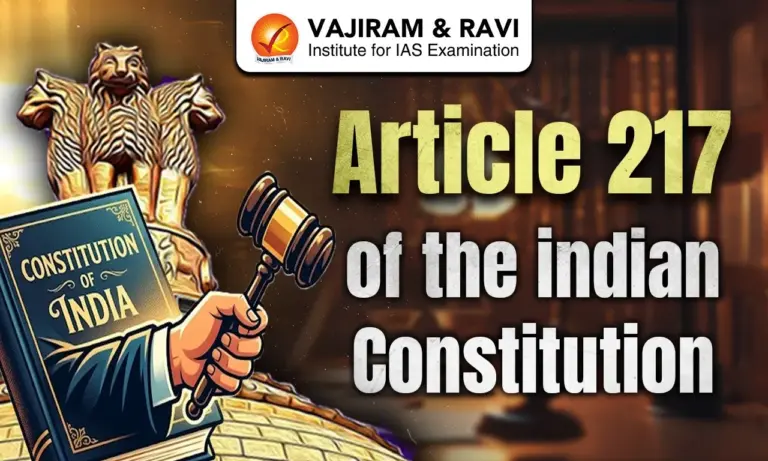
The recent recommendation by the Supreme Court Collegium for the elevation of nine advocates as judges of the Calcutta High Court has once again brought attention to Article 217 of the Indian Constitution.
Article 217 of the Indian Constitution Provisions
Article 217 of the Indian Constitution lays down the constitutional provisions relating to the appointment, qualifications, tenure, resignation, transfer, and removal of judges of High Courts in India.
Appointment of High Court Judges
Article 217(1) states that every judge of a High Court shall be appointed by the President of India through a warrant under his hand and seal.
- Originally, the Constitution provided that such appointments would be made after consultation with the Chief Justice of India, the Governor of the concerned State, and the Chief Justice of the concerned High Court.
- Later, the text was amended to include the National Judicial Appointments Commission under the 99th Constitutional Amendment.
- However, after the Supreme Court struck down the amendment in 2015, the collegium system continued in practice.
At present, High Court judges are appointed through the collegium system, and the Memorandum of Procedure (MoP) lays down the step-by-step process by which recommendations are examined and exchanged between the judiciary and the government before the final appointment by the President.
Tenure of High Court Judges
- Article 217 provides that a permanent judge of a High Court shall hold office until attaining the age of 62 years.
- Additional and acting judges hold office according to the provisions of Article 224.
Resignation of Judges
Under Article 217(1)(a), a High Court judge may resign from office by submitting a written resignation addressed to the President of India.
Removal of Judges
- Article 217(1)(b) provides that a High Court judge may be removed by the President in the same manner prescribed under Article 124(4) for the removal of a Supreme Court judge.
- A judge can only be removed on grounds of proved misbehaviour or incapacity. The process requires a special majority in both Houses of Parliament.
Transfer and Elevation of Judges
- Article 217(1)(c) states that the office of a High Court judge becomes vacant if the judge is appointed to the Supreme Court or transferred to another High Court.
- Transfers are governed by Article 222 and are made by the President after consultation with the Chief Justice of India.
Qualifications for Appointment
Article 217(2) lays down the qualifications required for appointment as a judge of a High Court. A person must be a citizen of India and must satisfy one of the following conditions:
- A person should have held a judicial office in the territory of India for at least ten years.
- A person should have been an advocate of a High Court or of two or more such courts in succession for at least ten years.
While a “distinguished jurist” can be appointed to the Supreme Court (under Article 124), no such provision exists for High Courts under Article 217.
Determination of Age of Judges
- Article 217(3) provides that if any question arises regarding the age of a High Court judge, the matter shall be decided by the President after consultation with the Chief Justice of India, and the decision shall be final.
- This provision was inserted to avoid disputes and constitutional uncertainty regarding judicial tenure.
- This clause was inserted by the 15th Constitutional Amendment Act, 1963, to provide a definitive mechanism and avoid constitutional uncertainty regarding judicial
Constitutional Amendments Related to Article 217
The constitutional amendments related to Article 217 have introduced important changes in the appointment process, retirement age, and selection system of High Court judges in India.
- 7th Constitutional Amendment) Act, 1956 amended Article 217(1) to clarify that additional and acting judges of High Courts would hold office according to the provisions of Article 224.
- The 15th Constitutional Amendment Act, 1963 increased the retirement age of High Court judges from 60 to 62 years in order to retain experienced judges and improve the efficiency of the higher judiciary.
- It also inserted Article 217(3), empowering the President to decide disputes regarding the age of a High Court judge after consultation with the Chief Justice of India, with the decision being final.
- 99th ConstitutionalAmendment Act, 2014 amended Article 217 to replace the collegium-based consultation process with appointments through the National Judicial Appointments Commission (NJAC) under Article 124A in an attempt to increase transparency and accountability in judicial appointments.
- The 99th Constitutional Amendment Act, 2014 was later struck down by the Supreme Court in 2015 on the ground that judicial independence is part of the Basic Structure of the Constitution, resulting in the restoration of the collegium system.


Important Judgments Related to Article 217 of the Indian Constitution
The Supreme Court has delivered several landmark judgments related to Article 217 that have shaped the process of appointment, transfer, and independence of High Court judges in India.
- In the First Judges Case (S.P. Gupta v. Union of India, 1981), the Supreme Court held that the executive had primacy in judicial appointments and that the opinion of the Chief Justice of India was not binding on the government.
- In the Second Judges Case (Supreme Court Advocates-on-Record Association v. Union of India, 1993), the Supreme Court reversed the earlier position and established the collegium system by giving primacy to the judiciary in judicial appointments.
- In the Third Judges Case (Presidential Reference, 1998), the Supreme Court expanded the collegium system and clarified that the Chief Justice of India must consult a group of senior-most judges while recommending appointments and transfers of judges.
- In the NJAC Judgment or Fourth Judges Case (Supreme Court Advocates-on-Record Association v. Union of India, 2015), the Supreme Court struck down the 99th Constitutional Amendment Act, 2014 and the National Judicial Appointments Commission Act, holding that judicial independence is part of the Basic Structure of the Constitution.
- In Union of India v. Sankalchand Himatlal Sheth (1977), the Supreme Court upheld the constitutional validity of transfer of High Court judges under Article 222 while emphasizing the importance of consultation with the Chief Justice of India.
Significance of Article 217 of the Indian Constitution
Article 217 is significant because it provides the constitutional framework for the appointment and service conditions of High Court judges, thereby ensuring an independent, impartial, and efficient higher judiciary in India.
- Article 217 safeguards judicial independence by providing security of tenure and a difficult removal procedure for High Court judges.
- It strengthens the rule of law by enabling High Courts to function free from executive and political interference.
- Article 217 maintains constitutional governance by ensuring the proper functioning of High Courts as protectors of Fundamental Rights and constitutional values.
- The provision supports the federal structure because High Courts act as the highest judicial institutions at the State level.
- It creates a balance between the judiciary and executive through a structured appointment process involving constitutional authorities.
- Article 217 also contributes to judicial accountability by laying down constitutional provisions relating to resignation, transfer, and removal of judges.
Challenges Related to Article 217 of the Indian Constitution
Article 217, despite being a cornerstone of judicial independence, faces several practical and institutional challenges in its implementation within the Indian judicial system.
- The collegium-based appointment system is often criticised for lack of transparency as the criteria and reasoning behind selections are not always made public.
- Delays in judicial appointments under Article 217 lead to significant vacancies in High Courts, which in turn increases pendency of cases and reduces judicial efficiency.
- The absence of a clear statutory framework for appointment timelines creates administrative uncertainty in the functioning of High Courts.
- Concerns regarding limited representation of women, Scheduled Castes, Scheduled Tribes, Other Backward Classes, and minority communities continue to persist in High Court appointments.
- Differences between the judiciary and executive in the appointment process often result in delays and institutional friction.
- The broad and subjective nature of “suitability” in judicial appointments can sometimes lead to debates over consistency and objectivity in selections.
- The limited accountability mechanisms in the collegium system raise concerns regarding institutional transparency and public trust in the appointment process.

 Last updated on August, 2026
→ UPSC Mains 2026 commenced on 21st August 2026 and will continue through 30th August 2026, as per the official examination schedule.
→ UPSC Mains Question Paper 2026 is out now for Essay & GS Paper 1, 2, 3 & 4.
→ UPSC Mains GS Paper 1 2026 is out now.
→ UPSC Mains GS Paper 2 2026 is out now.
→ UPSC Mains GS Paper 3 2026 is out now.
→ UPSC Mains GS Paper 4 2026 is out now.
→ UPSC Mains Indian Language Paper & English Compulsory Paper are out now.
→ Check out the latest UPSC Syllabus 2026 here.
→ UPSC Mains Admit Card 2026 is now out.
→ Enroll in Vajiram & Ravi’s UPSC Mains Test Series 2027 for structured answer writing practice, expert evaluation, and exam-oriented feedback.
→ Join Vajiram & Ravi’s UPSC Mentorship Program 2027 for personalized guidance, strategy planning, and one-to-one support from experienced mentors.
→ Go through the UPSC Mains Previous Year Papers to enhance your preparation.
→ Download UPSC Mains Essay Paper 2025, UPSC Mains GS Paper-I 2025, UPSC Mains GS Paper-II 2025, UPSC Mains GS Paper-III 2025, UPSC Mains GS Paper-IV 2025, UPSC Mains English (Compulsory) Paper 2025, UPSC Mains Hindi (Qualifying) Paper 2025 here.
→ UPSC has released UPSC Toppers List 2025 with the Civil Services final result on its official website.
→ UPSC Calendar 2027 has been released.
→ Also check Best UPSC Coaching in India
Article 217 of the Indian Constitution FAQs
Q1. What is Article 217 of the Indian Constitution?+
Q2. Who appoints High Court judges under Article 217 of the Indian Constitution?+
Q3. What is the retirement age of a High Court judge under Article 217 of the Indian Constitution?+
Q4. What are the qualifications required for appointment as a High Court judge?+
Q5. How can a High Court judge be removed under Article 217 of the Indian Constitution?+
Q6. Why is Article 217 of the Indian Constitution important for the Indian judiciary?+
Tags: article 217 of the indian constitution