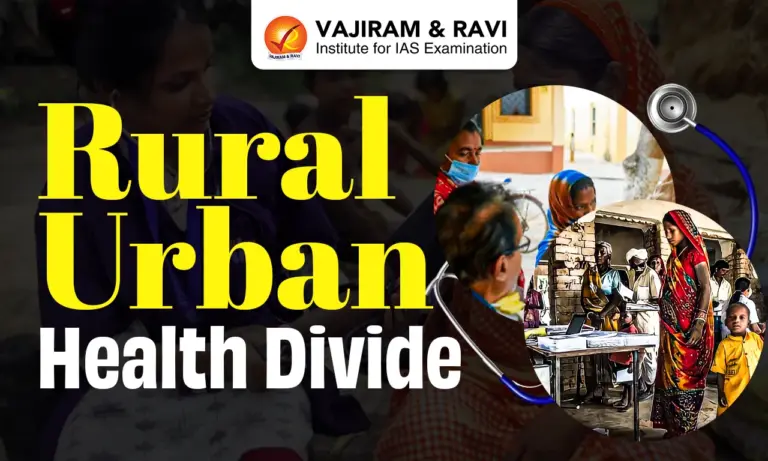
Recently, the Union Government informed Parliament that 43 new medical colleges have been established and 11,682 MBBS seats along with 8,967 postgraduate seats have been approved for the 2025-26 academic year. However, despite the expansion of medical education infrastructure, India continues to face a severe rural-urban health divide marked by shortage of doctors, inadequate healthcare infrastructure, and poor specialist availability in rural, tribal, hilly, and underserved regions.
What is the Rural-Urban Health Divide?
The rural-urban health divide refers to unequal access to healthcare services, medical infrastructure, doctors, specialists, diagnostics, and quality treatment between urban and rural areas.
While urban regions have relatively better hospitals, specialists, and healthcare facilities, rural and remote areas continue to face shortages of doctors, weak infrastructure, and poor healthcare delivery systems.
Status of the Rural Health Crisis in India
India’s rural healthcare system continues to face severe shortages of specialists and functional healthcare facilities.
- According to The Health Dynamics of India 2022-23 report, rural Community Health Centres (CHCs) face a specialist vacancy rate of nearly 79.9%.
- Only 4,413 specialists are available against the required 21,964 specialists across 5,491 rural Community Health Centres (CHCs).
- The shortfall of specialists in Community Health Centres (CHCs) has remained around 17,500 since 2014 despite expansion of postgraduate medical seats.
- India currently has 731 medical colleges with nearly 72,627 postgraduate medical seats, yet rural specialist vacancies remain largely unfilled.
- 11 out of 18 All India Institutes of Medical Sciences (AIIMS) reportedly face around 40% vacancies in teaching and research faculty positions.
- Most rural patients continue to travel long distances to district hospitals and medical colleges due to non-functional Community Health Centres (CHCs).


Structural Causes of the Rural-Urban Health Divide
Despite expansion in public health infrastructure, India’s rural–urban health gap continues due to deep structural imbalances in human resources, infrastructure, medical education, and financing that together weaken the effectiveness of rural health delivery.
1. Shortage of Specialists and Weak Deployment
- Rural CHCs face persistent shortages of specialist doctors, severely limiting their functioning.
- Although CHCs are meant to have five specialists (physician, surgeon, obstetrician, paediatrician, anaesthetist), many posts remain vacant.
- Even where doctors are posted, irregular or partial deployment reduces overall service capacity.
- Lack of peer support and professional isolation further discourages specialists from serving in rural areas.
2. Inadequate Healthcare Infrastructure
- Many rural facilities lack essential clinical infrastructure such as operation theatres, ICUs, laboratories, and diagnostic equipment.
- Weak transport systems, poor electricity supply, and inadequate referral networks reduce emergency response and efficiency.
- Poor staff housing and difficult living conditions discourage doctors from accepting or continuing rural postings.
- Limited social infrastructure such as schools, housing, and connectivity further reduces long-term retention.
3. Urban-Centric Medical Education and Career Pathways
- Medical education is heavily concentrated in urban centres, creating an inherent urban bias in training and exposure.
- Career progression is largely oriented towards tertiary care and private urban hospitals.
- Rural health priorities like primary care, prevention, and community health receive limited emphasis in curricula.
- As a result, doctors move towards cities due to better income, infrastructure, and professional growth opportunities.
4. Flawed Budgetary and Planning Priorities
- Health spending continues to focus more on infrastructure creation than on operational needs.
- Insufficient funding for staffing, medicines, diagnostics, and emergency care weakens actual service delivery.
- Many CHCs exist structurally but function at a lower level due to resource and manpower shortages.
- Expansion without adequate operational support leads to underutilised infrastructure and inefficiency in public spending.
Impact of the Rural-Urban Health Divide
The unequal distribution of healthcare resources creates major social and economic consequences.
- Rural and tribal populations face delayed access to specialised healthcare services.
- High out-of-pocket expenditure increases financial burden on poor households.
- Maternal and child healthcare outcomes worsen in underserved regions.
- Overcrowding increases pressure on district hospitals and urban tertiary healthcare institutions.
- Lack of accessible healthcare deepens regional inequalities and social exclusion.
- Public trust in government healthcare institutions declines due to poor service delivery.
Measures to Reduce the Rural-Urban Health Divide
India’s public health system requires structural reforms in training, deployment, incentives, and infrastructure. India should shift from infrastructure-centric healthcare expansion towards outcome-oriented healthcare delivery.
- Linking Medical Education with Public Service: Medical education should be aligned with public health needs by linking government-funded postgraduate seats with compulsory service in rural and underserved areas, along with preference for candidates willing to serve in remote regions.
- Area-Based Incentive System: Health facilities should be classified as normal, difficult, and most difficult areas, and doctors working in difficult regions should receive higher pay, better career growth, and incentives such as priority in postgraduate admissions.
- Strengthening Healthcare Infrastructure: The focus should shift from simply building facilities to making them fully functional by upgrading CHCs with operation theatres, ICUs, diagnostics, emergency care, medicines, ambulances, and staff housing.
- Team-Based Specialist Deployment: All five specialists should be posted together in CHCs instead of isolated postings to ensure proper functioning, better coordination, reduced workload stress, and improved patient care.
- Better Human Resource Planning: Health workforce planning should be based on real vacancy needs, with medical seats and training aligned to rural demand, along with incentives for nurses and allied health workers to serve in underserved and aspirational districts.

 Last updated on Sep, 2026
→ UPSC 2027 Notification will be released on 13 January 2027 at upsconline.nic.in.
→ Check out the latest UPSC Syllabus here.
→ Download UPSC Model Answers for Mains 2026
→ UPSC Mains Question Paper 2026 is out now for Essay & GS Paper 1, 2, 3 & 4.
→ UPSC Calendar 2027 has been released.
→ Enroll in Vajiram & Ravi’s UPSC Mains Test Series 2027 for structured answer writing practice, expert evaluation, and exam-oriented feedback.
→ Join Vajiram & Ravi’s UPSC Mentorship Program 2027 for personalized guidance, strategy planning, and one-to-one support from experienced mentors.
→ Go through the UPSC Mains Previous Year Papers to enhance your preparation.
→ UPSC has released UPSC Toppers List 2025 with the Civil Services final result on its official website.
→ Also check Best UPSC Coaching in India
Rural Urban Health Divide FAQs
Q1. What is the rural-urban health divide in India?+
Q2. Why does the rural-urban health divide persist despite more medical colleges and seats?+
Q3. What is the most critical structural bottleneck in rural healthcare delivery?+
Q4. What is the impact of this divide on rural populations?+
Q5. What structural reforms are required to address the rural-urban health divide?+
Tags: rural urban health divide