


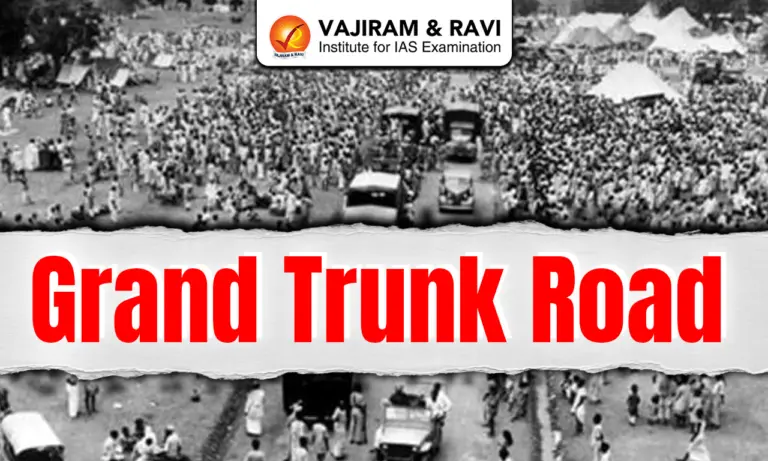
The Grand Trunk Road (GT Road) is one of the oldest and most important road networks in South Asia. It has connected regions of the Indian subcontinent for centuries and played a major role in trade, administration, culture, and military movement. The road stretches from present-day Bangladesh through India and Pakistan up to Afghanistan
Grand Trunk Road During Sher Shah Suri’s Reign
The Grand Trunk Road became highly developed during the rule of Sher Shah Suri in the 16th century. Sher Shah Suri rebuilt and expanded the ancient road to improve communication and trade across his empire.
He extended the road from Sonargaon in present-day Bangladesh to Peshawar in present-day Pakistan. His administration introduced several facilities for travelers and traders. Important developments during his reign included:
- Construction of sarais (rest houses) at regular intervals for travelers.
- Plantation of shady trees on both sides of the road.
- Establishment of wells for drinking water.
- Deployment of security personnel to protect travelers.
- Development of an efficient postal system using horse riders.
Grand Trunk Road Under British Rule
During British colonial rule, the Grand Trunk Road became one of the most important transportation and communication routes in India. The British administration modernized the road to improve governance, strengthen military control, and expand commercial activities across the subcontinent.
- Large-Scale Road Reconstruction – The British extensively repaired and widened the Grand Trunk Road to support heavy transport and long-distance travel.
- Use of Modern Engineering Techniques – Stone paving, drainage systems, and durable road surfaces were introduced to improve road quality.
- Construction of Bridges – Permanent bridges were built across major rivers to ensure uninterrupted transportation throughout the year.
- Strategic Military Route – The road was used for quick deployment of British troops during wars, revolts, and emergencies, especially during the Revolt of 1857.
- Administrative Connectivity – Enabled British officials to travel efficiently between provinces and maintain centralized control.
- Expansion of Postal Services – Improved postal communication helped in faster delivery of government orders, trade information, and official records.
- Economic Exploitation – The British used the road to transport raw materials such as cotton, indigo, and grains from interior regions to ports for export.
- Growth of Trade Centers – Markets, warehouses, and trading towns developed rapidly along the route due to increased commercial activity.
- Support to Industrial Development – Industrial cities like Kanpur and Kolkata benefited from improved transportation networks connected to the road.
- Facilitated Cultural Interaction – Travelers, traders, scholars, and pilgrims from different regions used the route, encouraging cultural exchange.
- Integration with Railways – In several regions, the road worked alongside railway networks to strengthen transportation infrastructure.


Route and Geographical Extent of Grand Trunk Road
The Grand Trunk Road is one of the longest and oldest road networks in South Asia, stretching across multiple countries and connecting important historical, cultural, and commercial regions. The road played a major role in linking eastern and northwestern parts of the Indian subcontinent.
- Historical Extent – Historically, the Grand Trunk Road extended from Chittagong in present-day Bangladesh to Kabul in Afghanistan.
- Countries Connected – The road passes through modern-day Bangladesh, India, Pakistan, and Afghanistan.
- Route in India – In India, the road mainly passes through the northern plains and connects several important states.
- States Connected in India – West Bengal, Jharkhand, Bihar, Uttar Pradesh, Haryana, Punjab, and parts of Delhi are connected by the route.
- Follows Indo-Gangetic Plains – Most sections of the road pass through the fertile Indo-Gangetic Plains, which supported agriculture and trade.
- Eastern Starting Point – The eastern section historically began near Chittagong and Sonargaon in Bengal.
- Western End Point – The western route extended toward Peshawar and Kabul, connecting India with Central Asia.
- Major River Crossings – The road crossed important rivers such as the Ganga, Yamuna, and Sutlej through bridges and ferry systems.
- Connected Trade Routes – Linked local trade routes with international trade networks of Central Asia and the Middle East.
- Modern Highway Alignment – Several portions of the historic road are now part of National Highway 19 and National Highway 44 in India.
Important Cities Connected by Grand Trunk Road
The Grand Trunk Road connected several important commercial, cultural, and administrative cities across South Asia, helping in trade, communication, and movement of people for centuries.
- Kolkata – Served as a major trading and colonial administrative center in eastern India.
- Varanasi – Known as an important religious and cultural city located on the banks of the Ganga River.
- Prayagraj – Acted as a key junction connecting northern and eastern regions of India.
- Kanpur – Developed as an important industrial and commercial center during British rule.
- Delhi – Functioned as a major political and administrative capital under various dynasties.
- Amritsar – Became an important center of trade and Sikh culture in Punjab.
- Lahore – Emerged as a major cultural and economic hub in the northwestern region.
- Rawalpindi – Played an important role in military and trade activities.
- Peshawar – Served as a gateway connecting the Indian subcontinent with Central Asia.
- Kabul – Connected South Asia with Central Asian trade routes and cultural exchanges.
Grand Trunk Road Importance
The Grand Trunk Road played a vital role in shaping the economic, cultural, political, and strategic history of South Asia by connecting important regions and facilitating communication and trade.
- Promoted Trade and Commerce – Helped merchants transport goods such as spices, textiles, grains, and handicrafts across different regions.
- Improved Connectivity – Connected major cities, markets, ports, and administrative centers efficiently.
- Administrative Significance – Enabled rulers to maintain better control over distant provinces and territories.
- Military Importance – Allowed rapid movement of armies, weapons, and supplies during wars and invasions.
- Cultural Exchange – Encouraged interaction among people of different languages, religions, and traditions.
- Development of Towns and Cities – Many settlements and commercial centers grew along the route of the road.
- Strengthened Postal Communication – Sher Shah Suri established an organized postal system along the route for faster communication.
- Economic Growth – Boosted regional economies by linking agricultural areas with urban markets.
- Strategic Importance During British Rule – The British used the road for governance, trade, and troop movement across northern India.
- Foundation for Modern Highways – Several parts of the present-day highway network in India are based on the historic Grand Trunk Road route.
Legacy of Sher Shah Suri
Sher Shah Suri is remembered as one of the most efficient rulers and administrators in medieval Indian history. His reforms in administration, economy, roads, and military organization left a long-lasting impact on later rulers, including the Mughals.
- Development of the Grand Trunk Road – Rebuilt and expanded the historic road network to improve trade, travel, and administration.
- Efficient Administrative System – Introduced better governance methods for tax collection, law and order, and provincial administration.
- Introduction of Currency Reforms – Issued the silver coin called the “Rupiya,” which later became the basis of modern Indian currency.
- Improved Postal System – Established a fast communication network using horse riders and postal stations.
- Construction of Sarais – Built rest houses for travelers, traders, and officials along major roads.
- Military Reforms – Strengthened the army through better organization, discipline, and record-keeping.
- Land Revenue Reforms – Introduced systematic measurement of agricultural land for fair tax collection.
- Promotion of Trade and Commerce – Improved roads and security, encouraging economic activities across regions.
- Influence on Mughal Administration – Many administrative reforms later adopted by Akbar were inspired by Sher Shah Suri’s policies.
- Historical Importance – Remembered as a visionary ruler who focused on public welfare, infrastructure, and efficient governance.

 Last updated on Oct, 2026
→ UPSC 2027 Notification will be released on 13 January 2027 at upsconline.nic.in.
→ Check Nobel Prize 2026 Winners List here.
→ Download PIB PRiSM Monthly Magazine 2026 here.
→ Check UPSC Monthly Current Affairs Magazine The Recitals here.
→ Check out the latest UPSC Syllabus here.
→ Download UPSC Model Answers for Mains 2026
→ UPSC Mains Question Paper 2026 is out now for Essay & GS Paper 1, 2, 3 & 4.
→ UPSC Calendar 2027 has been released.
→ Enroll in Vajiram & Ravi’s UPSC Mains Test Series 2027 for structured answer writing practice, expert evaluation, and exam-oriented feedback.
→ Join Vajiram & Ravi’s UPSC Mentorship Program 2027 for personalized guidance, strategy planning, and one-to-one support from experienced mentors.
→ Go through the UPSC Mains Previous Year Papers to enhance your preparation.
→ UPSC has released UPSC Toppers List 2025 with the Civil Services final result on its official website.
→ Also check Best UPSC Coaching in India
Grand Trunk Road FAQs
Q1. What is the Grand Trunk Road?+
Q2. Who rebuilt the Grand Trunk Road?+
Q3. Why is the Grand Trunk Road important?+
Q4. Which countries are connected by the Grand Trunk Road?+
Q5. Which major Indian cities are connected by the Grand Trunk Road?+
Q6. What facilities did Sher Shah Suri provide on the Grand Trunk Road?+
Tags: geography geography notes grand trunk road








