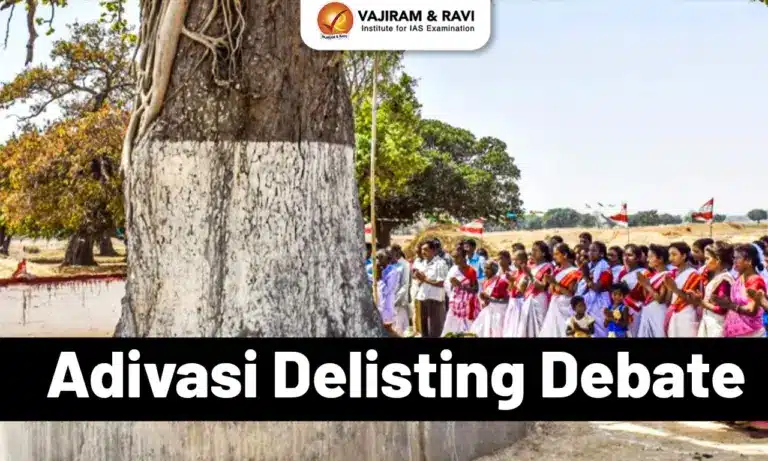
Adivasi Delisting Debate Latest News
- Two recent developments in Jharkhand have revived the long-running and deeply divisive debate around religious identity and Scheduled Tribe (ST) reservations.
- First, when the population census process began in Jharkhand on May 16, appeals circulated among Adivasi communities to write “Sarna” (their traditional tribal faith) — not “Hindu” — in the religion column.
- A week later, a large Sangh-affiliated Adivasi gathering in New Delhi demanded “delisting” — removal of ST benefits for tribal people who convert to Christianity or Islam.
What is Delisting
- Delisting refers to the demand that tribal people who convert to Christianity or Islam should no longer receive Scheduled Tribe reservation benefits.
- The demand is primarily raised by Adivasi Hindus and organisations affiliated to the RSS-BJP ecosystem.
- However, the Sarna community — which does not identify as either Hindu or Christian and follows an indigenous tribal faith — argues that if religion becomes the basis for removing tribal status, the same logic should apply to tribal people who converted to Hinduism as well — pointing to the inherent inconsistency in the selective application of the demand.


The Constitutional Distinction — SC vs ST
- This debate has significant constitutional dimensions.
- A recent Supreme Court observation reiterated that Dalits converting to Christianity or Islam cannot continue to claim Scheduled Caste status under Article 341 of the Constitution — which explicitly links SC status to religion (specifically Hinduism, Sikhism, and Buddhism).
- However, Article 342 — which governs Scheduled Tribes — does not mention religion at all.
- This crucial distinction is now central to the delisting debate — because unlike SCs, STs were never defined on religious grounds under the Constitution, making delisting legally far more complex.
The Two Sides of the Debate
- Pro-Delisting Camp
- The Janjati Suraksha Manch (JSM) — affiliated with the Sangh’s tribal outfit Akhil Bharatiya Vanavasi Kalyan Ashram — organised the New Delhi gathering recently, attended by Union Home Minister Amit Shah.
- Several Adivasi groups, including some from the Northeast, backed the delisting demand — arguing that religious conversion breaks the cultural and social continuity that justifies ST status.
- The Delhi event, however, triggered a separate controversy. Home Minister Shah used the word “vanvasi” (meaning forest dweller) while talking about Adivasis — prompting protests in Jharkhand.
- Critics argued that “vanvasi” reduces tribal identity to geography alone, while “Adivasi” — meaning “original inhabitants” — carries a deeper political and historical identity linked to land and indigeneity that the term “vanvasi” deliberately erases.
- Anti-Delisting Camp
- The Sarna community and the Christian Adivasi Mahasabha organised a large counter-rally in Jashpur, Chhattisgarh.
- Adivasi activists from Jharkhand and Chhattisgarh — especially Sarna followers — extended solidarity to Christian Adivasis.
- Their core argument is that tribal identity is ethnic, cultural, and historical — not religious — and that conversion does not strip away the social backwardness, land dispossession, and discrimination that form the actual basis of ST status.
Historical Origins of the Delisting Demand
- The roots of the delisting demand are traced to Baba Kartik Oraon — a prominent Adivasi leader and later a Union Minister in Indira Gandhi’s cabinet.
- In 1962, Kartik Oraon lost his debut Lok Sabha election from Lohardaga (an ST-reserved constituency) and argued before the Patna High Court that since his opponent had converted to Christianity, he no longer qualified as a tribal and should be disqualified.
- The Patna High Court rejected this argument — holding that “Oraon is primarily a tribe and ethnic identity, not merely a religion.”
- It observed that Christian Oraons retained their clan system, tribal customs, and festivals — concluding that they were “Oraons first and Christians next.”
- This judgment remains a foundational precedent cited by opponents of delisting.
The 1967-1969 Parliamentary Attempt
- Later, in August 1967, the government introduced the ‘Scheduled Castes and Scheduled Tribes Order Amendment Bill’ to revise inclusion and exclusion of castes and tribes.
- A Joint Parliamentary Committee (1969) proposed amending the Bill to exclude Christian and Muslim tribal converts from the ST category.
- However, the government expressed reservations and Parliament never adopted the proposal — effectively maintaining the status quo that ST status is religion-neutral.
The Core Constitutional Question
- The delisting debate ultimately rests on a fundamental question — what is the basis of ST identity? Is it religious, ethnic, cultural, or socio-economic?
- The constitutional framework under Article 342 clearly defines ST status on ethnic, social, and historical grounds — not religious ones.
- The Patna High Court’s precedent reinforces this — tribal identity survives religious conversion because the social backwardness, community ties, and historical disadvantages that justify ST status do not disappear with a change of faith.
Source: IE

 Last updated on August, 2026
→ UPSC Mains 2026 commenced on 21st August 2026 and will continue through 30th August 2026, as per the official examination schedule.
→ UPSC Mains Question Paper 2026 is out now for Essay & GS Paper 1, 2, 3 & 4.
→ UPSC Mains GS Paper 1 2026 is out now.
→ UPSC Mains GS Paper 2 2026 is out now.
→ UPSC Mains GS Paper 3 2026 is out now.
→ UPSC Mains GS Paper 4 2026 is out now.
→ Check out the latest UPSC Syllabus 2026 here.
→ UPSC Mains Admit Card 2026 is now out.
→ Enroll in Vajiram & Ravi’s UPSC Mains Test Series 2027 for structured answer writing practice, expert evaluation, and exam-oriented feedback.
→ Join Vajiram & Ravi’s UPSC Mentorship Program 2027 for personalized guidance, strategy planning, and one-to-one support from experienced mentors.
→ Go through the UPSC Mains Previous Year Papers to enhance your preparation.
→ Download UPSC Mains Essay Paper 2025, UPSC Mains GS Paper-I 2025, UPSC Mains GS Paper-II 2025, UPSC Mains GS Paper-III 2025, UPSC Mains GS Paper-IV 2025, UPSC Mains English (Compulsory) Paper 2025, UPSC Mains Hindi (Qualifying) Paper 2025 here.
→ UPSC has released UPSC Toppers List 2025 with the Civil Services final result on its official website.
→ UPSC Calendar 2027 has been released.
→ Also check Best UPSC Coaching in India
Adivasi Delisting Debate FAQs
Q1. What is the Adivasi Delisting Debate?+
Q2. Why is the Adivasi Delisting Debate gaining attention?+
Q3. How does the Constitution relate to the Adivasi Delisting Debate?+
Q4. What are the arguments against the Adivasi Delisting Debate?+
Q5. What is the key constitutional question in the Adivasi Delisting Debate?+
Tags: Adivasi Delisting Debate mains articles upsc current affairs upsc mains current affairs