Why in News?
Recently, the Supreme Court of India observed that the persistent denial of conjugal rights by one spouse without a valid reason can amount to mental cruelty.
What are Conjugal Rights?
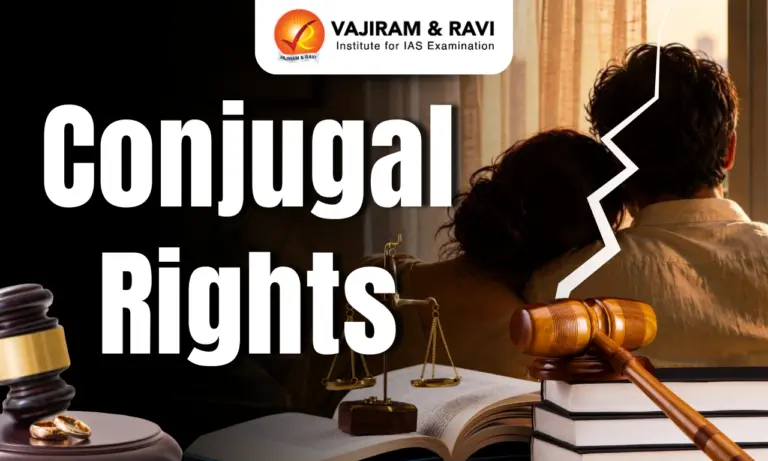
Conjugal Rights are the mutual rights and responsibilities that arise from a valid marriage. They include the right of spouses to live together, provide companionship, and maintain a normal marital relationship. These rights aim to strengthen the bond between husband and wife and promote family stability. In simple terms, conjugal rights ensure that both spouses enjoy the benefits and fulfill the obligations of married life.


What is Restitution of Conjugal Rights (RCR)?
Restitution of Conjugal Rights (RCR) is a legal remedy available when one spouse withdraws from the company of the other without a reasonable excuse. Under this provision, the aggrieved spouse can approach the court seeking an order for the resumption of marital cohabitation. The objective is to preserve the marriage and encourage reconciliation between the spouses. In India, RCR is primarily governed by Section 9 of the Hindu Marriage Act, 1955 and similar provisions under other personal laws.
Constitutional and Legal Basis of Conjugal Rights
Conjugal rights in India are recognized under various personal laws and are subject to constitutional principles such as dignity, privacy, equality, and the protection of marriage as a social institution.
- Section 9 of the Hindu Marriage Act, 1955 provides for the restitution of conjugal rights when one spouse withdraws from the company of the other without a reasonable excuse.
- Muslim Personal Law recognizes the right of spouses to cohabit and fulfill marital obligations.
- Indian Divorce Act, 1869 contains provisions related to restitution of conjugal rights for Christians.
- Parsi Marriage and Divorce Act, 1936 also recognizes the remedy of restitution of conjugal rights.
- Article 21 of the Constitution guarantees the right to life and personal liberty, including dignity and privacy, which are relevant in matrimonial matters.
- Courts seek to balance marital rights with individual autonomy, consent, and constitutional freedoms.
- Indian courts have consistently emphasized that conjugal rights cannot override the fundamental rights and dignity of either spouse.
Personal Laws
Different personal laws in India recognize the rights and obligations of spouses in marriage, including provisions related to cohabitation and conjugal rights.
- Hindu Marriage Act, 1955 – Section 9 provides for the restitution of conjugal rights when one spouse withdraws from the society of the other without a reasonable reason.
- Muslim Personal Law – Recognizes the mutual rights and duties of spouses, including cohabitation and marital companionship.
- Indian Divorce Act, 1869 – Provides remedies related to matrimonial disputes for Christians, including restitution of conjugal rights.
- Parsi Marriage and Divorce Act, 1936 – Contains provisions governing matrimonial rights and obligations among Parsis.
- Special Marriage Act, 1954 – Provides for restitution of conjugal rights for marriages solemnized under this secular law.
- These laws aim to promote marital harmony, reconciliation, and family stability while respecting legal and constitutional safeguards

 Last updated on Sep, 2026
→ UPSC 2027 Notification will be released on 13 January 2027 at upsconline.nic.in.
→ Check out the latest UPSC Syllabus here.
→ Download UPSC Model Answers for Mains 2026
→ UPSC Mains Question Paper 2026 is out now for Essay & GS Paper 1, 2, 3 & 4.
→ UPSC Calendar 2027 has been released.
→ Enroll in Vajiram & Ravi’s UPSC Mains Test Series 2027 for structured answer writing practice, expert evaluation, and exam-oriented feedback.
→ Join Vajiram & Ravi’s UPSC Mentorship Program 2027 for personalized guidance, strategy planning, and one-to-one support from experienced mentors.
→ Go through the UPSC Mains Previous Year Papers to enhance your preparation.
→ UPSC has released UPSC Toppers List 2025 with the Civil Services final result on its official website.
→ Also check Best UPSC Coaching in India
Conjugal Rights FAQs
Q1. What are conjugal rights?+
Q2. What is Restitution of Conjugal Rights?+
Q3. Can denial of conjugal rights be considered cruelty?+
Q4. Which law governs restitution of conjugal rights for Hindus?+
Q5. Does the court force spouses to have physical relations?+
Tags: civil law conjugal rights personal laws