About Deep Ocean Mission
- It is a mission-mode project to support the Blue Economy Initiatives of the Government of India.
- It is a high-level multi-ministerial, multidisciplinary programme for a better understanding of the deep sea living and non-living resources of the Indian Ocean.
- It was launched as a Central Sector Scheme with the overall estimated cost of Rs 4,077 crores for two phases of the Mission period during 2021-2026.
- The Ministry of Earth Sciences (MoES) will be the nodal Ministry implementing this multi-institutional Mission.
- The mission consists of six major components:
- Development of Technologies for Deep Sea Mining and Manned Submersible and Underwater Robotics;
- Development of Ocean Climate Change Advisory Services;
- Technological innovations for exploration and conservation of deep-sea biodiversity;
- Deep Ocean Survey and Exploration;
- Energy and freshwater from the Ocean;
- Advanced Marine Station for Ocean Biology
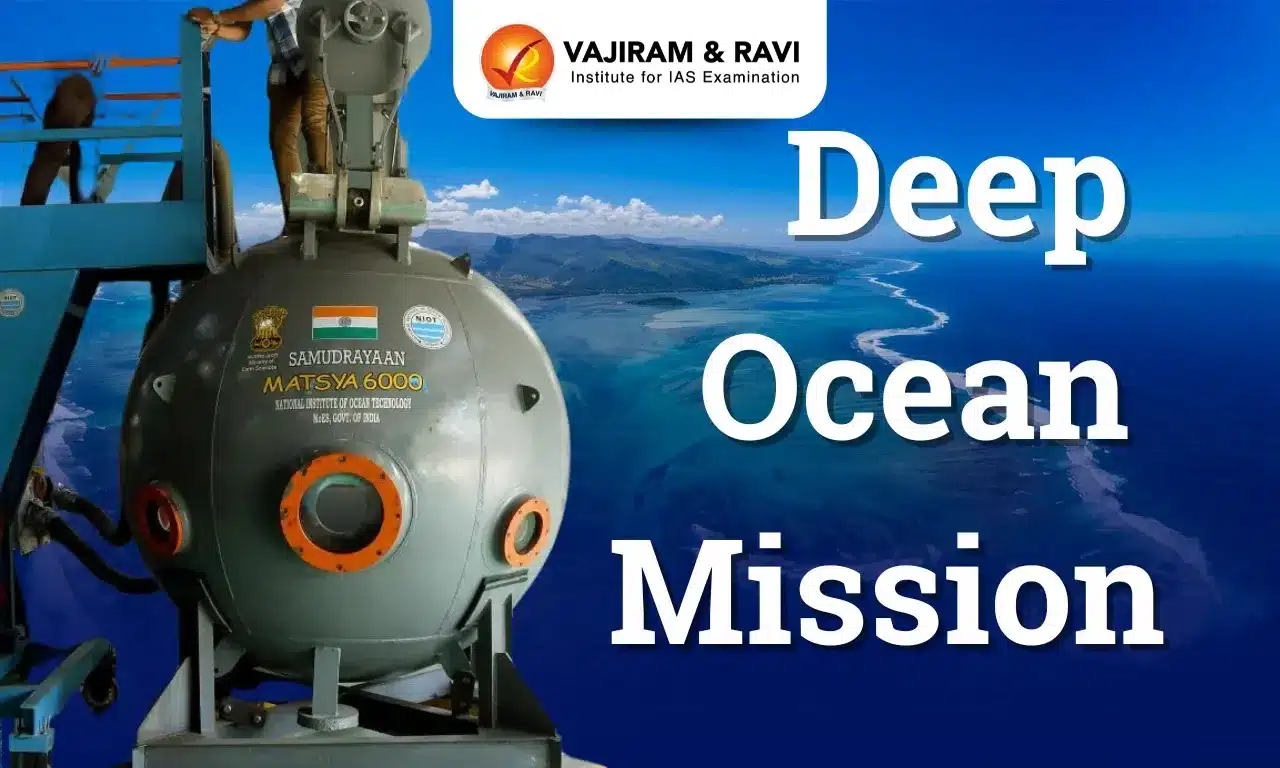
- The Samudrayaan project under the Deep Ocean Mission is for the development of a manned submersible to carry three people to a depth of 6000 meters in the ocean with a suite of scientific sensors for ocean exploration and observation.
- The vehicle is called Matsya 6000.
- The entire vehicle design has been completed and various sub-components like underwater battery, propulsion system, underwater telephone, navigation and communication devices, power distribution and control systems, personnel sphere for 500 m water depth, lift support system, control software, etc have been realised.
Deep Ocean Mission FAQs
Q1. Who launched the Deep Ocean Mission?
Ans. The Deep Ocean Mission was launched by the Government of India, specifically
by the Ministry of Earth Sciences (MoES).
Q2. What is the purpose of the Deep Ocean Mission?
Ans. To develop technologies to harness the living and non-living resources from the deep-oceans.
Q3. Who owns the deep ocean?
Ans. According to the United Nations Convention on the Law of the Sea (UNCLOS), the deep ocean beyond national jurisdiction is considered a common heritage of mankind.
Q4. What is the depth of the deepest ocean?
Ans. The deepest part of the ocean is called the Challenger Deep, approximately 10,935 meters (35,876 feet) deep, and is located beneath the western Pacific Ocean in the southern end of the Mariana Trench.
Source: BS


 Last updated on Oct, 2026
→ UPSC 2027 Notification will be released on 13 January 2027 at upsconline.nic.in.
→ Asian Games 2026 are being held in Aichi-Nagoya, Japan, from 19 September to 4 October.
→ Check Nobel Prize 2026 Winners List here.
→ Download PIB PRiSM Monthly Magazine 2026 here.
→ Check UPSC Monthly Current Affairs Magazine The Recitals here.
→ Check out the latest UPSC Syllabus here.
→ Download UPSC Model Answers for Mains 2026
→ UPSC Mains Question Paper 2026 is out now for Essay & GS Paper 1, 2, 3 & 4.
→ UPSC Calendar 2027 has been released.
→ Enroll in Vajiram & Ravi’s UPSC Mains Test Series 2027 for structured answer writing practice, expert evaluation, and exam-oriented feedback.
→ Join Vajiram & Ravi’s UPSC Mentorship Program 2027 for personalized guidance, strategy planning, and one-to-one support from experienced mentors.
→ Go through the UPSC Mains Previous Year Papers to enhance your preparation.
→ UPSC has released UPSC Toppers List 2025 with the Civil Services final result on its official website.
→ Also check Best UPSC Coaching in India