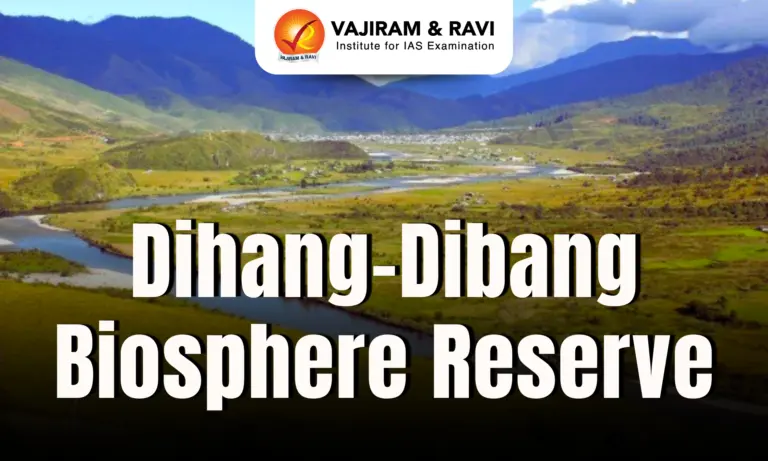
The Dihang-Dibang Biosphere Reserve, also known as Dehang-Debang Biosphere Reserve, is one of India’s most ecologically rich and biologically diverse protected landscapes. It was established in 1998, and the reserve is located in the northeastern state of Arunachal Pradesh and represents a unique transition zone between tropical forests and the high-altitude ecosystems of the Eastern Himalayas. Its remarkable altitudinal variation and rich biodiversity make it one of the most important conservation areas in India.
Dihang-Dibang Biosphere Reserve Geographical Features
The Dihang-Dibang Biosphere Reserve is characterized by rugged Himalayan mountains, deep river valleys, dense forests, and a wide altitudinal range that supports diverse ecosystems.
- Spread across the Dibang Valley, Upper Siang, and West Siang districts.
- Situated in the Eastern Himalayas and Mishmi Hills region.
- Named after the Dihang (Siang) River and Dibang River.
- Features steep mountain slopes, deep gorges, and narrow valleys.
- Altitude ranges from low-lying river valleys to peaks exceeding 5,000 meters above sea level.
- Contains numerous rivers, streams, and important watershed areas feeding the Brahmaputra River Basin.
- Exhibits diverse landforms, including tropical forests, temperate forests, alpine meadows, and snow-covered mountains.
- Experiences varied climatic conditions due to significant differences in elevation.
- Functions as an important ecological corridor, connecting various Himalayan habitats and supporting rich biodiversity.
Major Protected Areas within the Biosphere Reserve
The Dihang-Dibang Biosphere Reserve includes some of the most important protected landscapes of the Eastern Himalayas, which play a crucial role in conserving the region’s rich biodiversity and fragile ecosystems.
1. Mouling National Park
- Mouling National Park is located in the Upper Siang and West Siang districts of Arunachal Pradesh.
- Constitutes the core zone of the Dihang-Dibang Biosphere Reserve.
- Established to protect the rich biodiversity of the Eastern Himalayas.
- Named after Mouling Peak, a prominent mountain in the region.
- Characterized by rugged terrain, steep slopes, and dense forests.
- Elevation varies from low-lying valleys to high mountain areas.
- Vegetation includes subtropical broadleaf forests, temperate forests, and sub-alpine vegetation.
- Traversed by several streams and tributaries of the Siang River.
- Supports mammals such as the red panda, Mishmi takin, clouded leopard, serow, and Asiatic black bear.
- Rich diversity of birds, reptiles, amphibians, and insects can be found in the park.
- Experiences heavy rainfall due to the influence of the southwest monsoon.
- Remains one of the least disturbed forest ecosystems in northeastern India.
2. Dibang Wildlife Sanctuary
- Dibang Wildlife Sanctuary is located in the Dibang Valley district of Arunachal Pradesh.
- Covers a vast area of mountainous terrain and dense forests.
- Shares ecological continuity with the Mishmi Hills region.
- Features a wide altitudinal gradient ranging from tropical forests to alpine habitats.
- Contains deep river gorges, glacial streams, and high-altitude meadows.
- Home to several rare and endangered wildlife species.
- Supports populations of Musk Deer, Red Goral, Gongshan Muntjac, Tiger, and Snow Leopard in higher elevations.
- Provides suitable habitat for the Mishmi Takin, a flagship species of the region.
- Rich in avian diversity, including Sclater’s Monal and Blyth’s Tragopan.
- Contains extensive stretches of bamboo forests, an important food source for many species.
- Supports numerous medicinal plants and endemic flora.
- Includes remote and inaccessible areas that remain largely unexplored by scientists.
- Experiences climatic conditions ranging from humid subtropical to alpine cold deserts.
- Forms one of the largest contiguous forest landscapes in the Eastern Himalayan region.


Vegetation of Dihang-Dibang Biosphere Reserve
The Dihang-Dibang Biosphere Reserve possesses one of the most diverse vegetation profiles in India due to its vast altitudinal variation, ranging from tropical river valleys to snow-covered Himalayan peaks. The reserve is particularly known for its uninterrupted vegetation succession from tropical evergreen forests to alpine tundra, making it a unique ecological landscape in the Eastern Himalayas.
1. Sub-Tropical Broad-Leaved Forests
- Found at elevations of approximately 500–1,800 meters.
- Dominated by evergreen tree species such as Castanopsis, Schima, Michelia, and Lauraceae.
- Characterized by dense canopy cover and high rainfall.
- Rich in epiphytic orchids, mosses, lichens, and climbers.
- Supports numerous species of butterflies, birds, and mammals.
- Acts as an important carbon sink and water conservation zone.
- Provides habitat for the Asiatic Black Bear, Clouded Leopard, and various primates.
2. Sub-Tropical Pine Forests
- Occur mainly between 1,000-2,000 meters elevation.
- Dominated by Chir Pine (Pinus roxburghii) and other pine species.
- Thrive in relatively drier mountain slopes.
- Characterized by open forest structure and needle-covered forest floors.
- Help prevent soil erosion on steep hillsides.
- Serve as nesting grounds for several bird species.
- Support diverse shrub and grass communities.
3. Temperate Broad-Leaved Forests
- Found between 1,800–3,000 meters elevation.
- Dominated by oak, maple, magnolia, birch, and chestnut species.
- Experience cool temperatures and abundant moisture.
- Possess rich layers of shrubs, herbs, and ferns.
- Home to species such as the Red Panda and Musk Deer.
- Known for spectacular seasonal foliage changes.
- Support a large number of medicinal and aromatic plants.
4. Temperate Conifer Forests
- Occur in higher elevations above the broad-leaved forests.
- Dominated by Fir (Abies), Spruce (Picea), Hemlock (Tsuga), and Juniper species.
- Adapted to cold climates and heavy winter snowfall.
- Characterized by tall evergreen trees and dense forest cover.
- Provide important habitat for Mishmi Takin, Red Goral, and Himalayan pheasants.
- Contribute significantly to watershed protection.
- Help regulate local climate and moisture levels.
5. Sub-Alpine Woody Shrub Vegetation
- Found near the tree line between forests and alpine meadows.
- Dominated by Rhododendron, Juniper, and dwarf shrub species.
- Experiences low temperatures and strong winds.
- Represents a transition zone between forest and tundra ecosystems.
- Produces colorful flowering landscapes during spring and summer.
- Provides shelter and forage for mountain wildlife.
- Contains several endemic Himalayan plant species.
6. Alpine Meadows (Mountain Tundra)
- Occur above the tree line at elevations exceeding 3,500–4,000 meters.
- Characterized by grasses, sedges, herbs, and dwarf flowering plants.
- Covered by snow for a major part of the year.
- Support seasonal grazing by wild herbivores.
- Known for rich alpine floral diversity during summer months.
- Contain species adapted to extreme climatic conditions.
- Serve as important habitats for high-altitude mammals and birds.
7. Bamboo Brakes
- Widely distributed across subtropical and temperate zones.
- Dominated by various species of Himalayan bamboo.
- Form dense thickets in valleys and mountain slopes.
- Provide food, shelter, and nesting sites for wildlife.
- Essential for the survival of the Red Panda.
- Help stabilize fragile mountain soils.
- Regenerate quickly after natural disturbances.
Dihang-Dibang Biosphere Reserve Flora & Fauna
The Dihang-Dibang Biosphere Reserve supports an extraordinary diversity of plant and animal life due to its wide range of habitats, from tropical forests to alpine meadows. It is considered one of the most important biodiversity-rich regions of the Eastern Himalayas.
Flora
- The reserve contains an unbroken vegetation sequence from tropical evergreen forests to alpine tundra, making it botanically unique.
- Rich in Orchids, Rhododendrons, Magnolia, Oak, Maple, Fir, Spruce, and Juniper species.
- Extensive Bamboo forests occur across different altitudinal zones and provide important wildlife habitat.
- Home to numerous medicinal and aromatic plants used in traditional healthcare systems.
- Supports a diverse range of ferns, mosses, lichens, and other lower plant groups due to high humidity and rainfall.
- Contains several rare, endemic, and threatened plant species characteristic of the Eastern Himalayan biodiversity hotspot.
Fauna
- The reserve is home to rare mammals such as the Mishmi Takin, Red Panda, Musk Deer, Red Goral, and Gongshan Muntjac.
- Carnivores found in the region include the Tiger, Clouded Leopard, Snow Leopard, and Asiatic Black Bear.
- Rich bird diversity includes globally important species such as Sclater’s Monal and Blyth’s Tragopan.
- The forests and river valleys support numerous species of hornbills, pheasants, eagles, woodpeckers, and laughing thrushes.
- The biosphere reserve is known for the discovery of the Mechuka Giant Flying Squirrel and Mishmi Hills Giant Flying Squirrel, highlighting its unexplored wildlife wealth.
- Diverse habitats support a wide variety of reptiles, amphibians, insects, and other endemic Himalayan fauna, contributing to the reserve’s exceptional biodiversity.
Conservation Measures
Various conservation initiatives have been implemented in the Dihang-Dibang Biosphere Reserve to protect its rich biodiversity, fragile ecosystems, and endangered wildlife species from increasing environmental and human-induced pressures.
- Strengthening the management of Mouling National Park and Dibang Wildlife Sanctuary through regular monitoring and patrolling.
- Implementing anti-poaching measures to protect endangered species such as the Red Panda, Mishmi Takin, and Musk Deer.
- Conducting biodiversity surveys and scientific research to document flora, fauna, and ecosystem changes.
- Promoting community-based conservation by involving local tribal communities in sustainable resource management.
- Protecting critical wildlife habitats and ecological corridors to ensure the free movement of animals.
- Encouraging afforestation and habitat restoration programs in degraded forest areas.
- Conserving rare and endemic plant species through habitat protection and ecological monitoring.
- Raising public awareness through environmental education and conservation campaigns.
- Monitoring the impacts of climate change on high-altitude ecosystems and wildlife populations.
- Regulating developmental activities to minimize habitat fragmentation and ecological disturbance.

 Last updated on Oct, 2026
→ UPSC 2027 Notification will be released on 13 January 2027 at upsconline.nic.in.
→ Check Nobel Prize 2026 Winners List here.
→ Download PIB PRiSM Monthly Magazine 2026 here.
→ Check UPSC Monthly Current Affairs Magazine The Recitals here.
→ Check out the latest UPSC Syllabus here.
→ Download UPSC Model Answers for Mains 2026
→ UPSC Mains Question Paper 2026 is out now for Essay & GS Paper 1, 2, 3 & 4.
→ UPSC Calendar 2027 has been released.
→ Enroll in Vajiram & Ravi’s UPSC Mains Test Series 2027 for structured answer writing practice, expert evaluation, and exam-oriented feedback.
→ Join Vajiram & Ravi’s UPSC Mentorship Program 2027 for personalized guidance, strategy planning, and one-to-one support from experienced mentors.
→ Go through the UPSC Mains Previous Year Papers to enhance your preparation.
→ UPSC has released UPSC Toppers List 2025 with the Civil Services final result on its official website.
→ Also check Best UPSC Coaching in India
Dihang-Dibang Biosphere Reserve FAQs
Q1. When was the Dihang-Dibang Biosphere Reserve established?+
Q2. Where is the Dihang-Dibang Biosphere Reserve located?+
Q3. Which protected areas are included in the Dihang-Dibang Biosphere Reserve?+
Q4. Why is the Dihang-Dibang Biosphere Reserve important?+
Q5. Which are the major animals found in the Dihang-Dibang Biosphere Reserve?+
Q6. Notable animals include the Mishmi Takin, Red Panda, Musk Deer, Red Goral, Asiatic Black Bear, Clouded Leopard, and Tiger.+
Q7. The reserve contains sub-tropical broad-leaved forests, sub-tropical pine forests, temperate broad-leaved forests, temperate conifer forests, sub-alpine shrublands, alpine meadows, bamboo brakes, and grasslands.+
Tags: dihang dibang biosphere reserve geography geography notes