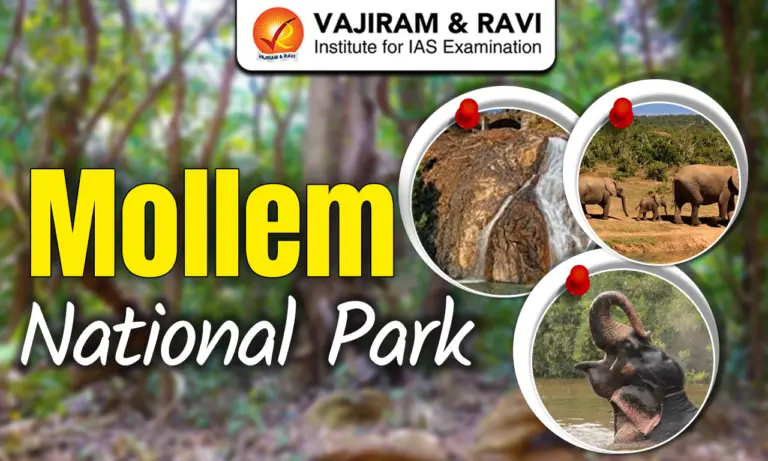
Mollem National Park is a protected forest area located in the state of Goa, known for its natural beauty, rich biodiversity, and dense tropical forests. It forms an important part of the Western Ghats, one of the world’s major biodiversity hotspots. The park provides habitat for a wide variety of plants, animals, and birds, and plays a key role in maintaining ecological balance. It is also popular for its scenic landscapes, waterfalls, and peaceful environment, making it important for both conservation and eco-tourism.
About Mollem National Park
- Mollem National Park is located in Goa within the Western Ghats, a globally recognized biodiversity hotspot known for its rich ecological wealth and high species diversity.
- It forms the core of the Bhagwan Mahavir Wildlife Sanctuary, making it a key protected area for conservation in the region.
- The park is characterized by dense forests, rivers, waterfalls, and rugged terrain, providing both ecological importance and scenic beauty.
- It supports a wide variety of flora and fauna, including several rare, endemic, and endangered species.
- The park plays an important role in eco-tourism, environmental education, and scientific research, attracting nature lovers and researchers.
- It also contributes to regional climate stability and water conservation, benefiting nearby areas.
Also Read : National Parks in Goa
Mollem National Park Location & Area
- Located in the Dharbandora/Sanguem region of eastern Goa, the park lies close to the Karnataka border, forming part of a larger forest ecosystem.
- It covers about 107 sq. km, while the sanctuary extends to nearly 240 sq. km, making it the largest protected forest area in Goa.
- The park is well connected to cities like Panaji and Margao, improving accessibility for tourism and management.
- The Mormugao-Londa railway line and highways pass through the forest, showing the interaction between development and ecology.
- Its location in the Western Ghats results in high rainfall, fertile soil, and thick vegetation, supporting rich biodiversity.
- The area also serves as an important wildlife corridor connecting different forest regions.


Mollem National Park History
- Initially known as the Mollem Game Sanctuary, the area was historically protected for wildlife conservation.
- In 1969, it was declared the Bhagwan Mahavir Wildlife Sanctuary, strengthening legal protection.
- In 1978, the core area was upgraded to Mollem National Park for stricter conservation measures.
- The aim was to protect the unique biodiversity of the Western Ghats and prevent habitat loss.
- Over time, it has become a center for conservation programs, biodiversity research, and eco-tourism development.
- Government initiatives and policies have helped improve wildlife protection and habitat management.
Mollem National Park Physical Features
- The park has a diverse landscape of hills, valleys, rivers, and dense forests, creating multiple habitats for wildlife.
- It lies at the foothills of the Western Ghats, resulting in heavy rainfall and lush green surroundings.
- Several perennial rivers and streams flow through the park, supporting aquatic and terrestrial life.
- Dense forest cover in some areas is so thick that sunlight barely reaches the ground, maintaining a cool microclimate.
- Famous natural attractions include Dudhsagar Waterfalls, Tambdi Falls, and Devil’s Canyon, which enhance its scenic appeal.
- The varied terrain supports both lowland and hill species, increasing biodiversity.
Mollem National Park Flora
- The park mainly consists of tropical evergreen, semi-evergreen, and moist deciduous forests.
- Dominant tree species include teak, Terminalia, bamboo, Lagerstroemia, and Xylia, which are ecologically and economically important.
- It supports more than 700 flowering plant species, many of which are endemic to the Western Ghats.
- The dense vegetation provides food, shelter, and breeding grounds for wildlife throughout the year.
- Forest cover helps in soil conservation, prevention of erosion, and maintenance of water cycles.
- It also plays an important role in carbon storage and climate regulation.
Mollem National Park Wildlife (Fauna)
- The park is home to animals like leopards, elephants, gaur (Indian bison), sambar, and deer, forming a strong wildlife base.
- Carnivores such as leopard cat, jungle cat, wild dog, and jackal are also found here.
- Smaller mammals include civets, monkeys, giant squirrels, and flying squirrels, adding to species diversity.
- Reptiles like king cobra, Indian rock python, vipers, and other snakes are commonly found.
- The park has over 120 bird species, including hornbills, flycatchers, eagles, and woodpeckers, making it ideal for birdwatching.
- Rich biodiversity makes the park suitable for scientific research and wildlife studies
Mollem National Park Biodiversity & Ecological Importance
- Being part of the Western Ghats (a global biodiversity hotspot), the park contributes significantly to global biodiversity conservation by protecting unique and endemic species.
- It helps maintain ecological balance by supporting complex food chains and trophic interactions, ensuring stability in predator–prey relationships.
- The dense forests act as a carbon sink, absorbing large amounts of carbon dioxide and helping in mitigating climate change.
- The park plays a key role in regulating water cycles, maintaining river flow, groundwater recharge, and rainfall patterns, which support nearby agriculture and human settlements.
- It protects several endemic and endangered species, thereby preventing biodiversity loss and species extinction.
- Supports essential ecosystem services such as pollination, seed dispersal, and nutrient cycling, which are crucial for forest regeneration.
- Acts as a natural buffer against climate change impacts, reducing the effects of floods, droughts, and temperature extremes.
- The forest ecosystem helps in soil conservation and prevention of land degradation, reducing erosion during heavy rainfall.
- It serves as an important wildlife corridor, enabling movement and genetic exchange between animal populations.
- The park contributes to local livelihoods by supporting eco-tourism and providing sustainable ecosystem benefits.
Mollem National Park Challenges
- Infrastructure Development Pressure such as railway doubling, highways, and power projects leads to habitat fragmentation and disrupts wildlife corridors.
- Human-Wildlife Conflict is increasing due to encroachment and proximity of settlements, leading to crop damage, livestock loss, and threats to human safety.
- Mining and Industrial Activities (in surrounding areas) create pollution, deforestation, and ecological degradation, indirectly affecting the park’s ecosystem.
- Deforestation and Encroachment for agriculture and settlements reduce forest cover and biodiversity, putting pressure on natural habitats.
- Tourism Pressure, if not properly regulated, leads to waste generation, noise pollution, and disturbance to wildlife behavior.
- Climate Change Impacts such as irregular rainfall, rising temperatures, and extreme weather events affect vegetation patterns and wildlife survival.
- Poaching and Illegal Activities like hunting and resource extraction still pose a threat despite conservation measures.
- Fragmentation of Wildlife Corridors restricts animal movement, breeding, and genetic exchange, weakening long-term species survival.
- Limited Resources and Management Challenges such as lack of adequate staff, funding, and infrastructure hinder effective conservation efforts.
- Conflicts Between Development and Conservation create policy challenges, especially in balancing economic growth with environmental protection.
- Inter-state Coordination Issues (Goa-Karnataka region) affect landscape-level conservation and wildlife movement.
Mollem National Park Conservation Measures
- Sustainable Infrastructure Development: Projects like railways and highways should follow Environmental Impact Assessment (EIA) norms, with eco-bridges, wildlife corridors, and underpasses to reduce habitat fragmentation and ensure safe animal movement.
- Strengthening Protection & Anti-Poaching Efforts: Use of modern surveillance techniques such as camera traps, drones, and regular patrolling helps prevent poaching and illegal activities, ensuring wildlife safety.
- Community Participation & Awareness: Involving local communities through eco-tourism, awareness programs, and alternative livelihood options reduces dependence on forest resources and promotes sustainable conservation practices.
- Human-Wildlife Conflict Mitigation: Implementation of compensation schemes, early warning systems, and habitat improvement helps reduce conflicts between humans and wildlife.
- Regulated Eco-Tourism: Promoting responsible tourism through carrying capacity limits, waste management, and eco-friendly practices minimizes disturbance to wildlife and preserves natural habitats.
- Forest Conservation & Habitat Restoration: Afforestation and reforestation programs help restore degraded areas, strengthen wildlife corridors, and enhance biodiversity.
- Control of Mining & Industrial Activities: Strict enforcement of environmental laws in surrounding areas helps prevent pollution, deforestation, and ecological degradation.
- Climate-Resilient Conservation Strategies: Measures like water conservation, habitat management, and biodiversity monitoring help the park adapt to climate change impacts such as irregular rainfall and temperature rise.

 Last updated on Oct, 2026
→ UPSC 2027 Notification will be released on 13 January 2027 at upsconline.nic.in.
→ Check Nobel Prize 2026 Winners List here.
→ Download PIB PRiSM Monthly Magazine 2026 here.
→ Check UPSC Monthly Current Affairs Magazine The Recitals here.
→ Check out the latest UPSC Syllabus here.
→ Download UPSC Model Answers for Mains 2026
→ UPSC Mains Question Paper 2026 is out now for Essay & GS Paper 1, 2, 3 & 4.
→ UPSC Calendar 2027 has been released.
→ Enroll in Vajiram & Ravi’s UPSC Mains Test Series 2027 for structured answer writing practice, expert evaluation, and exam-oriented feedback.
→ Join Vajiram & Ravi’s UPSC Mentorship Program 2027 for personalized guidance, strategy planning, and one-to-one support from experienced mentors.
→ Go through the UPSC Mains Previous Year Papers to enhance your preparation.
→ UPSC has released UPSC Toppers List 2025 with the Civil Services final result on its official website.
→ Also check Best UPSC Coaching in India
Mollem National Park FAQs
Q1. What is Mollem National Park famous for?+
Q2. Where is Mollem National Park located?+
Q3. Why is Mollem National Park important for biodiversity?+
Q4. What types of vegetation are found in Mollem National Park?+
Q5. What wildlife can be found in Mollem National Park?+
Tags: environment environment notes mollem national park