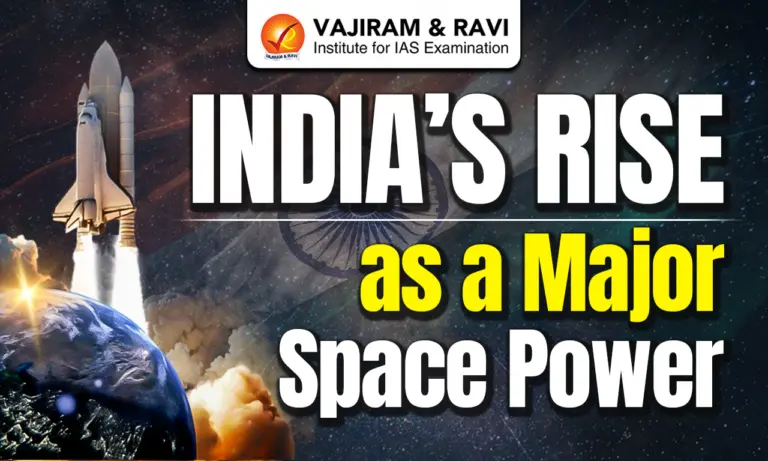
India’s space journey over the last 12 years reflects the spirit of Vishwas, Vikas and Jan Kalyan. Driven by Aatmanirbhar Bharat, Make in India and the vision of Viksit Bharat 2047, the nation has emerged as a leading space power through landmark missions, indigenous technological capabilities, private-sector participation and expanding international partnerships. Space technology today supports governance, economic growth, national security and citizen welfare, making it an essential component of India’s development trajectory.
Expanding India’s Space Capability
India has significantly strengthened its scientific and technological capabilities through ambitious space missions, advanced launch vehicles and indigenous technologies.
Lunar Exploration
- Chandrayaan-1 (2008) discovered water molecules on the Moon and provided crucial insights into the lunar surface and exosphere.
- Chandrayaan-2 (2019) generated high-resolution images of the lunar surface and significantly expanded scientific understanding of the Moon.
- Chandrayaan-3 (2023) made India the first country to achieve a soft landing near the lunar south pole and the fourth nation to successfully soft-land on the Moon. Scientific instruments onboard Chandrayaan-3 confirmed the presence of sulphur through direct elemental analysis.
- Chandrayaan-4 (2027) aims to bring lunar samples back to Earth.
- LUPEX/Chandrayaan-5, in collaboration with Japan, will explore water ice and volatile resources in permanently shadowed lunar regions.
Interplanetary Missions
- Mars Orbiter Mission (Mangalyaan): India became the first country to reach Mars orbit on its maiden attempt and demonstrated cost-effective deep-space mission capability.
- Venus Orbiter Mission: Scheduled for 2028, the mission will study Venusian geology, atmosphere and climate dynamics, expanding India’s planetary exploration programme.
Solar and Space Science Missions
- Aditya-L1: India’s first solar observatory placed at the Sun-Earth L1 Lagrange Point studies the solar corona, solar winds and space weather, with over 27 TB of scientific data already released.
- AstroSat and XPoSat: These missions have strengthened India’s capabilities in multi-wavelength and X-ray astronomy, contributing to global scientific research.
Human Spaceflight and Orbital Infrastructure
- Gaganyaan Mission: India’s first human spaceflight programme aims to send Indian astronauts into Low Earth Orbit, placing India among the few nations with independent human spaceflight capability.
- Axiom-4 Mission: Group Captain Shubhanshu Shukla’s participation provided valuable operational experience in astronaut training, microgravity research and human spaceflight systems.
- Bharatiya Antariksh Station (BAS): India’s planned space station, expected to begin with its first module by 2028, will support long-duration human missions and advanced scientific research.
Space Docking and Advanced Technologies
India achieved a major technological milestone through SPADEX (Space Docking Experiment).
- India became the fourth nation after the USA, Russia and China to demonstrate autonomous docking and undocking in space.
- Successful testing of the indigenous Bharatiya Docking System enables future missions such as Gaganyaan, Chandrayaan-4 and Bharatiya Antariksh Station.
Commercialisation: Expanding India’s Space Economy
- India’s space economy is currently valued at around $8 billion and is expected to grow five-fold to $40-45 billion, raising India’s share in the global space economy from 2-3% to nearly 8%.
- To boost commercialisation, the Government established NewSpace India Limited (NSIL) in 2019 for commercial utilisation of ISRO technologies and Indian National Space Promotion and Authorisation Centre (IN-SPACe) in 2022 to promote and regulate private sector participation.
- These reforms have delivered strong results, with NSIL’s revenue increasing from ₹321.77 crore in FY 2021–22 to ₹3,246.09 crore in FY 2024–25, reflecting growing global demand for Indian launch and satellite services.
- Private participation has expanded rapidly, as IN-SPACe facilitated 71 technology transfers from ISRO to industries and startups, while private entities launched 18 satellites and flew 25 payloads through the PSLV Orbital Experimental Module (POEM) platform.
- Further reforms such as the approval of an Earth Observation satellite constellation under the Public-Private Partnership (PPP) model and transfer of Small Satellite Launch Vehicle (SSLV) technology to Hindustan Aeronautics Limited (HAL) are creating a globally competitive and innovation-driven space ecosystem in India.


Self-Reliance in Space Transportation
- India has achieved self-reliance in space transportation through the Polar Satellite Launch Vehicle (PSLV), Geosynchronous Satellite Launch Vehicle (GSLV) and Launch Vehicle Mark-3 (LVM3), enabling the country to independently launch satellites for communication, navigation, Earth observation and space exploration missions.
- To meet future requirements, the Government has approved the Next Generation Launch Vehicle (NGLV), which will significantly enhance payload capacity and support ambitious missions such as human spaceflight, lunar exploration and future space station operations.
- India is also expanding its launch infrastructure with a second spaceport at Kulasekarapattinam (Tamil Nadu), the Small Satellite Launch Vehicle (SSLV) Complex, and the Third Launch Pad at Sriharikota, strengthening the country’s ability to undertake a larger number of launches every year.
- Simultaneously, the Indian Space Research Organisation (ISRO) is developing advanced propulsion technologies such as Electric Propulsion Systems (EPS), upgraded cryogenic engines and semi-cryogenic systems, which will improve mission efficiency, reduce costs and extend satellite life.
- A major focus is on reusable space transportation through the Reusable Launch Vehicle–Technology Demonstrator (RLV-TD) programme, which has successfully demonstrated autonomous runway landings and is expected to reduce the cost of accessing space in the future.
- India’s self-reliance has further deepened through indigenous technologies such as the VIKRAM3201 space microprocessor and KALPANA32 processor, reducing dependence on foreign electronic components and strengthening the country’s technological sovereignty in the space sector.
Global Partnerships and Space Diplomacy
India’s emergence as a major space power has been driven not only by indigenous achievements but also by strong international cooperation. Over the last decade, India has launched 399 foreign satellites and signed more than 300 space cooperation agreements with 61 countries and 5 multilateral organisations, enhancing its role as a trusted and responsible space partner.
India has also strengthened regional cooperation through the BIMSTEC Space Programme under its Neighbourhood First policy, supporting disaster management, weather forecasting, satellite applications, and capacity building across South Asia. Some of India’s most important collaborations include:
- NASA (USA): Joint development of the NISAR mission for Earth observation, climate monitoring, and disaster management.
- CNES (France): Partnership on the TRISHNA mission for monitoring agriculture, water resources, glaciers, and climate change.
- JAXA (Japan): Collaboration on Chandrayaan-5/LUPEX for exploring lunar water and resources near the Moon’s south pole.
- ROSCOSMOS (Russia): Support in astronaut training and human spaceflight technologies for the Gaganyaan mission.
- European Space Agency (ESA): Cooperation in future human spaceflight missions, astronaut training, and lunar exploration.
Beyond these, India has expanded strategic space partnerships with Germany, Italy, Saudi Arabia, Mauritius, and Bhutan in areas such as Earth observation, satellite communication, navigation, research, and commercial space activities.
India has also used space as an instrument of diplomacy through initiatives like the South Asia Satellite (GSAT-9), which provides communication, telemedicine, education, and disaster-management services to neighbouring countries.
These partnerships have transformed India from a participant in global space activities into a key collaborator shaping the future of space exploration, scientific research, and sustainable development.
Space Technology for Citizen Welfare and National Development
India’s space programme has increasingly focused on using technology for governance, development and citizen welfare.
- NavIC (Navigation with Indian Constellation): India’s indigenous navigation system provides accurate positioning and timing services across India and neighbouring regions, supporting train tracking, vehicle monitoring, Aadhaar geo-tagging, logistics, public safety, and strategic self-reliance.
- Data-Driven Governance: Geospatial platforms and satellite imagery are helping ministries and state governments improve planning, monitoring, and implementation of schemes such as Mahatma Gandhi National Rural Employment Guarantee Act (MGNREGA), Pradhan Mantri Gram Sadak Yojana (PMGSY), Pradhan Mantri Krishi Sinchayee Yojana (PMKSY), and Atal Mission for Rejuvenation and Urban Transformation (AMRUT).
- Food, Water and Livelihood Security: Satellite-based crop forecasting, drought assessment, yield estimation, and water-resource monitoring through the National Hydrology Project and India-Water Resources Information System (India-WRIS) strengthen agricultural productivity and water management.
- Disaster Management and Early Warning: Space-based systems provide real-time monitoring of cyclones, floods, landslides, forest fires, and other hazards through platforms such as the National Database for Emergency Management and Satellite Aided Search and Rescue (SASAR), improving preparedness and response.
- Support to Coastal Communities: Potential Fishing Zone (PFZ) advisories help fishermen identify productive fishing areas, reducing fuel costs and search time, while Indigenous Distress Alert Transmitters (DATs) enhance safety at sea.
- Healthcare Through Telemedicine: ISRO’s telemedicine network connects remote and high-altitude regions such as Ladakh, Siachen, and Jammu & Kashmir with specialist healthcare services, improving medical access in difficult terrains.
- Education Through Satellite Connectivity: Under PM e-VIDYA, educational content is delivered through 370 satellite-based television channels using GSAT satellites, extending quality learning opportunities to remote and underserved regions.
- Regional Development Through South Asia Satellite (GSAT-9): The satellite supports telemedicine, tele-education, weather forecasting, disaster management, and communication services across neighbouring countries, strengthening regional cooperation.
- Citizen-Centric Digital Platforms: Geoportals such as Bhuvan, Bhoonidhi, Meteorological and Oceanographic Satellite Data Archival Centre (MOSDAC), and Visualization of Earth Observation Data and Archival System (VEDAS) provide satellite-derived information for weather forecasting, infrastructure monitoring, flood management, and digital governance.
Through these applications, space technology has become a key enabler of inclusive development, strengthening governance, improving service delivery, and enhancing the quality of life for millions of citizens.

 Last updated on Oct, 2026
→ UPSC 2027 Notification will be released on 13 January 2027 at upsconline.nic.in.
→ Check Nobel Prize 2026 Winners List here.
→ Download PIB PRiSM Monthly Magazine 2026 here.
→ Check UPSC Monthly Current Affairs Magazine The Recitals here.
→ Check out the latest UPSC Syllabus here.
→ Download UPSC Model Answers for Mains 2026
→ UPSC Mains Question Paper 2026 is out now for Essay & GS Paper 1, 2, 3 & 4.
→ UPSC Calendar 2027 has been released.
→ Enroll in Vajiram & Ravi’s UPSC Mains Test Series 2027 for structured answer writing practice, expert evaluation, and exam-oriented feedback.
→ Join Vajiram & Ravi’s UPSC Mentorship Program 2027 for personalized guidance, strategy planning, and one-to-one support from experienced mentors.
→ Go through the UPSC Mains Previous Year Papers to enhance your preparation.
→ UPSC has released UPSC Toppers List 2025 with the Civil Services final result on its official website.
→ Also check Best UPSC Coaching in India
India’s Rise as a Major Space Power FAQs
Q1. What major space achievements have made India a leading space power?+
Q2. How is India strengthening its self-reliance in space transportation?+
Q3. How is India strengthening its self-reliance in space transportation?+
Q4. How does space technology help citizens in India?+
Q5. How has India expanded its global space partnerships?+