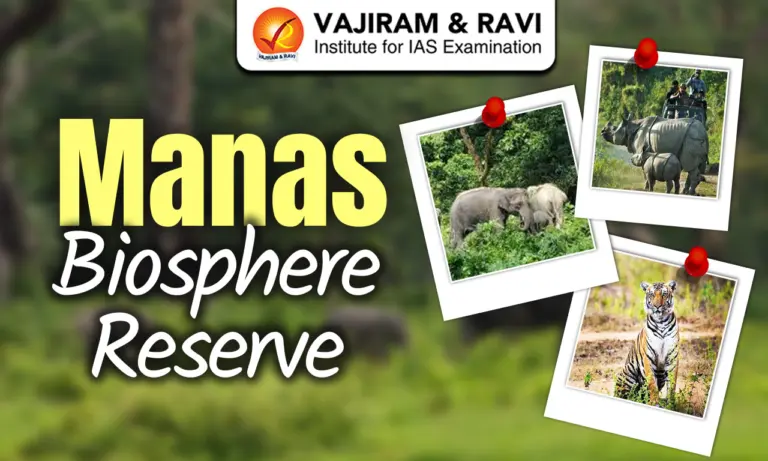
The Manas Biosphere Reserve is a protected natural area located in the state of Assam in northeastern India. It is known for its rich forests, grasslands, and diverse wildlife. The reserve plays an important role in nature conservation while also supporting local communities living nearby. It is recognized for its ecological importance and is home to many rare and endangered species, making it a valuable part of India’s natural heritage.
Manas Biosphere Reserve Location
- The park is located in the state of Assam, in the foothills of the Eastern Himalayas, and shares an international boundary with Royal Manas National Park, forming an important transboundary conservation landscape that allows free movement of wildlife.
- The Manas River, a major tributary of the Brahmaputra River, flows through the park and plays a crucial role in shaping its alluvial plains, grasslands, and riverine ecosystem, making the region highly fertile and ecologically dynamic.
- The area consists of a mix of low-lying floodplains and slightly elevated forested tracts, which together create a wide variety of natural habitats supporting diverse species.
Also Read : Biosphere Reserves in India
Manas Biosphere Reserve Historical Development & Status
- The region was first declared a Wildlife Sanctuary in 1950, marking the beginning of formal conservation efforts to protect its rich biodiversity and fragile ecosystems.
- In 1973, it was included under Project Tiger, making it one of the earliest Tiger Reserves in India, highlighting its importance as a critical habitat for the Bengal tiger.
- It was recognized as a UNESCO World Heritage Site in 1985 due to its exceptional natural beauty and high concentration of rare and endangered species.
- Later, it was designated as a Biosphere Reserve in 1989, aiming to balance conservation with sustainable use of resources and local community development.
- In 1990, it was upgraded to a National Park, which provided it with stronger legal protection and stricter conservation measures.


Manas Biosphere Reserve Physical Features & Climate
- The park experiences a tropical monsoon climate, with heavy rainfall during the monsoon season, which supports dense vegetation and maintains the ecological productivity of the region.
- Its landscape is characterized by semi-evergreen forests, moist deciduous forests, swamp forests, and extensive alluvial grasslands, making it one of the most diverse ecological zones in India.
- Seasonal flooding by the Manas River helps in nutrient replenishment of soil and sustains the grasslands, which are crucial for herbivorous animals.
Manas Biosphere Reserve Biodiversity
- Manas is considered a biodiversity hotspot, supporting a wide range of plant and animal species, many of which are rare, endemic, or endangered.
Fauna
- The park provides habitat to several endangered species such as the Bengal tiger, Indian elephant, one-horned rhinoceros, wild water buffalo, and clouded leopard, making it a key conservation site.
- It is especially famous for unique species like the pygmy hog, golden langur, hispid hare, and Assam roofed turtle, which are rarely found elsewhere in the world.
- The park supports around 60 species of mammals, over 500 species of birds, more than 40 reptiles, and several amphibians and fish, reflecting its rich faunal diversity.
- It is also an important habitat for rare birds like the Bengal florican and great hornbill, making it a paradise for birdwatchers.
Flora
- The vegetation includes a mix of semi-evergreen and deciduous forests along with grasslands, which support a large number of herbivores and maintain ecological balance.
- The area has a high diversity of plant species including trees, shrubs, herbs, climbers, orchids, and grasses, which provide food and shelter for wildlife.
Manas Biosphere Reserve Ecological Importance
- The park contains both grassland and forest biomes, which creates a variety of habitats and allows different species with diverse ecological needs to survive and coexist in the same region.
- It is known for having the only pure strain of wild water buffalo in India, making it extremely important for genetic conservation and preservation of original species characteristics.
- The presence of many Schedule I species under the Wildlife Protection Act, 1972 highlights its status as a high-priority conservation area requiring strict protection measures.
- Its location along the India-Bhutan international border improves ecological connectivity, allowing free movement of wildlife and supporting a larger, healthier ecosystem across boundaries.
- The park forms part of a transboundary conservation landscape with Royal Manas National Park, which strengthens biodiversity conservation at a regional and international level.
- The alluvial grasslands of Manas are among the most productive ecosystems, supporting large herbivores and, in turn, sustaining top predators like the tiger, thus maintaining a balanced food chain.
- It serves as a critical habitat for several endemic and rare species such as the pygmy hog, golden langur, and hispid hare, many of which are not found anywhere else in the world.
- The park acts as an important ecological corridor in the Eastern Himalayan region, linking different forest areas and helping in gene flow between wildlife populations.
- Seasonal flooding by the Manas River plays a vital role in nutrient cycling, soil fertility, and regeneration of grasslands, which maintains long-term ecosystem health.
- It contributes significantly to climate regulation and carbon sequestration, as its forests store large amounts of carbon and help in reducing the impact of climate change.
Manas Biosphere Reserve Cultural Aspects
- The park derives its name from the Manas River, associated with the serpent goddess Manasa, giving it strong cultural and mythological significance.
- Indigenous communities such as the Bodo and Adivasi tribes live in and around the reserve, and their lifestyle and traditions are closely linked with the forest ecosystem.
- These communities depend on forests for livelihoods like agriculture, fishing, and collection of forest produce, making them key stakeholders in conservation.
- The biosphere reserve concept promotes sustainable development, balancing environmental conservation with human needs.
- Local communities actively participate in community-based conservation, helping in wildlife protection and reducing illegal activities.
- Eco-tourism and conservation initiatives provide employment opportunities and support inclusive development while promoting awareness about biodiversity.
Threats & Challenges faced by Manas Biosphere Reserve
- Invasive species and grassland loss: The spread of invasive plants like Mikania and growth of woody vegetation are reducing native grasslands, which are important feeding areas for species like pygmy hog and rhino.
- Poaching and illegal hunting: Illegal killing of animals such as tiger, rhino, and wild buffalo still poses a threat and affects wildlife populations and conservation efforts.
- Encroachment and land use change: Expansion of agriculture and settlements near the reserve is leading to loss and fragmentation of forest areas, especially due to lack of a proper buffer zone.
- Human-wildlife conflict: Animals like elephants and tigers often enter nearby villages due to shrinking habitats, causing crop damage and conflicts with local communities.
- Changes in river flow and flooding: Activities like dams upstream and sudden water release disturb the natural flow of the Manas River, leading to floods, erosion, and habitat damage.
- Dependence on forest resources: Local use of forests for grazing, fuelwood, and fishing leads to gradual degradation of ecosystems and sometimes harms wildlife.
- Weak protection and staff shortage: Limited forest staff and resources reduce effective patrolling and make it harder to control poaching and illegal activities.
- Climate change effects: Changing rainfall patterns and rising temperatures are affecting vegetation, water availability, and overall ecosystem stability.
- Tourism pressure: Uncontrolled tourism can disturb wildlife and increase pollution if not managed properly.
Measures to Protect Manas Biosphere Reserve
- Community-led conservation efforts: Local communities, including Bodo groups, actively participate through Forest Protection Forces and conservation programs, helping reduce poaching and illegal logging while promoting a sense of ownership.
- Sustainable livelihoods and eco-development: Initiatives by organizations like the Wildlife Trust of India and eco-tourism groups provide alternative income sources, reducing dependence on forest resources.
- Transboundary cooperation with Bhutan: India works closely with Royal Manas National Park through joint patrolling and monitoring, ensuring protection of wildlife that moves across borders.
- Use of modern technology (SMART patrolling): Advanced systems like SMART monitoring help track wildlife movements, detect threats in real time, and improve overall protection efficiency.
- Habitat restoration and grassland management: Programs focus on removing invasive species and restoring grasslands, which are essential for animals like rhinos, pygmy hogs, and deer.
- Species reintroduction and conservation programs: Efforts such as translocation of rhinos and protection of endangered species have helped rebuild wildlife populations after past declines.
- Strong governance and zonation system: The reserve is divided into core, buffer, and transition zones, ensuring strict protection in critical areas while allowing sustainable human activities in others.
- Institutional support and management: Bodies like the Manas Tiger Conservation Foundation and Bodoland Territorial Council provide funding, infrastructure, and long-term conservation planning.
- Strengthening anti-poaching and security: Increasing forest staff, improving surveillance, and enhancing patrolling help control illegal hunting and protect endangered species.
- Human-wildlife conflict mitigation: Compensation schemes, awareness programs, and preventive measures help reduce conflicts between wildlife and nearby communities.

 Last updated on Oct, 2026
→ UPSC 2027 Notification will be released on 13 January 2027 at upsconline.nic.in.
→ Check Nobel Prize 2026 Winners List here.
→ Download PIB PRiSM Monthly Magazine 2026 here.
→ Check UPSC Monthly Current Affairs Magazine The Recitals here.
→ Check out the latest UPSC Syllabus here.
→ Download UPSC Model Answers for Mains 2026
→ UPSC Mains Question Paper 2026 is out now for Essay & GS Paper 1, 2, 3 & 4.
→ UPSC Calendar 2027 has been released.
→ Enroll in Vajiram & Ravi’s UPSC Mains Test Series 2027 for structured answer writing practice, expert evaluation, and exam-oriented feedback.
→ Join Vajiram & Ravi’s UPSC Mentorship Program 2027 for personalized guidance, strategy planning, and one-to-one support from experienced mentors.
→ Go through the UPSC Mains Previous Year Papers to enhance your preparation.
→ UPSC has released UPSC Toppers List 2025 with the Civil Services final result on its official website.
→ Also check Best UPSC Coaching in India
Manas Biosphere Reserve FAQs
Q1. What is Manas Biosphere Reserve famous for?+
Q2. Where is Manas Biosphere Reserve located?+
Q3. Why is Manas Biosphere Reserve ecologically important?+
Q4. What are the major threats to Manas Biosphere Reserve?+
Q5. How are local communities involved in conservation?+
Tags: environment environment notes manas biosphere reserve