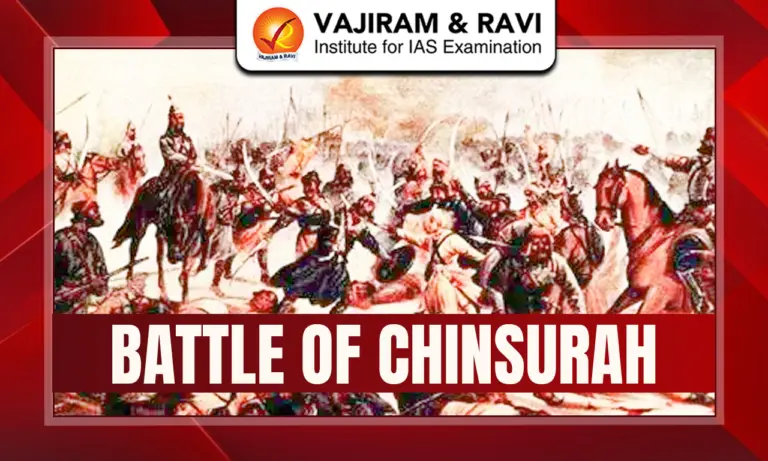
The Battle of Chinsurah was a historical conflict that took place during the period of European colonial rivalry in India. It reflected the struggle for trade dominance and political control among European powers, especially in the Bengal region. The battle is generally seen as part of the broader competition between colonial forces to expand their influence and secure economic interests in India.
About Battle of Chinsurah
- The Battle of Chinsurah was fought on 25 November 1759 in present-day Hooghly-Chinsurah.
- It took place during a period of intense rivalry among European powers competing for trade and political control in India.
- The conflict was mainly between the British East India Company and the Dutch East India Company.
- The battle reflected the growing struggle for dominance in Bengal, which was a rich and strategically important region.
- It became significant as it strengthened British power and reduced the influence of other European trading powers in eastern India.
Battle of Chinsurah Background
- After the Battle of Plassey, the British gained political control over Bengal by installing Mir Jafar as a puppet ruler.
- Over time, Mir Jafar became dissatisfied with British interference in administration, revenue collection, and trade policies.
- To counter British dominance, he secretly negotiated with the Dutch, hoping to use them as a balancing force.
- The Dutch already had an established presence in Chinsurah and wanted to revive their declining trade influence in Bengal.
- They sent troops and naval forces from Batavia (Indonesia), aiming to strengthen their military and commercial base.
- Bengal at that time was a rich economic region, known for textiles, agriculture, and river-based trade, attracting European competition.
- Earlier trade networks involving Armenian merchants and other groups had connected Bengal to global markets, but British dominance after 1757 began to replace these systems.


Battle of Chinsurah Causes
- Political Instability in Bengal: The rule of Mir Jafar was marked by weak leadership and heavy dependence on the British, which created widespread dissatisfaction among local elites and officials. This instability led to frequent conspiracies and power struggles, making Bengal politically fragile.
- Mir Jafar’s Secret Alliance: In an attempt to reduce British control, Mir Jafar secretly negotiated with the Dutch East India Company, directly challenging British authority and creating tensions that eventually contributed to the conflict.
- Dutch Ambitions: The Dutch aimed to revive their declining commercial influence in Bengal by strengthening their military presence. Their objective was to re-establish trade supremacy and compete with the growing dominance of the British.
- British Expansionist Policy: The British East India Company followed an aggressive policy of eliminating all European rivals, aiming to establish a complete monopoly over trade and political control in Bengal.
- Economic Importance of Bengal: Bengal was one of the richest regions in India, known for its textile production, fertile agriculture, and high revenue generation, which made it a highly attractive and contested area for European powers.
- Strategic Control of Trade Routes: Control over the Hooghly River and key ports was crucial for both trade and military movement, making it strategically important. Dominance over these routes meant economic advantage as well as military superiority in the region.
Also Read : British Territorial Expansionist Policies
Course of Battle of Chinsurah
- Naval Engagement (24 November 1759):
- British naval forces intercepted Dutch ships on the Hooghly River before they could fully organize.
- Several Dutch vessels were captured, damaged, or forced to surrender, weakening their strength.
- This early naval success gave the British a strategic advantage even before the land battle began.
- Land Battle (25 November 1759):
- The British forces were led by Francis Forde, commanding a relatively smaller army of around 1,100 soldiers.
- The Dutch army was larger but lacked coordination and effective leadership.
- The battle took place near Chinsurah and lasted for less than an hour, showing its swift and decisive nature.
- British troops used better tactics, discipline, and coordination, which helped them defeat the Dutch quickly.
- The Dutch suffered heavy casualties, and many soldiers were captured.
Result & Consequences of Battle of Chinsurah
- The British achieved a decisive victory in the Battle of Chinsurah, completely defeating the Dutch forces and eliminating them as a serious military threat in Bengal. This demonstrated the superiority of British military strategy, discipline, and coordination over other European powers operating in India.
- Following the defeat, the Dutch East India Company was forced to abandon its political and military ambitions in India and limit itself only to commercial activities, marking the decline of Dutch influence in the region.
- The victory significantly strengthened the position of the British East India Company, establishing it as the undisputed dominant power in Bengal and giving it greater confidence to expand its control further into Indian territories.
- It confirmed that no other European power could effectively challenge British authority in eastern India, thereby reducing colonial competition and allowing the British to move from trade dominance to political control.
- The battle reinforced the outcomes of the Battle of Plassey, consolidating British political supremacy and accelerating the process of territorial expansion and administrative control in Bengal.
- It also weakened the position of local rulers like Mir Jafar, making them increasingly dependent on British support, which further reduced their autonomy and turned them into puppet rulers under British influence.
Historical Significance of Battle of Chinsurah
- The Battle of Chinsurah is considered the second major milestone after the Battle of Plassey, as it further consolidated British supremacy in Bengal and removed the possibility of European rivalry in the region.
- It marked the clear decline of the Dutch East India Company in India, effectively ending its ambitions for political expansion and reducing it to a minor trading presence.
- The battle highlighted an important transition from trade-based competition to political control, where the British East India Company began laying the foundation of a colonial empire rather than just a commercial network.
- It demonstrated how internal conflicts and rivalries among Indian rulers, such as those involving Mir Jafar, were strategically exploited by European powers to strengthen their own position and expand influence.
- The decisive victory boosted British confidence, encouraging them to pursue aggressive territorial expansion and political intervention in other parts of India.
- Overall, the battle played a crucial role in shaping the future course of colonial rule in India, as it reinforced British dominance and paved the way for long-term imperial control and administrative expansion.

 Last updated on Oct, 2026
→ UPSC 2027 Notification will be released on 13 January 2027 at upsconline.nic.in.
→ Check Nobel Prize 2026 Winners List here.
→ Download PIB PRiSM Monthly Magazine 2026 here.
→ Check UPSC Monthly Current Affairs Magazine The Recitals here.
→ Check out the latest UPSC Syllabus here.
→ Download UPSC Model Answers for Mains 2026
→ UPSC Mains Question Paper 2026 is out now for Essay & GS Paper 1, 2, 3 & 4.
→ UPSC Calendar 2027 has been released.
→ Enroll in Vajiram & Ravi’s UPSC Mains Test Series 2027 for structured answer writing practice, expert evaluation, and exam-oriented feedback.
→ Join Vajiram & Ravi’s UPSC Mentorship Program 2027 for personalized guidance, strategy planning, and one-to-one support from experienced mentors.
→ Go through the UPSC Mains Previous Year Papers to enhance your preparation.
→ UPSC has released UPSC Toppers List 2025 with the Civil Services final result on its official website.
→ Also check Best UPSC Coaching in India
Battle of Chinsurah FAQs
Q1. What was the Battle of Chinsurah?+
Q2. When and where was the Battle of Chinsurah fought?+
Q3. What were the main causes of the Battle of Chinsurah?+
Q4. Who fought in the Battle of Chinsurah?+
Q5. What happened during the Battle of Chinsurah?+
Tags: battle of chinsurah history history notes