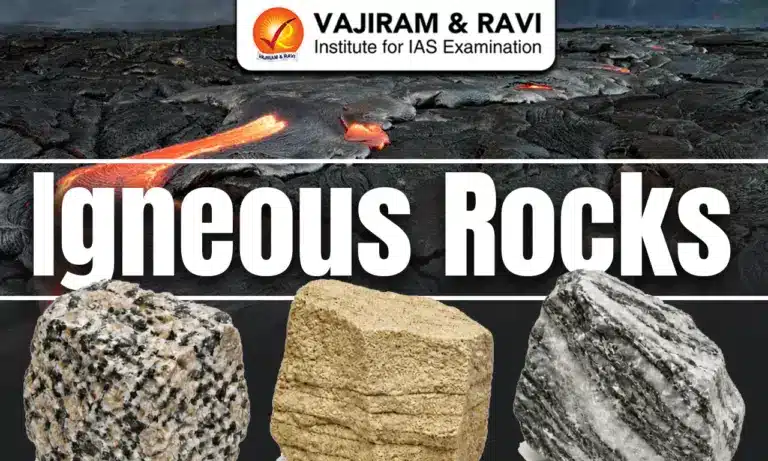
Igneous Rocks are one of the main types of rocks found on Earth. They are formed when hot molten material called magma (below the Earth’s surface) or lava (on the surface) cools and hardens. These rocks are often considered the “original” rocks because they are the first to form in the rock cycle, and other rocks can be made from them over time.
Igneous Rocks
- Rocks formed from the solidification of magma (molten rock below the surface) and lava (molten rock above the surface) are called Igneous Rocks or primary rocks.
- The term igneous is derived from a Latin word meaning “fire.”
- Magma refers to molten rock inside the Earth, while lava refers to molten rock that comes out onto the surface.
- Igneous Rocks are formed under high-temperature conditions and are unfossiliferous.
- Molten rock usually forms deep inside the Earth, especially near plate boundaries or hot spots, and then gradually moves upward.
- Based on the place and time taken for cooling, Igneous Rocks are of two types: plutonic rocks and volcanic rocks.
- Based on the presence of silicon (acid-forming radical), rocks are classified into acidic rocks and basic rocks.
- Examples of Igneous Rocks include granite, gabbro, and basalt.
Also Read : Types of Rocks
Classification of Igneous Rocks Based on Place of Cooling
The classification of Igneous Rocks based on the place of cooling explains how the location where magma or lava solidifies influences the type of rock formed. Based on this variation in place of cooling, Igneous Rocks are broadly categorized into types discussed below.
Intrusive Igneous Rocks (Plutonic Rocks)
- These rocks are formed when magma gets trapped deep inside the Earth and does not reach the surface.
- The trapped magma cools very slowly, sometimes taking thousands or even millions of years to solidify.
- Because of this slow cooling, mineral crystals get enough time to grow, making them large and clearly visible.
- These rocks have a coarse-grained texture, meaning you can easily see the grains with the naked eye.
- Intrusive rocks are also known as plutonic rocks.
- Common examples include granite, diorite, gabbro, and peridotite.
- A special type called pegmatite can have extremely large crystals, sometimes even bigger than a human hand.
Extrusive Igneous Rocks (Volcanic Rocks)
- These rocks form when magma comes out onto the Earth’s surface as lava and cools there.
- This usually happens during volcanic eruptions or through cracks (fissures) in the Earth’s crust.
- Since the lava is exposed to the cool air or water, it cools very quickly.
- Due to rapid cooling, crystals do not get much time to grow, so they remain very small or even invisible.
- These rocks have a fine-grained or glassy texture.
- Sometimes, gas bubbles get trapped in the lava, creating a bubbly (vesicular) texture.
- Common examples include basalt, rhyolite, andesite, and obsidian.
- Obsidian forms when lava cools almost instantly, giving it a glassy appearance with no crystals.
Also Read : Sedimentary Rock


Cooling and Texture of Igneous Rocks
- The speed at which magma or lava cools plays a very important role in deciding the texture, crystal size, and overall appearance of Igneous Rocks.
- When cooling happens slowly deep inside the Earth, minerals get enough time to grow into large, well-formed crystals, resulting in a coarse-grained texture, also known as phaneritic texture.
- These crystals are usually clearly visible to the naked eye, making such rocks look rough and grainy.
- When cooling happens quickly on or near the Earth’s surface, crystals do not get enough time to grow, so they remain very small or may not form at all.
- This leads to a fine-grained texture, called aphanitic texture, where individual crystals are too small to be seen without a microscope.
- In cases of extremely rapid cooling, such as when lava cools almost instantly, the rock may form a glassy texture with no crystals, like in obsidian.
- Sometimes, gases trapped in quickly cooling lava create small holes or bubbles, giving the rock a vesicular texture (for example, pumice).
Igneous Rocks Formation and Composition
- All Igneous Rocks begin as magma formed deep inside the Earth, mainly in the lower crust or upper mantle, where temperatures and pressure are extremely high.
- This magma forms due to processes like melting of rocks, movement of tectonic plates, or presence of hot spots.
- The composition of Igneous Rocks depends on the minerals present in the magma, which can vary in terms of silica content, temperature, and chemical makeup.
- Because of these differences, Igneous Rocks can range from light-colored (rich in silica) to dark-colored (rich in iron and magnesium).
- Even if two rocks originate from the same magma, they can look very different depending on how and where they cool.
- For example, slow cooling inside the Earth forms granite with large crystals, while rapid cooling on the surface forms rhyolite with very fine crystals.
- The environment of formation (inside or outside Earth) and rate of cooling together influence not only texture but also structure and mineral arrangement.
Igneous Rocks Chemical Components
- Most Igneous Rocks are mainly made up of silicate minerals, which are formed from silicon (Si) and oxygen (O). These two elements are the basic building blocks of most rocks in the Earth’s crust.
- In rare cases, Igneous Rocks can be rich in carbonates, but such examples are very uncommon. Therefore, most studies focus on silicate-based Igneous Rocks.
- Role of Silica in Rock Composition
- The amount of silica (SiO₂) present in magma is very important because it controls the chemical nature and appearance of the rock.
- Rocks with low silica content usually contain higher amounts of iron and magnesium, which makes them darker, heavier, and denser.
- These rocks generally have less sodium and potassium.
- Rocks with high silica content contain more sodium and potassium and less iron and magnesium, which makes them lighter in color.
- Other components like calcium oxide and alumina also change with silica content. Calcium is usually higher in rocks with moderate silica but decreases as silica increases further.
- Classification Based on Silica Content
- Igneous Rocks are commonly classified into different groups based on their silica percentage.
- Felsic (or silicic) rocks contain more than 66 percent silica and are usually light in color.
- Intermediate rocks contain about 55 to 66 percent silica and show a balance of light and dark minerals.
- Mafic rocks contain about 45 to 55 percent silica and are rich in iron and magnesium, giving them a darker appearance.
- Ultramafic rocks contain less than 45 percent silica and have very high amounts of iron and magnesium.
- The terms felsic and mafic are widely used to describe the chemical character of Igneous Rocks.
Classification of Igneous Rocks Based on Chemical Composition
Igneous Rocks can be broadly divided into acidic and basic rocks depending on the amount of silica and other elements present in them.
Acidic Igneous Rocks
- Acidic rocks contain a high proportion of silica, often up to about 70-80 percent, mainly in the form of minerals like quartz and feldspar. Other elements such as aluminium, alkalis, iron, and magnesium are present in smaller amounts. Because they lack heavy elements like iron and magnesium, these rocks are lighter in colour and less dense.
- The high silica content makes the magma thick and sticky, so it cools relatively quickly and does not flow very far. As a result, the lava tends to pile up near the source, leading to the formation of steep and high landforms like mountains and domes.
- These rocks are generally hard, compact, and massive in structure, which makes them resistant to weathering and erosion. Because of this strength, they often form the core of continental crust (sial region) and contribute to stable landforms.
- Common examples include granite, rhyolite, microgranite, and quartz-rich rocks, which mainly contain minerals such as quartz, feldspar, and biotite.
Basic Igneous Rocks
- Basic rocks contain a lower amount of silica, usually around 40-50 percent, and are rich in magnesium and iron, along with other elements like lime and aluminium. Due to the presence of these heavy elements, they are denser and darker in colour, often appearing black or dark grey.
- The low silica content makes the magma more fluid, allowing it to flow easily over long distances before cooling. This widespread flow of lava results in the formation of large flat landforms such as plateaus, like volcanic plateaus.
- These rocks are generally less hard compared to acidic rocks and are therefore more prone to weathering over time, which contributes to soil formation.
- Common examples include basalt, gabbro, and dolerite, which contain minerals like olivine, pyroxene, and feldspar. Because of their composition, they are also referred to as mafic rocks.
Igneous Rocks Significance
- Igneous Rocks are very important economically because they are a major source of valuable minerals and metals. Since they are formed from magma, many important ores are directly linked to these rocks and are mined for industrial use.
- Several useful minerals are found in Igneous Rocks, including iron, nickel, copper, lead, zinc, manganese, chromite, gold, platinum, and even diamonds. These minerals are widely used in industries like construction, manufacturing, electronics, and jewellery.
- Some Igneous Rocks contain special structures called amygdales, which are small, almond-shaped cavities formed by gas bubbles. Over time, these spaces get filled with useful minerals like quartz, calcite, and zeolites, increasing their economic value.
- The ancient rocks of the Indian Peninsula are especially rich in mineral resources, and many important mining areas are located in these regions. These deposits play a key role in the country’s mineral-based industries and economy.
- Igneous Rocks like granite are widely used as building materials because they are strong, durable, and available in attractive colours and textures. They are commonly used in construction, monuments, flooring, and decorative purposes.
- Basalt, another important igneous rock, is used in road construction and as railway ballast due to its hardness and resistance to weathering. This makes it useful for infrastructure development.
- Igneous Rocks also help in the formation of gemstones and precious stones, which are highly valuable in the jewellery industry and contribute to trade and exports.
- These rocks play a role in scientific and geological studies, helping in understanding the Earth’s interior and guiding the exploration of mineral resources.

 Last updated on Oct, 2026
→ UPSC 2027 Notification will be released on 13 January 2027 at upsconline.nic.in.
→ Check Nobel Prize 2026 Winners List here.
→ Download PIB PRiSM Monthly Magazine 2026 here.
→ Check UPSC Monthly Current Affairs Magazine The Recitals here.
→ Check out the latest UPSC Syllabus here.
→ Download UPSC Model Answers for Mains 2026
→ UPSC Mains Question Paper 2026 is out now for Essay & GS Paper 1, 2, 3 & 4.
→ UPSC Calendar 2027 has been released.
→ Enroll in Vajiram & Ravi’s UPSC Mains Test Series 2027 for structured answer writing practice, expert evaluation, and exam-oriented feedback.
→ Join Vajiram & Ravi’s UPSC Mentorship Program 2027 for personalized guidance, strategy planning, and one-to-one support from experienced mentors.
→ Go through the UPSC Mains Previous Year Papers to enhance your preparation.
→ UPSC has released UPSC Toppers List 2025 with the Civil Services final result on its official website.
→ Also check Best UPSC Coaching in India
Igneous Rocks FAQs
Q1. What are Igneous Rocks and how are they formed?+
Q2. What is the difference between intrusive and extrusive Igneous Rocks?+
Q3. How does cooling rate affect the texture of Igneous Rocks?+
Q4. What are felsic, mafic, intermediate, and ultramafic rocks?+
Q5. What is the difference between acidic and basic Igneous Rocks?+
Tags: geography geography notes igneous rocks