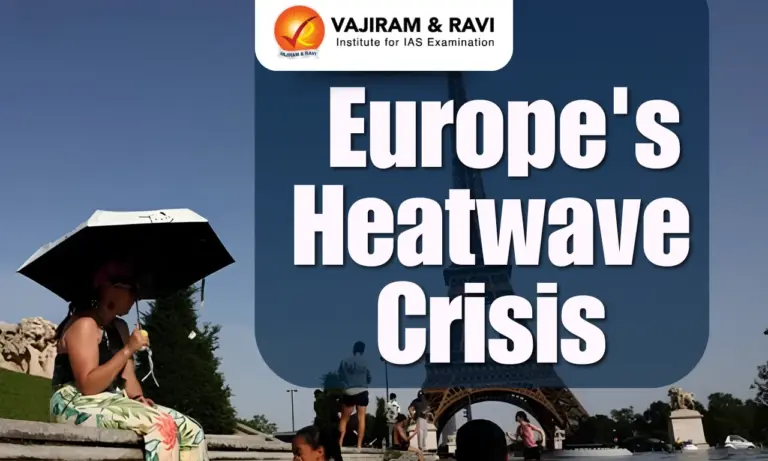
Europe’s Heatwave Crisis Latest News
- Western Europe is reeling under a severe heatwave in June 2026. Countries from the Netherlands, UK, France, and Italy to beyond have been affected. Around 50 people have died.
- France recorded its hottest day since record-keeping began in 1947 — hitting 44.3°C. Schools shut, public transport was disrupted, and air-conditioned cinemas and museums were opened as emergency shelters.
- Forty people drowned in France alone after seeking relief in unsupervised water bodies.
What Is Causing This Heat? The Omega Block
- The immediate cause of the heatwave is a meteorological phenomenon called the Omega Block — named because the resulting air pressure pattern resembles the Greek letter Ω.
- Normally, jet streams — high-altitude winds — blow steadily from west to east over Europe, moving weather systems along.
- When this flow gets disrupted, it develops large bends. A high-pressure zone builds in the middle, flanked by low-pressure zones on either side. This creates the omega shape.
- This high-pressure zone acts like a lid over the land. Warm air rising from the ground cannot escape into the upper atmosphere.
- It gets trapped near the surface and keeps heating up further. The result is prolonged, intense heat with no relief.
- This phenomenon is also called a Heat Dome. Its effects include suppressed cloud formation, no rainfall, prolonged sunshine, and rising temperatures through compressional heating — where sinking air heats up as it is compressed.


Why Is Europe Warming So Fast
- The Omega Block is an immediate trigger, but Europe’s deeper vulnerability is structural. As per the research reports, Europe is now the fastest-warming continent on Earth.
- Several factors are driving this accelerated warming.
- Industrialisation and Urban Heat Islands — Highly concretised urban areas absorb and retain heat far more than natural landscapes, creating localised zones of extreme temperature.
- The Albedo Effect — Albedo refers to how much sunlight a surface reflects back. The Arctic — the only region warming faster than Europe — is losing its bright white glacial ice rapidly. The darker Arctic Ocean water that replaces it absorbs heat instead of reflecting it, warming the surrounding region including northern Europe.
- Fracking and Fossil Fuel Activity — Continued extraction of oil and gas contributes to greenhouse gas emissions, further accelerating warming.
Why Is Europe So Badly Hit Despite “Only” 40°C
- Many parts of the world — including large parts of India — routinely experience temperatures above 40°C and continue to function.
- Europe’s vulnerability at the same temperature reveals a structural mismatch between its climate history and its current climate reality.
Infrastructure Built for Cold, Not Heat
- European homes — particularly in western Europe — were designed historically to retain heat during cold winters.
- They use thick stone, brick, and concrete — materials with high thermal mass that absorb and slowly release heat.
- In summer, these same walls trap heat indoors, turning homes into ovens. Air conditioning is far from common in most of western Europe.
Longer Daylight Hours
- Western Europe receives significantly more hours of sunlight than tropical regions.
- This means homes have very little time to cool down at night — especially when nights are barely cooler than the day.
Ageing Population
- Europe has one of the world’s oldest populations. Elderly people are far more vulnerable to heat-related illness, heatstroke, and death.
- This demographic reality dramatically amplifies the health impact of every heatwave.
Adaptation Lagging Behind Climate Risk
- While Europe has developed heat action plans and early-warning systems in recent years — largely in response to the catastrophic 2003 European heatwave that killed over 70,000 people — experts note that adaptation efforts continue to lag behind the accelerating pace of climate change.

 Last updated on Oct, 2026
→ UPSC 2027 Notification will be released on 13 January 2027 at upsconline.nic.in.
→ Asian Games 2026 are being held in Aichi-Nagoya, Japan, from 19 September to 4 October.
→ Check Nobel Prize 2026 Winners List here.
→ Download PIB PRiSM Monthly Magazine 2026 here.
→ Check UPSC Monthly Current Affairs Magazine The Recitals here.
→ Check out the latest UPSC Syllabus here.
→ Download UPSC Model Answers for Mains 2026
→ UPSC Mains Question Paper 2026 is out now for Essay & GS Paper 1, 2, 3 & 4.
→ UPSC Calendar 2027 has been released.
→ Enroll in Vajiram & Ravi’s UPSC Mains Test Series 2027 for structured answer writing practice, expert evaluation, and exam-oriented feedback.
→ Join Vajiram & Ravi’s UPSC Mentorship Program 2027 for personalized guidance, strategy planning, and one-to-one support from experienced mentors.
→ Go through the UPSC Mains Previous Year Papers to enhance your preparation.
→ UPSC has released UPSC Toppers List 2025 with the Civil Services final result on its official website.
→ Also check Best UPSC Coaching in India
Europe's Heatwave Crisis FAQs
Q1. What is causing Europe's Heatwave Crisis in 2026?+
Q2. Why is Europe's Heatwave Crisis becoming more frequent and intense?+
Q3. What is the role of the Omega Block in Europe's Heatwave Crisis?+
Q4. Why is Europe's Heatwave Crisis more severe despite temperatures comparable to other regions?+
Q5. What lessons does Europe's Heatwave Crisis offer for climate adaptation?+
Tags: Europe's Heatwave Crisis mains articles upsc current affairs upsc mains current affairs