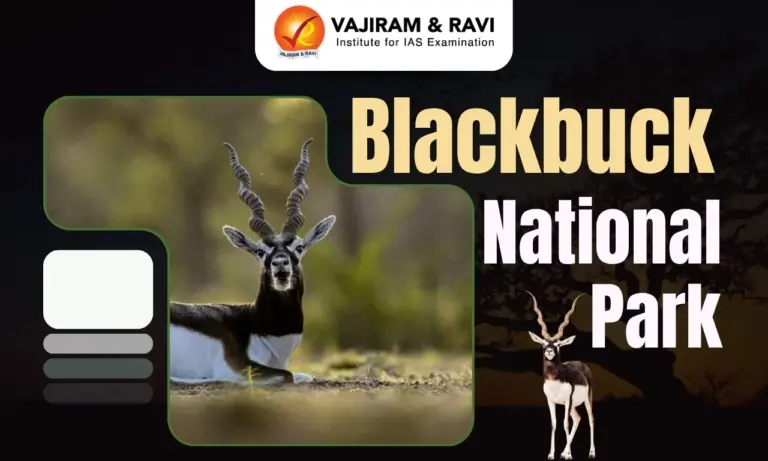
Blackbuck National Park, popularly known as Velavadar Blackbuck National Park, is one of India’s most important grassland protected areas. It is globally recognized for its thriving blackbuck population, significant Indian wolf habitat, and one of the world’s largest roosting sites for migratory harriers.
Blackbuck National Park Historical Background
The area was originally maintained as a royal grassland reserve by the Maharaja of Bhavnagar, who used it for hunting blackbucks with trained cheetahs. Recognising its ecological value, the government declared it a wildlife sanctuary and later expanded it into a national park in July 1976. Today, it is regarded as one of India’s finest examples of grassland conservation.
Blackbuck National Park Location and Geographical Features
- Blackbuck National Park is situated at Velavadar in Bhavnagar district of Gujarat, about 45 km from Bhavnagar city.
- It lies in the Bhal region of Saurashtra, near the Gulf of Khambhat (Cambay).
- The seasonal Parvalia and Alang rivers flow through the landscape, with the Alang River forming the southern boundary of the park.
- It falls within the semi-arid biogeographic zone and represents the Gujarat-Rajwada biotic province.
- The northern portion consists of open grasslands, while the southern region contains thorn scrub, saline flats, and tidal mudflats.


Blackbuck National Park Faunal Diversity
National Park is renowned for its rich wildlife diversity and serves as an important refuge for grassland mammals, carnivores, and migratory birds.
- Blackbuck (Antilope cervicapra): The park supports one of the largest and healthiest blackbuck populations in India; the species can run at speeds of nearly 80 km/h and is protected under Schedule I of the Wildlife (Protection) Act, 1972.
- Indian Wolf: Velavadar holds one of the most significant wolf populations among Indian protected areas, with the southern thorn-scrub region serving as an important breeding and denning habitat.
- Lesser Florican: This Critically Endangered grassland bird visits the park during the monsoon breeding season, making Velavadar one of its most important habitats in India.
- Other Mammals: Nilgai, Striped Hyena, Golden Jackal, Indian Fox, Jungle Cat and Wild Boar are commonly found in the park.
- Avifauna: Flamingoes, Pelicans, Painted Storks, White Storks and large numbers of migratory Harriers use the park and adjoining wetlands as feeding and roosting grounds.
Blackbuck National Park Floral Diversity
The flora of Blackbuck National Park reflects its unique semi-arid grassland ecosystem and plays a crucial role in sustaining the park’s rich wildlife population.
- Blackbuck National Park is dominated by tropical grasslands that provide ideal habitat and food for blackbucks and other herbivores.
- The vegetation mainly consists of grasses such as Dichanthium annulatum, which forms an important part of the blackbuck’s diet.
- Tree species like Babul (Acacia), Karanj, Banyan, and Jambu occur in scattered patches and provide shelter and nesting sites for wildlife.
- The southern part of the park contains thorn-scrub vegetation, which serves as an important habitat for Indian wolves and other carnivores.
- Due to the saline conditions influenced by the nearby Gulf of Khambhat, salt-tolerant plant species are also found in some areas.
This unique combination of grasslands, thorn scrub, and saline vegetation makes Velavadar one of India’s finest natural grassland ecosystems.

 Last updated on Oct, 2026
→ UPSC 2027 Notification will be released on 13 January 2027 at upsconline.nic.in.
→ Check Nobel Prize 2026 Winners List here.
→ Download PIB PRiSM Monthly Magazine 2026 here.
→ Check UPSC Monthly Current Affairs Magazine The Recitals here.
→ Check out the latest UPSC Syllabus here.
→ Download UPSC Model Answers for Mains 2026
→ UPSC Mains Question Paper 2026 is out now for Essay & GS Paper 1, 2, 3 & 4.
→ UPSC Calendar 2027 has been released.
→ Enroll in Vajiram & Ravi’s UPSC Mains Test Series 2027 for structured answer writing practice, expert evaluation, and exam-oriented feedback.
→ Join Vajiram & Ravi’s UPSC Mentorship Program 2027 for personalized guidance, strategy planning, and one-to-one support from experienced mentors.
→ Go through the UPSC Mains Previous Year Papers to enhance your preparation.
→ UPSC has released UPSC Toppers List 2025 with the Civil Services final result on its official website.
→ Also check Best UPSC Coaching in India
Blackbuck National Park FAQs
Q1. Where is Blackbuck National Park located and why is it important?+
Q2. Which is the flagship species of Blackbuck National Park?+
Q3. Why is Blackbuck National Park called a unique protected area in India?+
Q4. Which endangered bird species is associated with Blackbuck National Park?+
Q5. What makes Blackbuck National Park internationally significant for bird conservation?+
Tags: blackbuck national park