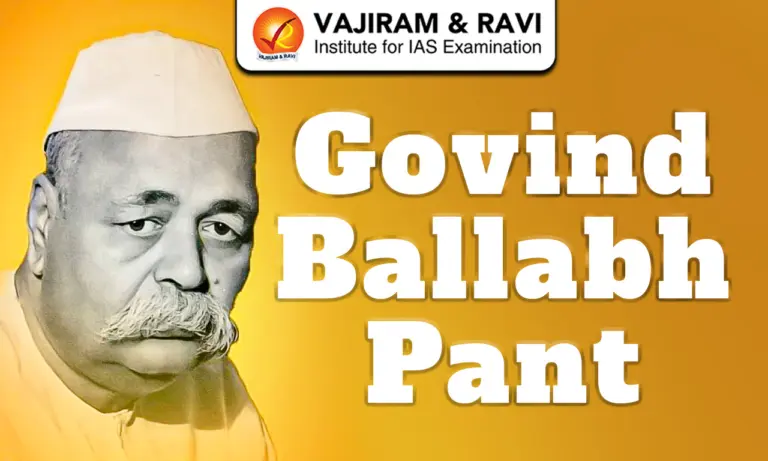
Govind Ballabh Pant was a prominent freedom fighter, lawyer, administrator, and one of the leading architects of modern India. He made significant contributions to India’s freedom struggle and later played an important role in land reforms, national integration, and public administration.
Govind Ballabh Pant Early Life and Education
Govind Ballabh Pant was born on 10 September 1887 in Khoont village near Almora in present-day Uttarakhand in a Marathi Karhade Brahmin family.
- He completed his early education in Almora and later joined Muir Central College, Allahabad University, where he studied law.
- After finishing his legal education, he began practising law in Kashipur and soon earned recognition for his strong legal acumen.
- The Indian National Congress recognised his legal talent and entrusted him with defending revolutionaries like Ashfaqulla Khan and Ramprasad Bismil in the Kakori conspiracy case.
- His legal career exposed him to the social and economic hardships faced by ordinary people under British rule, inspiring him to dedicate his life to public service and the national movement.
Govind Ballabh Pant Role in India’s Freedom Struggle
Inspired by Mahatma Gandhi, Govind Ballabh Pant joined the Indian National Congress and actively participated in every major phase of the national movement.
- He played a leading role in the Coolie Begar Movement in the Kumaon region, opposing forced unpaid labour imposed by the British, which became an early symbol of anti-colonial resistance in the hills.
- He actively participated in the Non-Cooperation Movement (1920) and supported Mahatma Gandhi’s call for boycott of British institutions, helping spread nationalist awareness among the masses.
- He took part in the Civil Disobedience Movement (1930) and protested against unjust colonial laws, for which he was arrested and imprisoned by the British authorities.
- He participated in the Quit India Movement (1942) and was again imprisoned, showing his commitment to complete independence from colonial rule.
- He worked to strengthen the organisational base of the Indian National Congress in the United Provinces by expanding its reach among rural and urban populations.
- He used legislative platforms during the colonial period to raise demands for civil liberties, education reforms, and responsible government.
- He faced repeated imprisonment during different phases of the freedom struggle, reflecting his consistent resistance and personal sacrifice against British rule.


Govind Ballabh Pant Contributions after Independence
Govind Ballabh Pant emerged as one of the key nation-builders of independent India, contributing significantly to administrative reforms, land redistribution, national integration, and strengthening of democratic institutions during the formative years of the Republic.
Contribution to Constitution-Making
After Independence, Govind Ballabh Pant became a member of the Constituent Assembly, where he contributed to debates on governance, federalism, and language policy.
- He supported a strong Union capable of preserving national unity while respecting India’s federal structure.
- Pant was also among the prominent advocates of adopting Hindi in the Devanagari script as the Official Language of the Union, while recognising India’s rich linguistic diversity.
Chief Minister of Uttar Pradesh (1950-1954)
Govind Ballabh Pant first served as Premier of the United Provinces (1937-39) under the Government of India Act, 1935. After Independence, he became the first Chief Minister of Uttar Pradesh (1950-1954) and laid the foundations of modern governance in the State.
- He implemented the Uttar Pradesh Zamindari Abolition and Land Reforms Act, 1950. The Act abolished the zamindari system, protected the rights of cultivators, and became a model for land reforms in other States.
- He strengthened administrative institutions and improved governance efficiency in Uttar Pradesh.
- He focused on expanding education, healthcare, irrigation, and rural infrastructure.
- He worked to improve law and order and promoted welfare-oriented governance aimed at inclusive development.
Nation Builder as Union Home Minister
In 1955, Govind Ballabh Pant became the Union Home Minister, succeeding Kailash Nath Katju. During this period, he played a decisive role in consolidating India’s administrative and political unity.
- Linguistic Reorganisation of States: One of his most important contributions was overseeing the implementation of the States Reorganisation Act, 1956. The reorganisation of states on linguistic lines helped address regional aspirations while preserving national unity. Pant ensured that this large-scale restructuring was carried out peacefully and without administrative breakdown.
- Strengthening Internal Administration: He worked to improve coordination between the Centre and States and strengthen India’s internal security framework. His focus remained on building stable institutions capable of maintaining law and order in a diverse and newly independent country.
Legacy of Govind Ballabh Pant
Govind Ballabh Pant is remembered as a key nation builder who helped shape modern India after Independence through land reforms, strong administration, and national integration. He played an important role in strengthening democratic institutions and ensuring peaceful reorganisation of states while maintaining national unity. He supported inclusive governance that balanced development with India’s linguistic and cultural diversity. For his outstanding service to the nation, he was awarded the Bharat Ratna in 1957.

 Last updated on Sep, 2026
→ UPSC Mains Question Paper 2026 is out now for Essay & GS Paper 1, 2, 3 & 4.
→ UPSC Mains GS Paper 1 2026 is out now.
→ UPSC Mains GS Paper 2 2026 is out now.
→ UPSC Mains GS Paper 3 2026 is out now.
→ UPSC Mains GS Paper 4 2026 is out now.
→ UPSC Mains Indian Language Paper & English Compulsory Paper are out now.
→ Check out the latest UPSC Syllabus 2026 here.
→ UPSC Mains Admit Card 2026 is now out.
→ Enroll in Vajiram & Ravi’s UPSC Mains Test Series 2027 for structured answer writing practice, expert evaluation, and exam-oriented feedback.
→ Join Vajiram & Ravi’s UPSC Mentorship Program 2027 for personalized guidance, strategy planning, and one-to-one support from experienced mentors.
→ Go through the UPSC Mains Previous Year Papers to enhance your preparation.
→ Download UPSC Mains Essay Paper 2025, UPSC Mains GS Paper-I 2025, UPSC Mains GS Paper-II 2025, UPSC Mains GS Paper-III 2025, UPSC Mains GS Paper-IV 2025, UPSC Mains English (Compulsory) Paper 2025, UPSC Mains Hindi (Qualifying) Paper 2025 here.
→ UPSC has released UPSC Toppers List 2025 with the Civil Services final result on its official website.
→ UPSC Calendar 2027 has been released.
→ Also check Best UPSC Coaching in India
Govind Ballabh Pant FAQs
Q1. Who was Govind Ballabh Pant?+
Q2. What were his major contributions during the freedom struggle?+
Q3. What was his role in the Kakori conspiracy case?+
Q4. What is his most important contribution as Chief Minister of Uttar Pradesh?+
Q5. Why is Govind Ballabh Pant remembered as a nation builder?+
Tags: govind ballabh pant