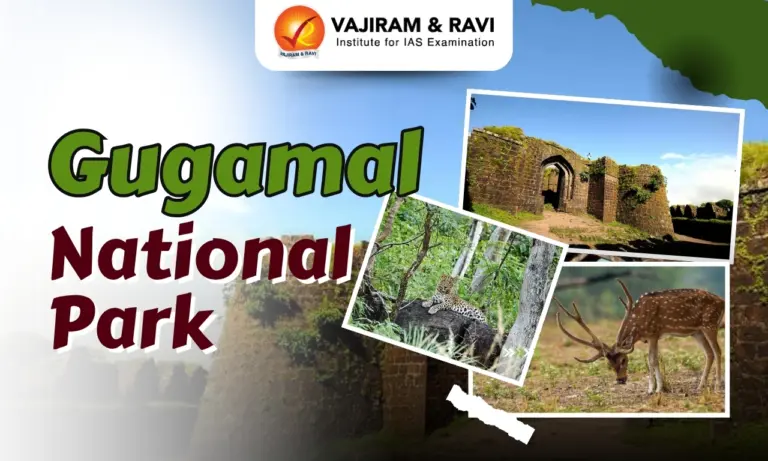
Gugamal National Park is a protected forest area located in the state of Maharashtra. It is known for its natural beauty, forest landscapes, and rich wildlife. The park is part of a larger conservation area and provides a safe habitat for many animals, birds, and plant species. Being surrounded by hills and greenery, it plays an important role in maintaining ecological balance and supporting biodiversity.
Gugamal National Park
- Gugamal National Park is an important protected forest area located in the Amravati district of Maharashtra, forming the core zone of the Melghat Tiger Reserve.
- It lies in the Satpura Range of hills, which adds to its rich natural beauty and ecological importance.
- The park covers an area of about 361.28 sq. km and is known for its diverse wildlife, forest ecosystems, and scenic landscapes.
- Being part of a major tiger reserve, it plays a key role in wildlife conservation and biodiversity protection.
Also Read : National Parks in Maharashtra
Gugamal National Park History and Significance
- Gugamal National Park was established in 1974 and later became an important part of the Melghat Tiger Reserve.
- The Melghat Tiger Reserve was among the first tiger reserves in India under Project Tiger (1973-74).
- The park is named after the Gugamal Range, a hill range that runs through its core area.
- It plays a significant role in protecting endangered species, especially the Bengal Tiger, and preserving the ecosystem of central India.


Gugamal National Park Geography and Physical Features
- The park is located in the Satpura hills, featuring rugged terrain, forests, valleys, and plateaus.
- Several rivers and streams flow through the park, making it a crucial water catchment area.
- Major rivers include the Tapti River (forming the northern boundary) and others like Sipna, Gadga, Dolar, Khandu, Khapra, and Wan rivers.
- These water bodies support wildlife and maintain the ecological balance of the region.
Gugamal National Park Flora (Vegetation)
- The vegetation is mainly tropical dry deciduous forest, adapted to the region’s climate.
- Dominant trees include Teak (Tectona grandis), Ain, Tendu, Kusum, and Indian Gooseberry.
- Bamboo forests are widely spread and play an important role in the ecosystem.
- The park also has orchids, Strobilanthes plants, and medicinal plants, which are important for both ecology and local communities.
- This rich vegetation provides food, shelter, and habitat for wildlife.
Gugamal National Park Fauna (Wildlife)
- Gugamal National Park is home to a wide variety of wildlife, making it an important biodiversity hotspot.
- Major animals include Bengal Tiger, Indian Leopard, Sloth Bear, Gaur (Indian bison), and Wild Dogs (Dholes).
- Other mammals such as Sambar, Chital (spotted deer), Barking deer, Nilgai, Wild Boar, and Langurs are commonly found.
- The park also supports species like Striped Hyena, Flying Squirrel, and Four-horned Antelope.
- Birdlife is rich, including species like Crested Serpent Eagle, Paradise Flycatcher, Hornbills, and Owls.
- Reptiles such as Indian Python, Cobra, Monitor Lizards, and Crocodiles are also present.
Tribal Communities
- The region around the park is home to indigenous tribes like the Korku Tribe and the Gond Tribe.
- These communities have a deep connection with the forest and possess traditional knowledge of plants and wildlife.
- Their lifestyle and culture are closely linked to the natural environment of the park.
Gugamal National Park Conservation Efforts
- Gugamal National Park is a key part of the Melghat Tiger Reserve, helping in the protection of tigers and other endangered species.
- It contributes to maintaining the ecological balance and preserving the Satpura ecosystem.
- The park also acts as an important water catchment area for the Tapti River basin.
- Continuous conservation efforts ensure the survival of wildlife and sustainability of natural resources.

 Last updated on August, 2026
→ UPSC Mains Question Paper 2026 is out now for Essay & GS Paper 1, 2, 3 & 4.
→ UPSC Mains GS Paper 1 2026 is out now.
→ UPSC Mains GS Paper 2 2026 is out now.
→ UPSC Mains GS Paper 3 2026 is out now.
→ UPSC Mains GS Paper 4 2026 is out now.
→ UPSC Mains Indian Language Paper & English Compulsory Paper are out now.
→ Check out the latest UPSC Syllabus 2026 here.
→ UPSC Mains Admit Card 2026 is now out.
→ Enroll in Vajiram & Ravi’s UPSC Mains Test Series 2027 for structured answer writing practice, expert evaluation, and exam-oriented feedback.
→ Join Vajiram & Ravi’s UPSC Mentorship Program 2027 for personalized guidance, strategy planning, and one-to-one support from experienced mentors.
→ Go through the UPSC Mains Previous Year Papers to enhance your preparation.
→ Download UPSC Mains Essay Paper 2025, UPSC Mains GS Paper-I 2025, UPSC Mains GS Paper-II 2025, UPSC Mains GS Paper-III 2025, UPSC Mains GS Paper-IV 2025, UPSC Mains English (Compulsory) Paper 2025, UPSC Mains Hindi (Qualifying) Paper 2025 here.
→ UPSC has released UPSC Toppers List 2025 with the Civil Services final result on its official website.
→ UPSC Calendar 2027 has been released.
→ Also check Best UPSC Coaching in India
Gugamal National Park FAQs
Q1. What is Gugamal National Park famous for?+
Q2. Where is Gugamal National Park located?+
Q3. When was Gugamal National Park established?+
Q4. Is Gugamal National Park a Tiger Reserve?+
Q5. What is the area of Gugamal National Park?+
Q6. Which mountain range is Gugamal National Park part of?+
Q7. Which are the major rivers in Gugamal National Park?+
Q8. What type of vegetation is found in Gugamal National Park?+
Tags: environment environment notes gugamal national park