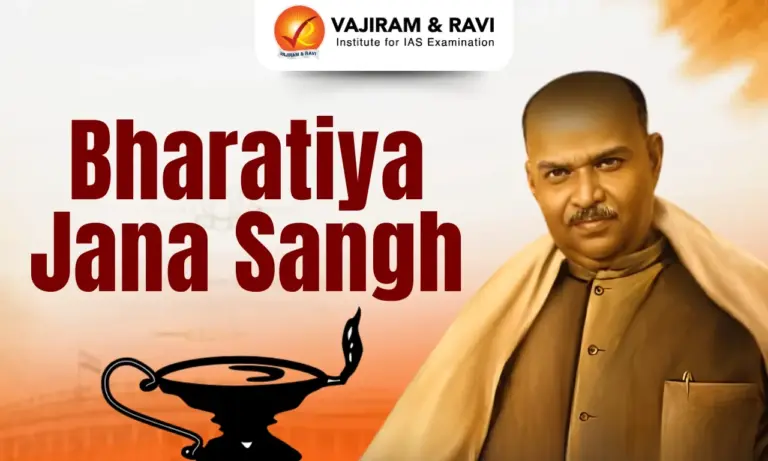
The Bharatiya Jana Sangh (BJSr) was one of the most influential political parties in post-independence India. Established in 1951 by Dr. Syama Prasad Mookerjee, the party promoted cultural nationalism, national unity, economic self-reliance, and strong governance. Although the Bharatiya Jana Sangh formally ceased to exist in 1977 after merging into the Janata Party, its political ideology and organizational framework continue to influence Indian politics through its successor, the Bharatiya Janata Party (BJP).
History of Bharatiya Jana Sangh
The Bharatiya Jana Sangh was founded in 1951 by Dr. Syama Prasad Mookerjee and emerged as a major opposition party that promoted nationalism, cultural identity, and democratic governance in post-independence India.
- Founded on 21 October 1951 in New Delhi by Dr. Syama Prasad Mookerjee.
- Established as a nationalist political alternative to the Indian National Congress.
- Advocated cultural nationalism, national unity, and strong democratic institutions.
- Opposed the special status of Jammu & Kashmir under Article 370 and demanded its complete integration with India.
- Expanded its political presence during the 1950s and 1960s, becoming a significant opposition party in several northern states.
- Played an active role in anti-corruption movements and campaigns for economic self-reliance through the Swadeshi approach.
- Participated in the movement against the Emergency (1975–1977), with many leaders imprisoned for opposing authoritarian rule.
- Merged with several opposition parties to form the Janata Party in 1977, ending its independent existence.
Objectives of Bharatiya Jana Sangh
The Bharatiya Jana Sangh aimed to build a strong, united, and self-reliant India by promoting national unity, cultural values, and democratic governance. Its objectives focused on ensuring national integration, economic development, and the protection of India’s civilizational heritage.
- Promote national unity and strengthen the integrity of India.
- Preserve and promote Indian culture and civilizational values.
- Ensure democratic governance and uphold the rule of law.
- Achieve economic self-reliance (Swadeshi) through indigenous industries.
- Strengthen national security and protect India’s borders.
- Advocate the complete integration of Jammu & Kashmir with India.
- Protect the fundamental rights and equal opportunities of all citizens.
- Encourage good governance, transparency, and accountability in public administration.


Ideology of Bharatiya Jana Sangh
The Bharatiya Jana Sangh was guided by the principles of cultural nationalism, national unity, democracy, and economic self-reliance. Its ideology emphasized preserving India’s cultural heritage while promoting strong governance, national security, and inclusive development.
- Cultural Nationalism: Promoted India’s cultural heritage as the foundation of national identity.
- National Integration: Advocated the complete integration of Jammu & Kashmir with the rest of India and opposed separate constitutional arrangements.
- Democratic Governance: Supported parliamentary democracy, constitutional values, the rule of law, and an independent judiciary.
- Economic Self-Reliance (Swadeshi): Encouraged indigenous industries, domestic manufacturing, and reduced dependence on imports.
- Integral Humanism: Adopted the philosophy of Integral Humanism, articulated by Deendayal Upadhyaya, which emphasized balanced development of the individual and society.
- Strong National Security: Favoured a robust defence system, secure borders, and a firm approach to safeguarding India’s sovereignty.
- Social Harmony: Sought to promote social cohesion and equal opportunities while emphasizing national unity.
Prominent Leaders of Bharatiya Jana Sangh
The Bharatiya Jana Sangh was led by several influential leaders who shaped its growth and strengthened its position as a major opposition party in India. Many of these leaders later played significant roles in national politics and contributed to the development of the Bharatiya Janata Party (BJP).
- Dr. Syama Prasad Mookerjee – Founder of the Bharatiya Jana Sangh and its first president.
- Deendayal Upadhyaya – Chief ideologue who propounded the philosophy of Integral Humanism.
- Atal Bihari Vajpayee – Eminent parliamentarian and later served as the Prime Minister of India.
- Lal Krishna Advani – Senior leader who helped strengthen the party’s organization and later became Deputy Prime Minister.
- Balraj Madhok – Prominent leader who expanded the party’s influence, especially in northern India.
Major Movements Led by Bharatiya Jana Sangh
The Bharatiya Jana Sangh actively participated in several nationalist and democratic movements that shaped its political identity. These movements focused on national integration, anti-corruption, economic self-reliance, and the protection of democratic rights.
- Jammu & Kashmir Integration Movement: Opposed the permit system and demanded the complete constitutional integration of Jammu & Kashmir with India.
- Movement Against Article 370: Advocated the removal of special constitutional provisions that, according to the party, hindered national unity.
- Swadeshi Movement: Promoted indigenous industries, domestic manufacturing, and reduced dependence on foreign goods.
- Anti-Corruption Campaigns: Criticized corruption in public life and demanded greater transparency and accountability in governance.
- Democratic Rights Movement During the Emergency (1975–77): Many Jana Sangh leaders participated in protests against the Emergency and were imprisoned for defending democratic freedoms.
- Price Rise and Public Welfare Agitations: Organized protests on issues affecting common citizens, including inflation, unemployment, and governance failures.
- National Security Campaigns: Raised concerns about border security and advocated a stronger defence policy.
- Student and Youth Mobilization: Through allied organizations, the party encouraged political participation among students and young citizens.

 Last updated on Sep, 2026
→ UPSC 2027 Notification will be released on 13 January 2027 at upsconline.nic.in.
→ UPSC Mains Question Paper 2026 is out now for Essay & GS Paper 1, 2, 3 & 4.
→ UPSC Mains GS Paper 1 2026 is out now.
→ UPSC Mains GS Paper 2 2026 is out now.
→ UPSC Mains GS Paper 3 2026 is out now.
→ UPSC Mains GS Paper 4 2026 is out now.
→ UPSC Mains Indian Language Paper & English Compulsory Paper are out now.
→ Check out the latest UPSC Syllabus 2026 here.
→ UPSC Mains Admit Card 2026 is now out.
→ Enroll in Vajiram & Ravi’s UPSC Mains Test Series 2027 for structured answer writing practice, expert evaluation, and exam-oriented feedback.
→ Join Vajiram & Ravi’s UPSC Mentorship Program 2027 for personalized guidance, strategy planning, and one-to-one support from experienced mentors.
→ Go through the UPSC Mains Previous Year Papers to enhance your preparation.
→ Download UPSC Mains Essay Paper 2025, UPSC Mains GS Paper-I 2025, UPSC Mains GS Paper-II 2025, UPSC Mains GS Paper-III 2025, UPSC Mains GS Paper-IV 2025, UPSC Mains English (Compulsory) Paper 2025, UPSC Mains Hindi (Qualifying) Paper 2025 here.
→ UPSC has released UPSC Toppers List 2025 with the Civil Services final result on its official website.
→ UPSC Calendar 2027 has been released.
→ Also check Best UPSC Coaching in India
Bharatiya Jana Sangh FAQs
Q1. What was the Bharatiya Jana Sangh?+
Q2. Who founded the Bharatiya Jana Sangh?+
Q3. What was the ideology of the Bharatiya Jana Sangh?+
Q4. When did the Bharatiya Jana Sangh merge into the Janata Party?+
Q5. Which political party succeeded the Bharatiya Jana Sangh?+
Tags: bharatiya jana sangh geography geography notes