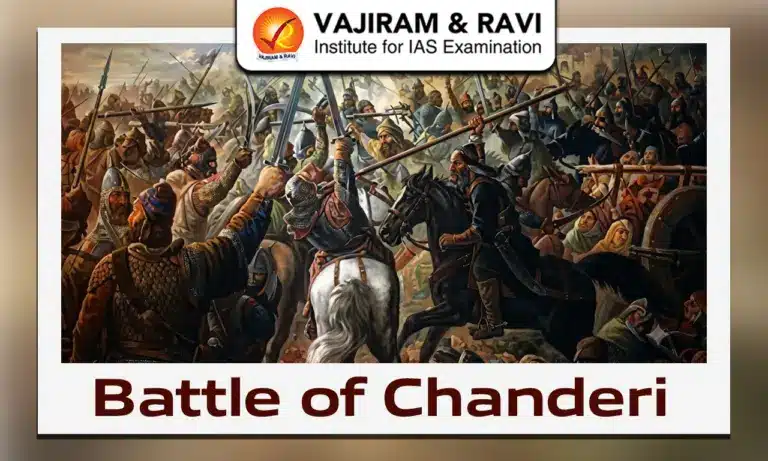
The Battle of Chanderi, fought in January 1528, was a decisive battle between the Mughal emperor Babur and the Rajput ruler Medini Rai. It was fought after the Battle of Khanwa (1527) and formed an important part of Babur’s campaign to strengthen Mughal rule in India. The victory at Chanderi weakened Rajput resistance and expanded Mughal control into Central India.
The Baburnama, the autobiography of Babur, is the principal contemporary source for the Battle of Chanderi and provides a detailed account of the siege and its outcome.
|
Date |
January 1528 |
|
Location |
Chanderi Fort, Madhya Pradesh |
|
Between |
Babur and Medini Rai |
|
Outcome |
Mughal Victory |
|
Importance |
Strengthened Mughal rule after Khanwa |
Battle of Chanderi Background
The Battle of Chanderi was closely linked to the Battle of Khanwa. Although Babur had defeated Rana Sanga in 1527, many Rajput chiefs continued to resist Mughal rule. Among them, Medini Rai, the ruler of Chanderi and a close ally of Rana Sanga, remained the most powerful.
Medini Rai had earlier served in the Malwa Sultanate and later became its most influential noble. After the defeat at Khanwa, he returned to the strong fort of Chanderi and prepared to continue the struggle against Babur.
Babur realised that lasting peace could not be achieved until the remaining Rajput strongholds were defeated. Therefore, he decided to capture Chanderi before another Rajput alliance could emerge.
Battle of Chanderi Causes
Babur’s decision to attack Chanderi was driven by military, political and strategic considerations.
- To strengthen Mughal rule: Babur wanted to remove the remaining centres of resistance after Khanwa.
- To defeat Rana Sanga’s allies: Medini Rai was one of Rana Sanga’s strongest supporters. His defeat would weaken the Rajput Confederacy.
- Strategic importance of Chanderi: The fort controlled important routes between Malwa and Bundelkhand, making it valuable for both trade and military movement.
- Failure of peace talks: Babur offered to exchange Shamsabad Fort for Chanderi, but Medini Rai refused, leading to war.


Course of the Battle of Chanderi
Babur reached Chanderi in January 1528 and first tried to settle the dispute peacefully. When Medini Rai rejected his proposal, Babur laid siege to the fort.
Since Chanderi was built on a hill, attacking it was difficult. Babur used gunpowder artillery and ordered raised platforms to improve the range of his cannons. After heavy fighting, the Mughal army captured the lower fort and soon occupied the upper fort.
When defeat became certain, the Rajput women performed Jauhar (a mass self-immolation to avoid capture, enslavement, and dishonour by the victorious army) while the warriors carried out Saka (donning saffron robes and charging into battle with the resolve to fight to the death)l Medini Rai was killed defending the fort.
After the victory, Babur ordered a tower of skulls to be built, following the Timurid tradition of celebrating military victories.
Outcome of the Battle of Chanderi
The Battle of Chanderi resulted in a decisive Mughal victory.
- Medini Rai was killed defending the fort.
- Chanderi was annexed into the Mughal Empire.
- The Rajput Confederacy suffered another major setback.
- Mughal influence expanded into Malwa and Bundelkhand.
- Babur emerged as the undisputed power in northern India before the Battle of Ghaghra.
Significance of the Battle of Chanderi
The Battle of Chanderi was a turning point in early Mughal history, as it strengthened Babur’s empire, weakened Rajput resistance, and reshaped the political and military landscape of northern India.
- Completed Mughal Consolidation: Together, Panipat, Khanwa and Chanderi transformed Babur from an invader into the ruler of a stable empire.
- Decline of Rajput Resistance: The fall of Chanderi deprived Rana Sanga of one of his strongest allies and effectively ended the first phase of organised Rajput resistance against the Mughals.
- Rise of Gunpowder Warfare: The siege demonstrated the superiority of artillery, firearms and organised siege tactics over traditional fort defences.
- Political Transformation of Malwa: The death of Medini Rai accelerated the decline of the Malwa Sultanate and altered the balance of power in Central India.
- Foundation for Mughal Expansion: The victory secured Babur’s position, enabling later Mughal rulers to expand deeper into the Indian subcontinent.

 Last updated on Sep, 2026
→ UPSC 2027 Notification will be released on 13 January 2027 at upsconline.nic.in.
→ Check out the latest UPSC Syllabus here.
→ Download UPSC Model Answers for Mains 2026
→ UPSC Mains Question Paper 2026 is out now for Essay & GS Paper 1, 2, 3 & 4.
→ UPSC Calendar 2027 has been released.
→ Enroll in Vajiram & Ravi’s UPSC Mains Test Series 2027 for structured answer writing practice, expert evaluation, and exam-oriented feedback.
→ Join Vajiram & Ravi’s UPSC Mentorship Program 2027 for personalized guidance, strategy planning, and one-to-one support from experienced mentors.
→ Go through the UPSC Mains Previous Year Papers to enhance your preparation.
→ UPSC has released UPSC Toppers List 2025 with the Civil Services final result on its official website.
→ Also check Best UPSC Coaching in India
Battle of Chanderi FAQs
Q1. Why was the Battle of Chanderi fought?+
Q2. Who fought the Battle of Chanderi and what was its outcome?+
Q3. Why was the Battle of Chanderi significant in Indian history?+
Q4. What was the role of Medini Rai in the Battle of Chanderi?+
Q5. Which historical source provides the main account of the Battle of Chanderi?+
Tags: battle of chanderi