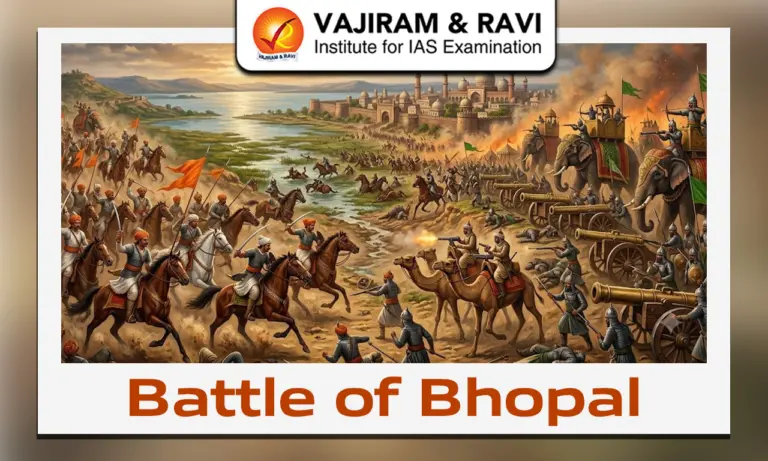
The Battle of Bhopal was an important event in 18th century Indian history, fought during a time when the Mughal Empire was declining and new regional powers like the Marathas were rising. It was part of a larger struggle for power and control in central India, involving the Marathas and Mughal forces along with their allies. The battle reflects the changing political situation of the period, where strong regional kingdoms began challenging Mughal authority. It played a key role in shaping the balance of power and showed how military strength, strategy, and alliances influenced the course of Indian history.
What is the Battle of Bhopal?
- The Battle of Bhopal was one of the most important military conflicts of 18th century India, fought between the Maratha forces under Peshwa Bajirao and the combined armies of the Mughals, Nizams, and Rajputs, reflecting the intense power struggle of that period.
- It took place in 1737 near Bhopal, during a time when the Mughal Empire was steadily declining and the Marathas were emerging as the most dominant regional power, expanding rapidly across central and northern India.
- This battle is especially remembered for Bajirao’s exceptional leadership and strategic brilliance, as he managed to defeat a stronger enemy not through direct confrontation but through smart planning, mobility, and resource control.
Why was the Battle of Bhopal fought?
- After the death of Aurangzeb, the Mughal Empire began to weaken politically and militarily, creating opportunities for rising powers like the Marathas to expand their influence into key regions such as Malwa and Gujarat.
- Peshwa Bajirao, an ambitious and highly skilled leader, led several campaigns and even reached the outskirts of Delhi, which alarmed the Mughal rulers and exposed their vulnerability.
- The growing strength of the Marathas became a major concern for the Mughal court, as they feared losing control over central India and important provinces like Malwa.
- In response, the Mughals sought help from the Nizam of Hyderabad and Rajput rulers, forming a powerful alliance to counter Bajirao’s expansion and stop the Marathas from gaining further ground.
- This rising tension and fear of Maratha dominance ultimately led to a direct military confrontation near Bhopal, making the battle almost unavoidable.
Also Read : Aurangzeb and Fall of Mughals


How did the Battle of Bhopal unfold?
- The Nizam of Hyderabad assembled a large and well-equipped army, including strong artillery, and positioned his forces strategically near Bhopal to block Bajirao’s return.
- Instead of engaging in a traditional face-to-face battle, Bajirao adopted a flexible and intelligent approach, avoiding direct conflict with the enemy’s superior artillery.
- He focused on cutting off the enemy’s supply lines, including food and water, which gradually weakened the combined forces and created panic within their camp.
- Bajirao also used rapid movement and cavalry strength to surround the enemy forces, effectively trapping them and limiting their ability to respond.
- By forcing the Nizam to leave his secure base and chase him, Bajirao created a situation where the enemy became vulnerable and isolated.
- The absence of timely reinforcements from Delhi further worsened the situation for the Mughal side, leading to a decline in morale and strength.
Who won the Battle of Bhopal?
- The brilliant leadership of Peshwa Bajirao was the most important factor, as his ability to think strategically and act quickly gave the Marathas a clear advantage over their opponents.
- The use of indirect warfare techniques, such as supply blockades and avoiding heavy artillery confrontation, proved far more effective than traditional battle methods.
- Efficient use of cavalry and speed, which allowed the Marathas to control movement and surround the enemy, played a crucial role in weakening the opposition.
- The failure of coordination among the Mughal, Nizam, and Rajput forces reduced their overall effectiveness despite their numerical strength.
- The lack of reinforcements and resources, especially from Delhi, forced the enemy into a defensive and desperate position, eventually leading to surrender.
What was the Treaty of Bhopal (1738)?
- The conflict came to an end with the signing of a peace treaty on 7 January 1738, marking a decisive diplomatic victory for the Marathas.
- According to the agreement, the Mughals and the Nizam were forced to recognize Maratha control over the Malwa region, which was a strategically important area.
- The Marathas were also granted 50 lakh rupees as compensation for war expenses, highlighting the scale of their success.
- This treaty was considered a humiliating settlement for the Mughal side, as it clearly demonstrated their declining power and inability to resist Maratha expansion.
What were the main consequences of the Battle of Bhopal?
- The Marathas secured complete control over Malwa, which significantly strengthened their political and military position in central India.
- The battle established the Marathas as a dominant force in the Indian subcontinent, capable of defeating even large combined armies.
- The Mughal Empire experienced a further decline in authority and prestige, losing both territory and influence after the defeat.
- The success of Bajirao’s strategy showed that intelligent planning and resource control could be more effective than sheer military strength.
- The weakened Mughal Empire later became more vulnerable to foreign invasions, including those by Nadir Shah and Ahmad Shah Abdali, accelerating its downfall.
What is the historical significance of the Battle of Bhopal?
- The Battle of Bhopal is considered one of the largest and most decisive battles of 18th century India, as it marked a major turning point in the political structure of the subcontinent and clearly shifted the balance of power.
- It strongly highlighted the rapid decline of the Mughal Empire, which was no longer able to defend its territories effectively, while at the same time showing the rise of the Marathas as the new dominant political and military force in India.
- The battle demonstrated the growing importance of advanced military strategies, speed, mobility, and adaptability, especially through Peshwa Bajirao’s innovative tactics, which became a defining feature of Maratha warfare.
- It played a crucial role in the expansion of Maratha influence across central and northern India, especially with the control over Malwa, thereby shaping the future political landscape of the region.
- Overall, the battle represents a transitional phase in Indian history, where traditional imperial powers weakened and new regional powers emerged, leading to a complete transformation of the political order.

 Last updated on Sep, 2026
→ UPSC 2027 Notification will be released on 13 January 2027 at upsconline.nic.in.
→ Check out the latest UPSC Syllabus here.
→ Download UPSC Model Answers for Mains 2026
→ UPSC Mains Question Paper 2026 is out now for Essay & GS Paper 1, 2, 3 & 4.
→ UPSC Calendar 2027 has been released.
→ Enroll in Vajiram & Ravi’s UPSC Mains Test Series 2027 for structured answer writing practice, expert evaluation, and exam-oriented feedback.
→ Join Vajiram & Ravi’s UPSC Mentorship Program 2027 for personalized guidance, strategy planning, and one-to-one support from experienced mentors.
→ Go through the UPSC Mains Previous Year Papers to enhance your preparation.
→ UPSC has released UPSC Toppers List 2025 with the Civil Services final result on its official website.
→ Also check Best UPSC Coaching in India
Battle of Bhopal FAQs
Q1. What is the Battle of Bhopal?+
Q2. When was the Battle of Bhopal fought?+
Q3. Where did the Battle of Bhopal take place?+
Q4. Who fought in the Battle of Bhopal?+
Q5. Who won the Battle of Bhopal?+
Q6. Why was the Battle of Bhopal fought?+
Q7. What strategies were used by Peshwa Bajirao?+
Q8. What was the Treaty of Bhopal (1738)?+
Tags: battle of bhopal history history notes