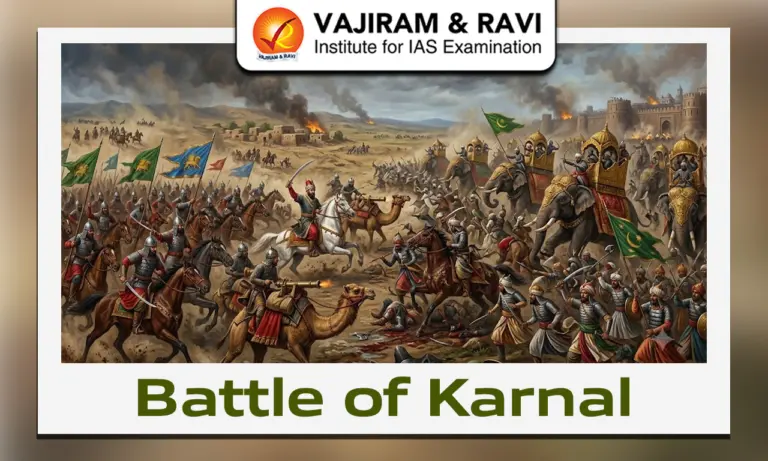
The Battle of Karnal was an important event in Indian history that took place during a time when the Mughal Empire was becoming weak and facing many challenges. It was fought between the Mughal forces and a powerful invading army from outside India. The battle reflects how internal problems, poor leadership, and lack of unity made the Mughal Empire vulnerable to external attacks. This event marked a turning point, as it exposed the declining strength of the Mughals and opened the way for further invasions and political changes in India.
What Was the Battle of Karnal?
- The Battle of Karnal was fought on 24 February 1739 between the Mughal Emperor Muhammad Shah Rangila and the Persian ruler Nadir Shah, and it proved to be a decisive and humiliating defeat for the Mughal Empire.
- This battle is considered a major turning point in Indian history because it clearly exposed the declining strength of the Mughals.
- Even though the Mughal Empire still appeared powerful on the surface, this battle revealed its internal weaknesses, poor leadership, and lack of coordination, which eventually led to its downfall.
What Was the Background of the Battle of Karnal?
- After the death of Aurangzeb in 1707, the Mughal Empire began to weaken due to continuous internal conflicts, administrative inefficiency, and economic problems, creating an opportunity for foreign invasions.
- Meanwhile, Nadir Shah, the powerful ruler of Persia from the Afsharid dynasty, had strengthened his empire through military reforms and expansion. His empire extended from the Black Sea to the Persian Gulf, making him one of the most formidable rulers of his time.
- Nadir Shah used the issue of Afghan rebels taking shelter in Mughal territories as an excuse to invade India, as the Mughal authorities failed to hand them over despite repeated demands.
- In 1738, he captured Kandahar and Kabul, and by early 1739, he had already seized Lahore, facing very little effective resistance from Mughal forces.


What Were the Forces and Military Strength?
- The Mughal army was numerically very large, consisting of nearly 300,000 soldiers along with elephants, heavy artillery, and cavalry, but it lacked unity, discipline, and effective leadership due to factional divisions among nobles.
- In contrast, Nadir Shah commanded a much smaller force of around 50,000-55,000 troops, but they were highly trained, disciplined, and strategically organized, giving them a strong qualitative advantage.
- The Persian army used advanced military techniques and modern weaponry, including mounted musketeers, mobile artillery, and zamburaks (camel-mounted swivel guns), which allowed them to move quickly and attack effectively.
- On the other hand, the Mughal forces relied heavily on traditional warfare methods such as slow cavalry charges and outdated artillery, which proved ineffective against the speed and precision of the Persian army.
How Did the Battle of Karnal Take Place?
- The battle was fought at Karnal in present-day Haryana, where the Mughal army positioned itself to stop the advancing Persian forces before they could reach Delhi.
- Despite having a larger army, the Mughal forces suffered from lack of coordination among commanders, while Nadir Shah effectively used intelligence, planning, and tactical positioning to weaken them.
- The Persian army launched a well-planned attack and managed to defeat the Mughal forces within just three hours, causing massive losses and confusion among the Mughal ranks.
- Key Mughal commanders such as Khan Dauran and Sa’adat Khan were killed or captured, and Emperor Muhammad Shah himself was taken prisoner, which was a major blow to Mughal prestige.
What Happened After the Battle of Karnal (Loot of Delhi)?
- After winning the battle, Nadir Shah marched to Delhi (Shahjahanabad) along with the captured Mughal emperor, effectively gaining control over the capital without further resistance.
- Although discipline was initially maintained, a conflict between local residents and Persian soldiers led Nadir Shah to order a brutal massacre in the city, resulting in widespread destruction and fear.
- It is estimated that around 30,000 civilians were killed, and the city was looted extensively, with homes destroyed and wealth forcibly taken from the people.
- The Persian army carried away enormous wealth from Delhi, including the Peacock Throne, Koh-i-Noor diamond, Darya-i-Noor diamond, and vast quantities of gold and silver, completely draining the Mughal treasury.
What Were the Immediate and Long-Term Impacts on the Mughal Empire?
- The Mughal Empire suffered a severe economic collapse, as its treasury was emptied, making it difficult to maintain administration, pay soldiers, and defend its territories.
- The authority of the Mughal emperor became largely symbolic, as real power shifted to regional governors who began acting independently.
- Provinces such as Bengal, Awadh, and Hyderabad gradually emerged as autonomous states, weakening the central authority of the empire.
- The Mughal military system was exposed as outdated and ineffective, encouraging future invasions and internal instability.
- The empire also lost important territories west of the Indus, including Afghanistan, Kashmir, Sindh, and Multan, which were annexed by Nadir Shah.
How Did It Lead to Further Invasions?
- After the death of Nadir Shah, his general Ahmad Shah Abdali took control of Afghanistan and launched multiple invasions of India between 1748 and 1767, taking advantage of Mughal weakness.
- One of the most significant events was the Third Battle of Panipat (1761), where Abdali defeated the Marathas, further destabilizing the political situation in North India.
How Did It Contribute to the Rise of New Powers?
- The weakening of Mughal authority created a political vacuum, which allowed regional powers to rise and expand their influence across different parts of India.
- The Marathas expanded rapidly and even captured Delhi in 1771, while the Sikhs strengthened their control in Punjab and emerged as a powerful force.
- Regional rulers in Bengal, Awadh, and Hyderabad established independent administrations, reducing the Mughal emperor to a nominal figurehead.
What Was Its Role in British Expansion?
- The Battle of Karnal indirectly helped the British East India Company, as it exposed the fragility of Indian political structures and military weakness.
- The British used this opportunity to gradually expand their influence through trade, diplomacy, and military interventions, eventually establishing colonial rule over India.
Why Is the Battle of Karnal Considered a Turning Point?
- The battle marked the beginning of the irreversible decline of the Mughal Empire, as it destroyed its economic strength, military power, and political authority.
- It highlighted the importance of modern warfare, disciplined armies, and effective leadership, which the Mughal Empire lacked during this period.
- Historians often argue that without the devastating impact of Nadir Shah’s invasion, the course of Indian history, including British colonization, might have been significantly different.
- Overall, the Battle of Karnal stands as a powerful example of how internal weaknesses and poor governance can make even a large empire collapse quickly under external pressure.

 Last updated on Sep, 2026
→ UPSC 2027 Notification will be released on 13 January 2027 at upsconline.nic.in.
→ Check out the latest UPSC Syllabus here.
→ Download UPSC Model Answers for Mains 2026
→ UPSC Mains Question Paper 2026 is out now for Essay & GS Paper 1, 2, 3 & 4.
→ UPSC Calendar 2027 has been released.
→ Enroll in Vajiram & Ravi’s UPSC Mains Test Series 2027 for structured answer writing practice, expert evaluation, and exam-oriented feedback.
→ Join Vajiram & Ravi’s UPSC Mentorship Program 2027 for personalized guidance, strategy planning, and one-to-one support from experienced mentors.
→ Go through the UPSC Mains Previous Year Papers to enhance your preparation.
→ UPSC has released UPSC Toppers List 2025 with the Civil Services final result on its official website.
→ Also check Best UPSC Coaching in India
Battle of Karnal FAQs
Q1. What was the Battle of Karnal?+
Q2. Why is the Battle of Karnal important in Indian history?+
Q3. Who fought in the Battle of Karnal?+
Q4. What were the main causes of the Battle of Karnal?+
Q5. Why did the Mughal army lose the Battle of Karnal?+
Q6. What happened after the Battle of Karnal?+
Tags: battle of karnal history history notes