AI in the Judiciary Latest News
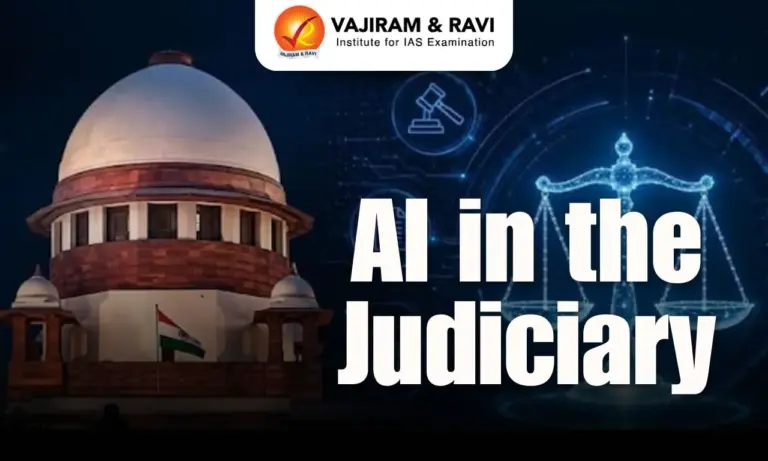
- The Supreme Court, in June 2026, released the draft Regulations for Use of Artificial Intelligence (AI) in Courts, 2026, aimed at creating a governance framework for AI adoption in the judiciary.
- It prescribes general principles for AI’s use and establishes an institutional framework to oversee it.
Applicability: Is It Binding?
- The Draft Regulations are not automatically or uniformly binding.
- They will come into force for the Supreme Court on a date notified by the Chief Justice of India, and separately for each High Court (and courts/tribunals under its jurisdiction) on dates notified by that High Court’s Chief Justice.
- Different provisions can also be implemented on different dates, allowing phased AI adoption suited to each court’s needs.


What Role Has Been Carved Out for AI?
- Courts are required to “actively seek opportunities” to deploy AI systems that demonstrably improve access to justice, reduce delays, or enhance administrative efficiency.
- AI use is explicitly permitted for administrative and assistive functions such as case management, transcription, translation, legal research, document summarisation, accessibility, and court administration.
- All such use requires written approval from the SC’s Apex Body or the concerned High Court/tribunal’s AI Committee, along with supervision by nominated court officers.
Can AI Decide a Case?
- No. The Draft Regulations categorically state that no judicial outcome can be reached through algorithmic decision-making alone or solely on AI-generated information.
- Human judicial authority remains determinative in all adjudicative decisions; AI’s role in decision-making, if any, is purely advisory and subject to independent human evaluation.
What Is Absolutely Barred?
- Certain uses are prohibited in “absolute and non-derogable” terms, meaning no authority can permit them under any circumstances:
- Risk scoring to assess flight risk;
- Predicting recidivism (the process of using historical, behavioral, and demographic data to estimate the likelihood that a previously convicted individual will commit a new crime or return to prison);
- Evaluating bail eligibility;
- Determining witness credibility;
- Predicting, profiling, or inferring future conduct of parties, accused persons, witnesses, or legal representatives;
- Submitting AI-generated output as independent evidence without full disclosure of its AI origin;
- Using “black-box” (unexplainable) AI systems in matters affecting personal liberty.
Transparency for Litigants
- If a court uses AI that “materially assists” it in case management, document analysis, or judicial administration, it must inform the parties involved in a timely, accessible manner.
- However, litigants will only be notified when AI has provided material assistance, not for every instance of AI use.
Institutional and Regulatory Architecture
- An “Apex Body” at the Supreme Court, comprising sitting SC and High Court judges, a MeitY official, and finance/cybersecurity experts, will set minimum mandatory standards and issue implementation guidelines.
- This body will operate through five specialised committees, while the SC and each High Court will form their own AI Committees, backed by an AI Secretariat.
- A separate research body, the Centre of Research and Excellence on Artificial Intelligence (CoRE-AI), will evaluate tools and track developments to support the Apex Body.
Role of Private Vendors
- Private companies can be involved only with written approval from the relevant court authority and must comply with mandatory contract terms covering:
- Ownership of and access rights to court data and AI outputs;
- A bar on using sensitive judicial data;
- A prohibition on retaining or fine-tuning models using court data without AI Committee approval;
- No exclusive IP claims over tools built substantially on judicial data or public resources.
Safety Measures: A Lifecycle Approach
- The Regulations mandate safety checks before, during, and after AI deployment:
- A Technical and Ethical Impact Assessment covering system architecture, training data, bias, hallucination risks, and cybersecurity
- Some systems may require “Controlled Environment Testing” in isolation before deployment
- Post-deployment, systems face technical, legal, ethical, and cybersecurity audits conducted in-house (source code and training data cannot be shared with third parties)
- Each court must maintain an AI Register of approved systems and audit outcomes
- Each AI Secretariat must maintain an AI Incident Database, with mandatory 24-hour notification if a tool fails or is suspended
- High Courts must have an emergency fall-back protocol to run processes manually if systems fail
Grievance Redressal for Litigants
- Where harm results from a prohibited use of AI, an affected party can file an application with the court where the AI system was used.
- The court must provide a hearing and pass appropriate orders.
- High Courts may design simplified procedures and complaint formats for accessibility, and this remedy exists alongside other legal remedies already available under ordinary law.
Conclusion
- The SC’s draft regulations strike a calibrated balance, embracing AI for efficiency and access to justice while firmly safeguarding judicial independence, personal liberty, and due process.
- By barring algorithmic decision-making in sensitive matters and ensuring layered oversight, India moves toward responsible, human-centric AI governance in courts.

 Last updated on Sep, 2026
→ UPSC 2027 Notification will be released on 13 January 2027 at upsconline.nic.in.
→ Check out the latest UPSC Syllabus here.
→ Download UPSC Model Answers for Mains 2026
→ UPSC Mains Question Paper 2026 is out now for Essay & GS Paper 1, 2, 3 & 4.
→ UPSC Calendar 2027 has been released.
→ Enroll in Vajiram & Ravi’s UPSC Mains Test Series 2027 for structured answer writing practice, expert evaluation, and exam-oriented feedback.
→ Join Vajiram & Ravi’s UPSC Mentorship Program 2027 for personalized guidance, strategy planning, and one-to-one support from experienced mentors.
→ Go through the UPSC Mains Previous Year Papers to enhance your preparation.
→ UPSC has released UPSC Toppers List 2025 with the Civil Services final result on its official website.
→ Also check Best UPSC Coaching in India
AI in the Judiciary FAQs
Q1. What is the objective of the Supreme Court's draft framework on AI in the Judiciary?+
Q2. Can AI decide cases under the proposed AI in the Judiciary framework?+
Q3. What functions can AI perform under the AI in the Judiciary framework?+
Q4. What safeguards are included in the AI in the Judiciary framework?+
Q5. Why is the AI in the Judiciary framework important for India's justice system?+
Tags: AI in the Judiciary upsc current affairs upsc mains current affairs