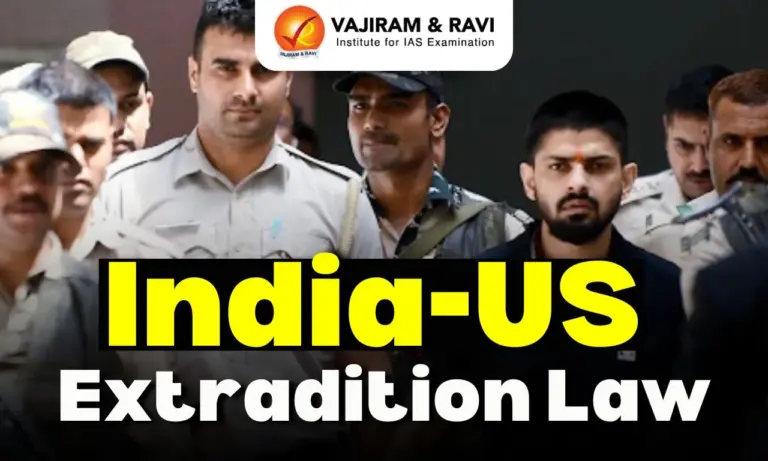
India-US Extradition Law Latest News
- The US Department of Justice (DoJ) has indicted jailed gangster Lawrence Bishnoi, Punjab Police SHO Gurinderjit Singh Nagra, and others for racketeering conspiracy, murder, extortion, and transnational organised crime spanning India, Canada, and the US.
- If the US formally seeks their extradition, the process will be governed by the India-US Extradition Treaty (1997) and India’s Extradition Act, 1962.
- The case reflects the growing challenge of transnational organised crime and the importance of balancing sovereignty, criminal justice, and international obligations.
Legal Framework Governing Extradition
- India-US Extradition Treaty (1997):
- The treaty regulates extradition between the two countries and is founded on the principle of dual criminality.
- Under dual criminality, an offence is extraditable only if it is punishable by more than one year of imprisonment in both jurisdictions.
- Key provisions:
- Dual criminality: The underlying conduct, not the exact legal terminology, must constitute a serious offence in both countries.
- Political offence exception: Political offences are exempt, but murder, terrorism, hostage-taking, drug trafficking, etc., are specifically excluded from this protection.
- Nationality not a bar: Indian citizenship alone cannot prevent extradition.
- Rule of speciality: An extradited person can ordinarily be tried only for the offences for which extradition was granted.


Do the Charges Quality for Extradition?
- The allegations against Bishnoi and Nagra broadly satisfy treaty requirements because the offences involved are recognised under Indian law.
- This includes murder, criminal conspiracy, extortion, drug trafficking, and firearms-related offences.
- Although the US indictment invokes the Racketeer Influenced and Corrupt Organizations (RICO) Act, identical legal provisions are not required under the treaty.
- Therefore, what matters is that the underlying criminal conduct is punishable in both countries.
- Judicial precedent – Tahawwur Rana case:
- Demonstrated the application of the dual criminality principle.
- Some charges were excluded as they lacked corresponding Indian offences, but extradition proceeded on offences satisfying dual criminality.
Extradition Procedure in India
(If the US submits a formal extradition request)
- Executive process:
- The US Department of Justice forwards the request through the US State Department to India’s Ministry of External Affairs (MEA).
- MEA, in consultation with the Ministry of Home Affairs (MHA) and agencies such as the CBI, examines compliance with the treaty and the Extradition Act.
- Judicial scrutiny:
- If accepted for consideration, an Indian court examines whether treaty conditions are fulfilled, and the evidence would justify prosecution if the offence had occurred in India.
- If satisfied, the court certifies the person as extraditable.
- Final executive decision:
- The Union Government has the final authority to approve or refuse surrender.
- It may impose conditions, seek diplomatic assurances, and delay extradition where legally justified.
- Orders are subject to judicial review before the High Court and the Supreme Court, making extradition proceedings time-consuming.
Can India Refuse or Delay Extradition?
- Extradition is not automatic, even if treaty requirements are fulfilled.
- Case of Lawrence Bishnoi:
- He is already in judicial custody with numerous criminal cases pending in India.
- Section 31 of the Extradition Act, 1962 allows India to postpone surrender while domestic criminal proceedings are pending.
- Article 14 of the Treaty permits temporary surrender but leaves discretion to the requested State.
- Hence, India may legally require Bishnoi to face domestic trials first, and serve any sentence before extradition.
- Case of Gurinderjit Singh Nagra:
- Not facing comparable prosecutions in India.
- However, Section 34 treats certain offences committed abroad as if committed in India.
- Section 34A empowers the Centre to prosecute an accused domestically instead of extraditing him.
Relevant Precedents
- Tahawwur Rana: India’s 2019 extradition request underwent multiple judicial stages in the US, including appeals up to the US Supreme Court, illustrating the lengthy nature of extradition proceedings.
- Vikash Yadav Case:
- Following a US indictment over an alleged assassination plot, Indian authorities registered an FIR and initiated domestic proceedings.
- Demonstrates that India may prioritise prosecution within its own jurisdiction before considering extradition.
India-US Extradition Record
- Despite strong strategic relations, extradition remains relatively limited.
- India to the US:
- Slightly over a dozen fugitives have been extradited since 1997.
- First: Yogesh Ratilal Shah (2002) – bank fraud.
- Latest: Ganesh Shenoy (2025) – fatal car crash case.
- US to India:
- 11 fugitives extradited between 2002 and 2018.
- Around 60 Indian extradition requests reportedly remained pending during that period.
- Notable refusals:
- David Coleman Headley: Extradition denied due to a plea agreement with US authorities.
- Warren Anderson: Extradition rejected citing insufficient evidence.
Source: IE

 Last updated on Oct, 2026
→ UPSC 2027 Notification will be released on 13 January 2027 at upsconline.nic.in.
→ Check Nobel Prize 2026 Winners List here.
→ Download PIB PRiSM Monthly Magazine 2026 here.
→ Check UPSC Monthly Current Affairs Magazine The Recitals here.
→ Check out the latest UPSC Syllabus here.
→ Download UPSC Model Answers for Mains 2026
→ UPSC Mains Question Paper 2026 is out now for Essay & GS Paper 1, 2, 3 & 4.
→ UPSC Calendar 2027 has been released.
→ Enroll in Vajiram & Ravi’s UPSC Mains Test Series 2027 for structured answer writing practice, expert evaluation, and exam-oriented feedback.
→ Join Vajiram & Ravi’s UPSC Mentorship Program 2027 for personalized guidance, strategy planning, and one-to-one support from experienced mentors.
→ Go through the UPSC Mains Previous Year Papers to enhance your preparation.
→ UPSC has released UPSC Toppers List 2025 with the Civil Services final result on its official website.
→ Also check Best UPSC Coaching in India
India-US Extradition Law
Q1. What is the principle of dual criminality under the India–US Extradition Treaty? +
Q2. Can India refuse or postpone extradition even if treaty conditions are satisfied? +
Q3. What is the significance of the rule of speciality in extradition law? +
Q4. How does the Tahawwur Rana case illustrate the extradition process? +
Q5. How do Sections 34 and 34A of the Extradition Act, 1962 strengthen India's legal options? +
Tags: India-US Extradition Law mains articles upsc current affairs upsc mains current affairs