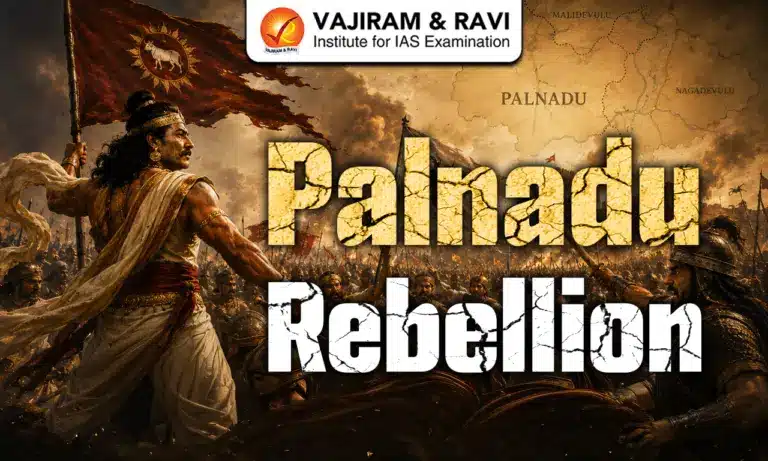
The Palnadu Rebellion, popularly known as the Battle of Palnadu (1182), was a major succession conflict within the Haihaya dynasty in present-day Andhra Pradesh. Although it began as a dynastic dispute, it gradually evolved into a broader conflict involving political rivalry, social reform and religious ideology. The battle significantly altered the political landscape of the eastern Deccan by weakening the existing regional powers and facilitating the rise of the Kakatiya dynasty.
Palnadu Rebellion Background
The roots of the Palnadu Rebellion lay in the internal rivalry of the Haihaya ruling family. After the death of Anugu Raju, a Haihaya ruler, differences emerged among his successors regarding the control and administration of the kingdom. Two major factions developed:
- Nalagama Raju ruled from Gurazala and was supported by his minister Nayakuralu Nagamma, a skilled political strategist.
- Malideva Raju established his base at Macherla and was supported by Brahma Naidu, an able administrator, military commander and social reformer.
Initially, the conflict was centred around political authority, but it gradually became a wider confrontation between Brahma Naidu’s reformist ideas and the traditional social order represented by Nagamma.
Palnadu Rebellion Causes
The Palnadu rebellion was the result of multiple political, social and immediate factors.
- Political Rivalry: The competition between the two factions for control over the kingdom created continuous tensions.
- Social Reforms: Brahma Naidu introduced reforms such as Chapa Koodu (inter-caste dining) and encouraged participation of people from different social groups in administration and military affairs. These measures challenged established caste practices.
- Religious Differences: Brahma Naidu promoted Veera Vaishnavism, which emphasised equality and devotion, while the opposing faction supported the existing orthodox social structure.
- Cockfight Incident: A political dispute associated with a cockfight resulted in the defeat of Malideva Raju’s faction. According to the agreed conditions, Malideva Raju and Brahma Naidu were forced into exile for seven years.
- Failure of Peaceful Settlement: After returning from exile, Malideva Raju’s claims were not accepted. The alleged killing of Alaraju, who had attempted reconciliation, ended efforts for a peaceful settlement and led to war.


Major Personalities of the Palnadu Rebellion
The Palnadu Rebellion was shaped by two influential figures who represented opposing political factions and contrasting social viewpoints. While Brahma Naidu advocated social reform and inclusive practices, Nayakuralu Nagamma represented the established political and social order.
Brahma Naidu
- Brahma Naidu was the chief minister and military commander of Malideva Raju.
- He was known for his administrative abilities, military leadership and reformist ideas.
- He promoted Veera Vaishnavism, which emphasised devotion, equality and social inclusion.
- Through Chapa Koodu (inter-caste dining), he attempted to challenge caste barriers and encourage social harmony.
- He expanded military participation by providing opportunities to warriors from different social backgrounds.
Nayakuralu Nagamma
- Nagamma was the chief minister and political advisor of Nalagama Raju.
- She was among the prominent women political figures of medieval South India.
- She played a decisive role in the administration and political strategy of her faction.
- She represented the traditional social and political order that opposed Brahma Naidu’s reformist measures.
Battle of Palnadu (1182 CE)
The final stage of the Palnadu rebellion was the Battle of Palnadu, fought at Karempudi between the two rival factions. The army of Malideva Raju, led by Brahma Naidu, confronted the forces of Nalagama Raju, supported by Nayakuralu Nagamma. The battle witnessed fierce warfare and the death of several prominent warriors, including Malideva Raju and Balachandrudu, the son of Brahma Naidu. Although Nalagama Raju’s faction secured victory, the prolonged conflict caused heavy losses on both sides and greatly weakened the political strength of the Haihaya dynasty.
Palnadu Rebellion Consequences
The rebellion brought major political changes in the region.
- The Haihaya dynasty lost much of its political strength after the prolonged conflict.
- The weakening of existing regional powers created a political vacuum.
- The Kakatiya dynasty benefited from this instability and expanded its influence.
- The conflict demonstrated how internal divisions could weaken kingdoms and alter regional power structures.
Palnadu Rebellion Social and Cultural Significance
Beyond its political impact, the Palnadu Rebellion left a lasting mark on the social and cultural history of medieval South India.
- Social Mobility: Brahma Naidu’s policies encouraged the participation of people from different social groups in military and administrative roles, reflecting changing patterns of social mobility during the period.
- Challenge to Social Orthodoxy: The reforms associated with Brahma Naidu questioned rigid social hierarchies and highlighted the possibility of a more inclusive social order.
- Preservation of Regional Identity: The memory of the rebellion became an important part of Telugu cultural identity, with its heroes and values continuing to influence regional traditions.
- Architectural Legacy: The Chennakesava Swamy Temple at Macherla, associated with Brahma Naidu’s reform movement, became an important centre of religious and cultural significance.
- Symbol of Heroic Tradition: The warriors of Palnadu became symbols of courage and sacrifice, contributing to the growth of heroic traditions in Telugu folklore and cultural expression.
Palnadu Rebellion Historical Significance
The Palnadu Rebellion was significant in shaping the political and social developments of medieval South India.
- Decline of Regional Powers: The prolonged conflict weakened the Haihaya dynasty and other regional powers, reducing their political influence.
- Rise of the Kakatiyas: The instability created after the rebellion provided an opportunity for the Kakatiya dynasty to strengthen and expand its authority.
- Example of Internal Political Conflict: The rebellion shows how struggles within ruling families could have wider consequences for regional politics and the balance of power.
- Intersection of Politics and Society: The conflict highlights how medieval political struggles were often connected with debates over social practices, religious ideas and administrative changes.
- Source for Understanding Medieval Society: The rebellion provides insights into the political structure, military organisation and social conditions of medieval South India.

 Last updated on Sep, 2026
→ UPSC 2027 Notification will be released on 13 January 2027 at upsconline.nic.in.
→ Check out the latest UPSC Syllabus here.
→ Download UPSC Model Answers for Mains 2026
→ UPSC Mains Question Paper 2026 is out now for Essay & GS Paper 1, 2, 3 & 4.
→ UPSC Calendar 2027 has been released.
→ Enroll in Vajiram & Ravi’s UPSC Mains Test Series 2027 for structured answer writing practice, expert evaluation, and exam-oriented feedback.
→ Join Vajiram & Ravi’s UPSC Mentorship Program 2027 for personalized guidance, strategy planning, and one-to-one support from experienced mentors.
→ Go through the UPSC Mains Previous Year Papers to enhance your preparation.
→ UPSC has released UPSC Toppers List 2025 with the Civil Services final result on its official website.
→ Also check Best UPSC Coaching in India
Palnadu Rebellion FAQs
Q1. What was the Palnadu Rebellion?+
Q2. Who were the main leaders of the Palnadu Rebellion?+
Q3. Why is the Palnadu Rebellion called the “Andhra Kurukshetra”?+
Q4. What was the social significance of Brahma Naidu’s reforms?+
Q5. What were the consequences of the Palnadu Rebellion?+
Tags: palnadu rebellion