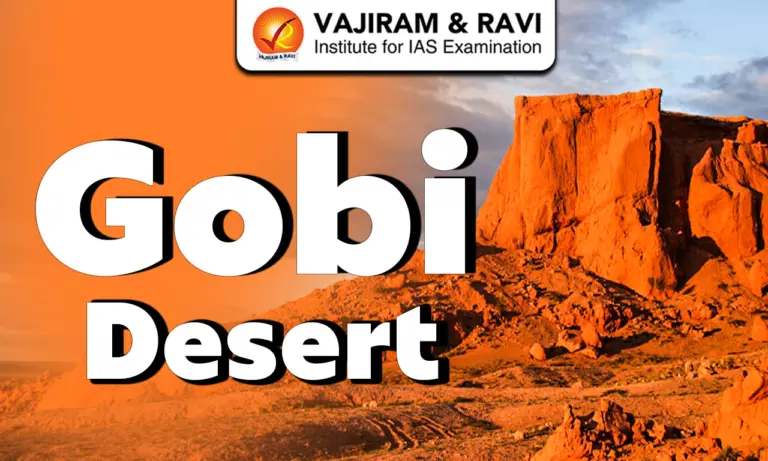
The Gobi Desert is one of the largest deserts in Asia and the largest cold desert in Asia. Covering about 1.3 million sq. km, it extends across southern Mongolia and northern China. Unlike typical hot deserts, the Gobi is dominated by rocky plains, gravel-covered surfaces and barren landscapes rather than vast sand dunes. It was formed mainly due to the combined effects of continentality and the rain-shadow effect of the Himalayas and the Tibetan Plateau. The desert is globally important for its unique biodiversity, rich dinosaur fossil deposits, mineral resources and its role as a major source of dust storms in East Asia.
Gobi Desert Location
The Gobi Desert is located in East Asia and extends across southern Mongolia and northern China.
- It lies in the interior of the Asian continent and forms part of the temperate desert biome.
- It stretches from the Tien Shan Mountains in the west to the Greater Khingan Mountains in the east.
- The Altai Mountains and the Mongolian Plateau lie to its north, while the Tibetan Plateau forms its southern boundary.
Gobi Desert Formation
The Gobi Desert was formed due to a combination of its continental location and the rain-shadow effect created by surrounding mountain ranges. These factors prevent adequate moisture from reaching the region, resulting in an extremely dry climate.
- Rain-shadow Effect: The Himalayas and the Tibetan Plateau block moisture-laden monsoon winds from the Indian Ocean. As the winds lose most of their moisture on the southern slopes of these mountains, very little rainfall reaches the Gobi Desert.
- Continental Location: The Gobi lies deep inside the Asian continent, far from major oceans. By the time air masses reach the region, they have already lost much of their moisture, resulting in very low precipitation.
- High Evaporation: Although the region receives limited rainfall, low humidity, strong winds and dry air increase moisture loss, making the landscape even more arid.
Due to these combined factors, the Gobi receives less than 200 mm of annual rainfall, preventing the growth of dense vegetation and maintaining its cold desert environment.


Gobi Desert Geographical Features
The Gobi Desert exhibits several distinctive physical features that reflect its unique cold desert environment and geological history.
- Predominantly Rocky Landscape: Unlike many deserts, the Gobi is mainly covered by rocky plains, gravel-covered surfaces and barren plateaus, while sand dunes occupy only a small part of the desert.
- Varied Relief: The landscape includes mountain ranges, broad basins, dry valleys, escarpments and isolated hills, giving the region a diverse topography.
- Cold Desert Environment: The desert remains largely barren because of low rainfall, extreme temperatures and sparse vegetation.
- Rich Fossil Deposits: The Gobi is internationally renowned for its dinosaur fossils and fossilised eggs. The Flaming Cliffs (Bayanzag) are among the world’s most important palaeontological sites.
- Active Geomorphological Processes: Strong winds continuously shape the landscape through weathering, erosion and the movement of sand and dust, creating unique desert landforms.
- Harsh Physical Conditions: Low humidity, strong winds, frequent dust storms and large differences between day and night temperatures make it one of the most challenging environments for life.
Gobi Desert Climate
The Gobi Desert experiences an extreme continental climate with large seasonal and daily variations in temperature.
- Winters are long and extremely cold, while summers are short and warm.
- Winter temperatures may fall below –40°C, whereas summer temperatures can exceed 40°C.
- Annual rainfall is generally less than 200 mm, with most of it occurring during summer.
- Strong winds frequently produce dust storms, especially during spring.
- Low humidity and high evaporation make the region highly arid.
Gobi Desert Drainage System
The Gobi Desert has a poorly developed drainage system because of its dry climate.
- Most rivers are seasonal and flow only after rainfall or snowmelt.
- Water is mainly available through springs, oases and temporary lakes.
- Many streams end in inland (endorheic) basins without reaching the sea.
- Groundwater is an important source of water for local communities and wildlife.
Gobi Desert Flora
The vegetation of the Gobi Desert is sparse and well adapted to its cold and arid environment.
- It is dominated by drought-resistant shrubs, hardy grasses and low-growing bushes that can survive with very little rainfall.
- Saxaul is the most characteristic plant of the Gobi Desert and plays an important role in stabilising soil and preventing desertification.
- Many plants have deep root systems, small leaves or waxy surfaces to reduce water loss and withstand strong winds.
- Vegetation is relatively denser around oases, river valleys and seasonal water sources.
- During occasional rainfall, short-lived grasses and wildflowers bloom briefly, providing food for grazing animals.
Gobi Desert Fauna
Despite its harsh environment, the Gobi Desert supports several rare and endangered animal species.
- Mammals include the Wild Bactrian Camel, Gobi Bear, Snow Leopard, Mongolian Wild Ass (Khulan) and Goitered Gazelle.
- Reptiles such as lizards and snakes are commonly found.
- Birds include vultures, eagles, falcons and bustards.
- Many species have developed special adaptations to survive extreme temperatures and limited water availability.
Gobi Desert Importance
Beyond its distinctive physical features, the Gobi Desert holds immense ecological, scientific and economic importance.
- It contains some of the world’s richest dinosaur fossil deposits, providing valuable insights into prehistoric life and the evolution of reptiles.
- The desert is rich in coal, copper, gold and rare earth elements, making it an important mining region in Mongolia and China.
- Its vast open landscapes and high solar radiation provide significant potential for solar and wind energy development.
- Dust storms originating from the Gobi transport fine mineral particles over long distances, influencing air quality, weather patterns and nutrient cycles across East Asia and the North Pacific.
- It supports the traditional nomadic pastoral lifestyle, with camel, sheep and goat rearing forming an important source of livelihood.
- The Gobi also serves as an important natural laboratory for studying desertification, climate change, arid-land ecology and the adaptation of plants and animals to extreme environments.
Gobi Desert Climate Change Concerns
Climate change and human activities are increasing environmental pressure on the Gobi Desert.
- Rising temperatures are accelerating the expansion of desert areas into neighbouring grasslands.
- Overgrazing has reduced vegetation cover, leading to greater soil erosion and land degradation.
- Dust storms are becoming more frequent and are affecting air quality in China, Mongolia, the Korean Peninsula and Japan.
- Increasing evaporation and changing rainfall patterns are worsening water scarcity.
- Mining and infrastructure development are putting additional pressure on the fragile desert ecosystem.

 Last updated on Sep, 2026
→ UPSC 2027 Notification will be released on 13 January 2027 at upsconline.nic.in.
→ Check out the latest UPSC Syllabus here.
→ Download UPSC Model Answers for Mains 2026
→ UPSC Mains Question Paper 2026 is out now for Essay & GS Paper 1, 2, 3 & 4.
→ UPSC Calendar 2027 has been released.
→ Enroll in Vajiram & Ravi’s UPSC Mains Test Series 2027 for structured answer writing practice, expert evaluation, and exam-oriented feedback.
→ Join Vajiram & Ravi’s UPSC Mentorship Program 2027 for personalized guidance, strategy planning, and one-to-one support from experienced mentors.
→ Go through the UPSC Mains Previous Year Papers to enhance your preparation.
→ UPSC has released UPSC Toppers List 2025 with the Civil Services final result on its official website.
→ Also check Best UPSC Coaching in India
Gobi Desert FAQs
Q1. Where is the Gobi Desert located?+
Q2. Why is the Gobi Desert called a cold desert?+
Q3. Why does the Gobi Desert receive very little rainfall?+
Q4. Which endangered animals are found in the Gobi Desert?+
Q5. Why is the Gobi Desert important? +
Tags: gobi desert