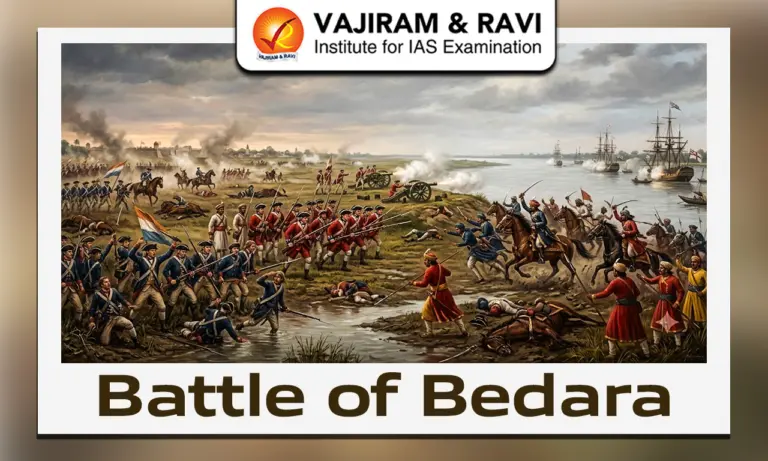
The Battle of Bedara (also known as the Battle of Chinsurah) was fought on 25 November 1759 in Bengal between the British East India Company and the Dutch East India Company. The British, led by Colonel Francis Forde, defeated the Dutch forces, ending Dutch ambitions of establishing political dominance in India. The victory further strengthened British control over Bengal after the Battle of Plassey (1757) and marked another milestone in the expansion of British rule in India.
Battle of Bedara Background
The Battle of Bedara took place in the aftermath of the Battle of Plassey (1757), which established the British East India Company as the dominant political power in Bengal. Although the Dutch East India Company had trading settlements at Chinsurah (Hooghly), they were concerned about the rapidly increasing influence of the British.
Nawab Mir Jafar, who had been placed on the throne by the British, grew dissatisfied with their growing interference in Bengal’s administration. Hoping to reduce British dominance, he secretly sought support from the Dutch. Encouraged by this opportunity, the Dutch sent troops and warships from Batavia (present-day Jakarta) to Bengal.
The arrival of Dutch forces alarmed the British East India Company, which decided to confront them before they could strengthen their position in Bengal.
Battle of Bedara 1759 Causes
The Battle of Bedara (1759) was fought due to the growing rivalry between the British East India Company and the Dutch East India Company over political influence and commercial dominance in Bengal.
- British dominance after Plassey (1757): The British became the most powerful European force in Bengal.
- Dutch trade interests: The Dutch sought to protect and expand their commercial interests in Bengal.
- Mir Jafar’s dissatisfaction: The Nawab secretly encouraged the Dutch to counter growing British influence.
- Arrival of Dutch reinforcements: The Dutch sent troops and warships from Batavia to strengthen their position.
- British suspicion: The British viewed the Dutch military buildup as a direct threat.
- Control over Bengal’s trade: Both companies wanted dominance over Bengal’s lucrative trade routes and resources.
- Political rivalry: Increasing competition among European powers intensified tensions in eastern India.
- British preventive action: Colonel Francis Forde launched military operations to stop the Dutch advance, leading to the Battle of Bedara.


Battle of Bedara Events and Outcome
The Battle of Bedara was fought on 25 November 1759 near Chinsurah in Bengal, where the British East India Company decisively defeated the Dutch East India Company, ending Dutch military ambitions in India.
Key Events
- The Dutch East India Company sent warships, European soldiers, and Indian sepoys from Batavia (present-day Jakarta) to Bengal.
- The British East India Company, under Colonel Francis Forde, prepared to stop the Dutch advance.
- British naval forces intercepted and engaged several Dutch ships on the Hooghly River.
- On 25 November 1759, British and Dutch forces clashed at Bedara, near Chinsurah.
- The disciplined British infantry and artillery outperformed the Dutch forces during the battle.
- The Dutch suffered heavy casualties, and many of their soldiers were captured or forced to surrender.
Outcome
- The British East India Company secured a decisive victory.
- The defeat ended the Dutch East India Company’s political and military ambitions in India.
- The Dutch were allowed to retain only their trading settlements without political influence.
- British supremacy in Bengal became firmly established after the victory.
- The battle further strengthened the British position following the Battle of Plassey (1757) and paved the way for future territorial expansion in India.
Battle of Bedara Significance
The Battle of Bedara (1759) was a landmark event that consolidated the British East India Company’s dominance in Bengal and eliminated the Dutch East India Company as a political rival in India.
- Ended Dutch ambitions: The defeat permanently ended the Dutch East India Company’s political and military aspirations in India.
- Strengthened British supremacy: The victory established the British East India Company as the dominant European power in Bengal.
- Consolidated post-Plassey gains: It reinforced British control gained after the Battle of Plassey (1757).
- Reduced European rivalry: The battle weakened competition from other European trading companies in eastern India.
- Increased British political influence: The British gained greater control over the Nawab of Bengal and regional administration.
- Secured British trade interests: It ensured British dominance over Bengal’s lucrative trade and strategic river routes.
- Boosted Company confidence: The victory enhanced the military reputation of the British East India Company among Indian rulers.
- Paved the way for expansion: It laid the foundation for the British to expand their territorial and political control across India.

 Last updated on Oct, 2026
→ UPSC 2027 Notification will be released on 13 January 2027 at upsconline.nic.in.
→ Check Nobel Prize 2026 Winners List here.
→ Download PIB PRiSM Monthly Magazine 2026 here.
→ Check UPSC Monthly Current Affairs Magazine The Recitals here.
→ Check out the latest UPSC Syllabus here.
→ Download UPSC Model Answers for Mains 2026
→ UPSC Mains Question Paper 2026 is out now for Essay & GS Paper 1, 2, 3 & 4.
→ UPSC Calendar 2027 has been released.
→ Enroll in Vajiram & Ravi’s UPSC Mains Test Series 2027 for structured answer writing practice, expert evaluation, and exam-oriented feedback.
→ Join Vajiram & Ravi’s UPSC Mentorship Program 2027 for personalized guidance, strategy planning, and one-to-one support from experienced mentors.
→ Go through the UPSC Mains Previous Year Papers to enhance your preparation.
→ UPSC has released UPSC Toppers List 2025 with the Civil Services final result on its official website.
→ Also check Best UPSC Coaching in India
Battle of Bedara FAQs
Q1. What was the Battle of Bedara?+
Q2. When and where was the Battle of Bedara fought?+
Q3. Who fought the Battle of Bedara?+
Q4. What were the main causes of the Battle of Bedara?+
Q5. Who won the Battle of Bedara?+
Q6. Why is the Battle of Bedara important?+
Tags: battle battle of bedara battle of india