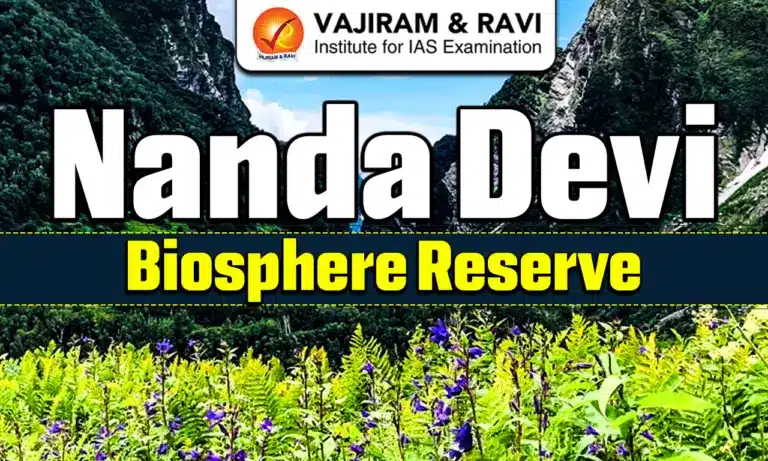
The Nanda Devi Biosphere Reserve is one of India’s most important protected mountain ecosystems. Located in the Western Himalayas, it is known for its spectacular landscapes, rich biodiversity, glaciers, alpine meadows and endemic Himalayan flora and fauna. The reserve is recognised under UNESCO’s Man and the Biosphere (MAB) Programme and includes the Nanda Devi National Park and the Valley of Flowers National Park, both of which are designated as UNESCO World Heritage Sites.
Nanda Devi Biosphere Reserve Location
The Nanda Devi Biosphere Reserve is situated in the Western Himalayas of Uttarakhand.
- It extends across the Chamoli, Bageshwar and Pithoragarh districts.
- The reserve surrounds Nanda Devi, India’s second-highest mountain.
- It lies within the upper catchments of the Alaknanda River.
- The reserve comprises a Core Zone, Buffer Zone and Transition Zone, following the UNESCO Biosphere Reserve model.
Nanda Devi Biosphere Reserve Geographical Features
The Nanda Devi Biosphere Reserve exhibits the characteristic features of a high-altitude Himalayan ecosystem.
- It consists of rugged mountain ranges, deep gorges, glaciers and snow-covered peaks.
- Elevation ranges from about 1,800 metres to over 7,800 metres, resulting in diverse climatic and ecological conditions.
- The Nanda Devi Sanctuary, enclosed by high mountain peaks, forms a unique natural basin.
- Numerous glaciers, including the Uttari Rishi, Dakshini Rishi, Trisul and Ramani glaciers, occur within the reserve.
- Alpine meadows (Bugyals), temperate forests and sub-alpine vegetation dominate the landscape.


Nanda Devi Biosphere Reserve Drainage System
The Nanda Devi Biosphere Reserve plays an important role in the Himalayan river system.
- The Rishi Ganga River originates from the glaciers within the Nanda Devi Sanctuary. It joins the Dhauliganga River, which is a tributary of the Alaknanda River.
- The Alaknanda later joins the Bhagirathi at Devprayag to form the Ganga River.
- Snow and glacier melt help sustain river flows, especially during the dry season.
Nanda Devi Biosphere Reserve Climate
The Nanda Devi Biosphere Reserve experiences a typical high-altitude Himalayan climate.
- Winters are long and extremely cold, with heavy snowfall at higher elevations.
- Summers are short and cool.
- Most precipitation is received during the southwest monsoon, while higher elevations also receive snowfall from western disturbances.
- Climate varies significantly with altitude, creating distinct ecological zones.
Nanda Devi Biosphere Reserve Flora
The Nanda Devi Biosphere Reserve supports exceptional floral diversity because of its wide altitudinal range.
- Temperate forests contain oak, deodar, blue pine, fir, spruce and rhododendron.
- Sub-alpine and alpine zones support birch forests and extensive alpine meadows.
- The Valley of Flowers is famous for its seasonal bloom of wildflowers.
- Important medicinal plants include Aconitum, Picrorhiza kurroa (Kutki), Nardostachys jatamansi (Jatamansi) and Atis.
Nanda Devi Biosphere Reserve Fauna
The Nanda Devi Biosphere Reserve is home to many rare and threatened Himalayan species. Several species are protected under the Wild Life (Protection) Act, 1972 and the IUCN Red List.
- Mammals include the Snow Leopard, Himalayan Musk Deer, Himalayan Tahr, Bharal (Blue Sheep), Asiatic Black Bear and Common Leopard.
- Important birds include the Himalayan Monal, Snow Partridge, Golden Eagle and various pheasants.
Nanda Devi Biosphere Reserve Significance
The Nanda Devi Biosphere Reserve is one of India’s most important protected mountain ecosystems because of its ecological, hydrological and conservation value.
- It is recognised as a UNESCO Biosphere Reserve under the Man and the Biosphere (MAB) Programme.
- It includes the Nanda Devi National Park and the Valley of Flowers National Park, both designated as UNESCO World Heritage Sites.
- It conserves a rich diversity of Himalayan flora and fauna, including several rare, endemic and threatened species.
- Its glaciers and snowfields support the upper catchments of the Ganga river system, contributing to long-term water security.
- It protects fragile Himalayan ecosystems, including temperate forests, alpine meadows and glacial landscapes.
- It serves as an important site for scientific research on biodiversity conservation, glacier dynamics and the impacts of climate change.
Nanda Devi Biosphere Reserve Climate Change Concerns
Climate change poses significant challenges to the Nanda Devi Biosphere Reserve.
- Rising temperatures are accelerating glacier retreat.
- Changes in snowfall patterns are affecting water availability and ecosystem stability.
- Increasing frequency of Glacial Lake Outburst Floods (GLOFs) threatens downstream communities.
- Alpine species are shifting to higher elevations due to warming temperatures.
- Extreme weather events are increasing ecological vulnerability.

 Last updated on Oct, 2026
→ UPSC 2027 Notification will be released on 13 January 2027 at upsconline.nic.in.
→ Check Nobel Prize 2026 Winners List here.
→ Download PIB PRiSM Monthly Magazine 2026 here.
→ Check UPSC Monthly Current Affairs Magazine The Recitals here.
→ Check out the latest UPSC Syllabus here.
→ Download UPSC Model Answers for Mains 2026
→ UPSC Mains Question Paper 2026 is out now for Essay & GS Paper 1, 2, 3 & 4.
→ UPSC Calendar 2027 has been released.
→ Enroll in Vajiram & Ravi’s UPSC Mains Test Series 2027 for structured answer writing practice, expert evaluation, and exam-oriented feedback.
→ Join Vajiram & Ravi’s UPSC Mentorship Program 2027 for personalized guidance, strategy planning, and one-to-one support from experienced mentors.
→ Go through the UPSC Mains Previous Year Papers to enhance your preparation.
→ UPSC has released UPSC Toppers List 2025 with the Civil Services final result on its official website.
→ Also check Best UPSC Coaching in India
Nanda Devi Biosphere Reserve FAQs
Q1. Where is the Nanda Devi Biosphere Reserve located?+
Q2. Which protected areas are included in the Nanda Devi Biosphere Reserve?+
Q3. Which river system is associated with the Nanda Devi Biosphere Reserve?+
Q4. Why is the Nanda Devi Biosphere Reserve environmentally important?+
Q5. Under which UNESCO programme is the Nanda Devi Biosphere Reserve recognised?+
Tags: nanda devi biosphere reserve