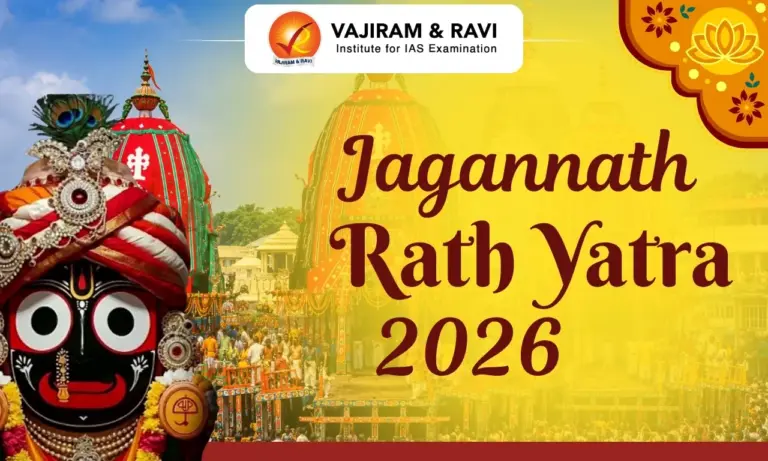
Jagannath Rath Yatra 2026 is one of the most revered Hindu festivals celebrated with great devotion in Puri, Odisha. Popularly known as the Festival of Chariots, it marks the annual journey of Lord Jagannath, Lord Balabhadra, and Goddess Subhadra from the Jagannath Temple to the Gundicha Temple. Every year, millions of devotees gather to witness the grand procession and pull the sacred chariots, believing it brings divine blessings and spiritual merit. The festival is an important symbol of India’s rich religious and cultural heritage.
What is Jagannath Rath Yatra?
Jagannath Rath Yatra is an annual Hindu festival that commemorates the ceremonial journey of Lord Jagannath, Lord Balabhadra, and Goddess Subhadra from their main temple in Puri to the Gundicha Temple, located about 3 kilometres away. The festival begins on Ashadha Shukla Dwitiya (the second day of the bright fortnight of the Hindu month of Ashadha) and continues for nine days.
Jagannath Rath Yatra 2026 History and Origin
Jagannath Rath Yatra is an ancient Hindu festival that commemorates the annual journey of Lord Jagannath, Lord Balabhadra, and Goddess Subhadra from the Jagannath Temple to the Gundicha Temple in Puri, Odisha.
- Believed to have ancient origins rooted in Hindu traditions and scriptures.
- The present Jagannath Temple was built in the 12th century CE by King Anantavarman Chodaganga Deva.
- The festival gained prominence after the construction of the Jagannath Temple in Puri.
- Celebrates the annual visit of the three deities to Gundicha Temple, believed to be their aunt’s abode.
- Popularly known as the Festival of Chariots because the deities travel in three grand wooden chariots.
- Observed every year on Ashadha Shukla Dwitiya and continues for nine days.
- Considered one of the oldest and largest religious festivals celebrated in India.
- Attracts millions of devotees and pilgrims from across the world every year.


Jagannath Rath Yatra 2026 Rituals
The Jagannath Rath Yatra 2026 is celebrated through a series of sacred rituals that symbolize devotion, humility, and the annual journey of Lord Jagannath, Lord Balabhadra, and Goddess Subhadra from the Jagannath Temple to the Gundicha Temple.
- Snana Purnima: The deities are ceremonially bathed with 108 pots of sacred water before the festival.
- Anavasara: After the ritual bath, the deities remain out of public view for about 15 days, symbolizing a period of rest.
- Nava Jaubana Darshan: Devotees receive the first glimpse of the deities after Anavasara.
- Pahandi Bije: The deities are carried from the temple to their respective chariots in a grand ceremonial procession.
- Chhera Pahanra: The Gajapati King of Puri sweeps the chariots with a golden broom, signifying humility and equality before God.
- Rath Yatra: Thousands of devotees pull the three massive wooden chariots to the Gundicha Temple using thick ropes.
- Stay at Gundicha Temple: The deities remain at the Gundicha Temple for several days, where special rituals and worship are performed.
- Hera Panchami: Goddess Lakshmi symbolically visits Gundicha Temple in a traditional ritual.
- Bahuda Yatra: The deities begin their return journey to the Jagannath Temple.
- Suna Besha: The deities are adorned with magnificent gold ornaments, one of the most awaited rituals of the festival.
- Niladri Bijay: The deities re-enter the Jagannath Temple, marking the successful conclusion of the nine-day Rath Yatra.
Mythological Significance of Jagannath Rath Yatra
The Jagannath Rath Yatra holds deep mythological and spiritual significance, symbolizing the divine journey of Lord Jagannath, Lord Balabhadra, and Goddess Subhadra to the Gundicha Temple, which is believed to be the home of their aunt.
- According to legend, Goddess Subhadra wished to visit her aunt’s house at Gundicha Temple.
- Lord Jagannath and Lord Balabhadra accompanied her, giving rise to the annual Rath Yatra tradition.
- The festival represents the love, affection, and family bond among the three divine siblings.
- It symbolizes Lord Jagannath’s willingness to leave the temple and bless all devotees without distinction.
- Pulling the sacred chariots is believed to bring spiritual merit, prosperity, and divine blessings.
- The Rath Yatra conveys the values of equality, devotion, compassion, and inclusiveness, as people from all communities participate together.
- The annual journey signifies the cyclical nature of life, renewal, and the connection between the divine and humanity.
- The festival is regarded as one of the most sacred Vaishnavite traditions in India, attracting millions of devotees every year.
The Three Chariots of Jagannath Rath Yatra
A unique feature of the Jagannath Rath Yatra is the procession of three magnificent wooden chariots, each dedicated to one of the deities. These chariots are constructed anew every year using traditional methods and sacred wood, showcasing Odisha’s rich craftsmanship and cultural heritage.
| The Three Chariots of Jagannath Rath Yatra | ||
|
Deity |
Chariot Name |
Canopy Colour |
|
Lord Jagannath |
Nandighosha |
Red and Yellow |
|
Lord Balabhadra |
Taladhwaja |
Red and Green |
|
Goddess Subhadra |
Darpadalana (Devadalana) |
Red and Black |
Jagannath Temple, Puri Architecture
The Jagannath Temple in Puri, Odisha, is one of India’s most sacred temples and a masterpiece of Kalinga architecture, renowned for its towering structure, intricate carvings, and immense religious significance.
Key Architectural Features
- Located in Puri, Odisha, on the eastern coast of India.
- Built in the 12th century CE by King Anantavarman Chodaganga Deva.
- One of the Char Dham pilgrimage sites, along with Badrinath, Dwarka, and Rameswaram.
- Popularly known as the “White Pagoda.”
- Designed in the Kalinga style of architecture, characterized by a curvilinear Shikhara (spire), elaborate carvings, and sculptural ornamentation.
- The temple complex is enclosed by a high fortified wall with four gateways facing the four cardinal directions.
- The main temple consists of four principal structures:
- Vimana (Deula): Sanctum sanctorum housing the deities.
- Jagamohana: Assembly or prayer hall.
- Nata Mandira: Festival and dance hall.
- Bhoga Mandapa: Hall where offerings are prepared and presented.
- The temple is revered as Yamanika Tirtha, where it is believed that the influence of Yama, the god of death, is nullified due to the presence of Lord Jagannath.
- The temple’s Nilachakra, an eight-spoked wheel made of Ashtadhatu (eight-metal alloy), is installed at the top of the main shrine and is considered highly sacred.
- The temple remains one of the finest examples of medieval temple architecture and an enduring symbol of Odisha’s rich cultural and spiritual heritage.

 Last updated on Oct, 2026
→ UPSC 2027 Notification will be released on 13 January 2027 at upsconline.nic.in.
→ Check Nobel Prize 2026 Winners List here.
→ Download PIB PRiSM Monthly Magazine 2026 here.
→ Check UPSC Monthly Current Affairs Magazine The Recitals here.
→ Check out the latest UPSC Syllabus here.
→ Download UPSC Model Answers for Mains 2026
→ UPSC Mains Question Paper 2026 is out now for Essay & GS Paper 1, 2, 3 & 4.
→ UPSC Calendar 2027 has been released.
→ Enroll in Vajiram & Ravi’s UPSC Mains Test Series 2027 for structured answer writing practice, expert evaluation, and exam-oriented feedback.
→ Join Vajiram & Ravi’s UPSC Mentorship Program 2027 for personalized guidance, strategy planning, and one-to-one support from experienced mentors.
→ Go through the UPSC Mains Previous Year Papers to enhance your preparation.
→ UPSC has released UPSC Toppers List 2025 with the Civil Services final result on its official website.
→ Also check Best UPSC Coaching in India
Jagannath Rath Yatra 2026 FAQs
Q1. When is Jagannath Rath Yatra 2026?+
Q2. Why is Jagannath Rath Yatra celebrated?+
Q3. Where is Jagannath Rath Yatra celebrated?+
Q4. How long does Jagannath Rath Yatra last?+
Q5. What are the names of the three chariots?+
Q6. Why is Jagannath Rath Yatra called the Festival of Chariots?+
Q7. What is the significance of pulling the Rath?+
Q8. What is special about the Jagannath Temple?+
Tags: jagannath rath yatra jagannath rath yatra 2026 rath yatra rath yatra 2026