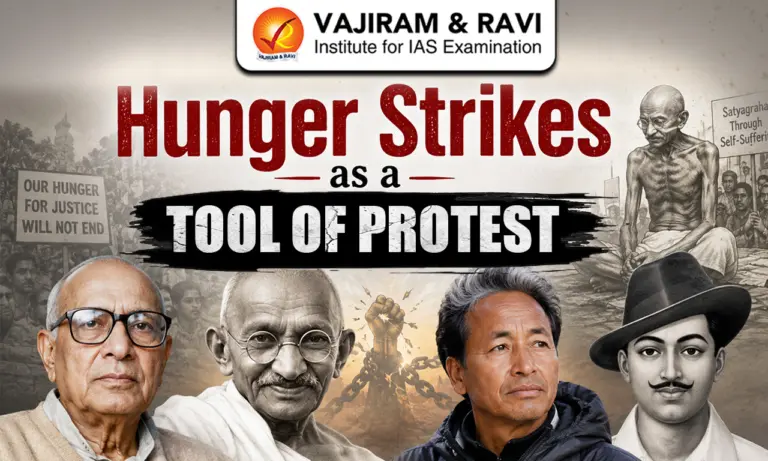
Hunger strikes have long been one of the most powerful forms of non-violent protest in India and across the world. By voluntarily refusing food, protesters seek to draw public attention, create moral pressure, and compel authorities to respond to their demands. From India’s freedom movement to contemporary social and environmental campaigns, hunger strikes continue to influence public discourse and democratic accountability.
Why in News?
Environmental activist Sonam Wangchuk is once again in the spotlight after continuing his indefinite hunger strike at Jantar Mantar, New Delhi. The protest has attracted nationwide attention due to concerns over his deteriorating health and the Delhi High Court’s direction for regular medical monitoring.
What is a Hunger Strike?
A hunger strike is a peaceful form of protest in which a person or group voluntarily refuses to eat food to express dissent or demand action from authorities. It is a non-violent method used to draw public attention to an issue. Hunger strikes aim to create moral and political pressure rather than using force. They have been widely used in democratic movements and social campaigns across the world.


Constitutional Basis of Peaceful Protest in India
The Constitution of India does not explicitly mention the “right to protest,” but it protects peaceful protest through various Fundamental Rights under Part III. These rights enable citizens to express dissent, assemble peacefully, and participate in a democratic society, subject to reasonable restrictions.
- Article 19(1)(a): Guarantees the freedom of speech and expression, allowing citizens to voice their opinions and dissent peacefully.
- Article 19(1)(b): Guarantees the right to assemble peacefully and without arms, forming the constitutional basis for protests and demonstrations.
- Article 19(1)(c): Provides the right to form associations or unions, enabling citizens to organize protest movements.
- Article 19(2): Allows reasonable restrictions on free speech in the interests of sovereignty, security, public order, decency, morality, etc.
- Article 19(3): Permits reasonable restrictions on the right to peaceful assembly to maintain public order and protect national interests.
- Article 21: Guarantees the right to life and personal liberty, balancing an individual’s right to protest with the State’s duty to protect life.
Reasonable Restrictions on the Right to Protest
The right to protest is a Fundamental Right, but it is not absolute. Under Articles 19(2) and 19(3) of the Constitution, the State can impose reasonable restrictions to protect public interest and maintain law and order.
- Sovereignty and Integrity of India: To safeguard the unity and integrity of the nation.
- Security of the State: To prevent activities that threaten national security.
- Public Order: To maintain peace and prevent violence or disruption.
- Friendly Relations with Foreign States: To avoid actions that may harm India’s diplomatic relations.
- Decency and Morality: To prevent obscene or immoral acts during protests.
- Contempt of Court: To protect the authority and dignity of the judiciary.
- Defamation: To prevent harm to the reputation of individuals or organizations.
- Incitement to an Offence: To prohibit speeches or actions that encourage criminal activities.
- Regulation of Time and Place: Authorities may regulate the venue, timing, and manner of protests to ensure public convenience and safety.
Peaceful Protests Supreme Court Judgments
The Supreme Court has consistently upheld peaceful protest as an essential part of democracy while emphasizing that it must be exercised within constitutional and legal limits.
- Kameshwar Prasad v. State of Bihar (1962): Peaceful demonstrations are protected under Articles 19(1)(a) and 19(1)(b), but violent demonstrations are not.
- Himat Lal K. Shah v. Commissioner of Police (1973): Citizens have the right to hold public meetings on public streets, subject to reasonable regulations.
- Ramlila Maidan Incident v. Home Secretary, Union of India (2012): Peaceful protest is a fundamental democratic right, and police action must be fair, reasonable, and proportionate.
- Mazdoor Kisan Shakti Sangathan (MKSS) v. Union of India (2018): The right to protest is a constitutional right, but authorities may regulate it to maintain public order.
- Amit Sahni v. Commissioner of Police (Shaheen Bagh Case) (2020): Public spaces cannot be occupied indefinitely for protests, and the right to protest must be balanced with the rights of others.
Hunger Strike in Indian Freedom Movement
Hunger strikes played a significant role during India’s freedom struggle as a powerful tool of non-violent resistance. Freedom fighters used fasting to protest against colonial policies, demand justice, and mobilize public support.
- Mahatma Gandhi: Used fasting as part of Satyagraha to oppose British rule, communal violence, and social injustice through moral persuasion.
- Bhagat Singh (1929): Along with fellow revolutionaries, undertook a historic hunger strike in Lahore Jail demanding equal treatment and better conditions for Indian political prisoners.
- Jatin Das (1929): Participated in the Lahore Jail hunger strike and died after a 63-day fast, becoming a symbol of sacrifice in the freedom movement.
- Potti Sriramulu (1952): Went on a prolonged hunger strike demanding a separate Telugu-speaking state. His death led to the formation of Andhra State in 1953 and later influenced the linguistic reorganization of states.
Significance of Hunger Strikes in Democracy
Hunger strikes are a powerful form of peaceful and non-violent protest that allow citizens to raise important public issues and hold governments accountable. They reflect the democratic values of dialogue, dissent, and constitutional participation.
- Provide a peaceful means of expressing dissent without the use of violence.
- Draw public and media attention to social, political, environmental, or human rights issues.
- Create moral pressure on governments and authorities to engage in dialogue.
- Strengthen participatory democracy by giving citizens a voice in public affairs.
- Encourage government accountability and transparency in decision-making.
- Uphold the constitutional values of freedom of speech and peaceful assembly.
- Help mobilize public support for important causes and reforms.
- Serve as a last resort when petitions, negotiations, and other peaceful methods fail to achieve results.
- Reinforce the principles of non-violence (Ahimsa) and democratic engagement.
- Demonstrate the importance of balancing the right to protest, public order, and the State’s duty to protect life under the Constitution.

 Last updated on Sep, 2026
→ UPSC 2027 Notification will be released on 13 January 2027 at upsconline.nic.in.
→ Check out the latest UPSC Syllabus here.
→ Download UPSC Model Answers for Mains 2026
→ UPSC Mains Question Paper 2026 is out now for Essay & GS Paper 1, 2, 3 & 4.
→ UPSC Calendar 2027 has been released.
→ Enroll in Vajiram & Ravi’s UPSC Mains Test Series 2027 for structured answer writing practice, expert evaluation, and exam-oriented feedback.
→ Join Vajiram & Ravi’s UPSC Mentorship Program 2027 for personalized guidance, strategy planning, and one-to-one support from experienced mentors.
→ Go through the UPSC Mains Previous Year Papers to enhance your preparation.
→ UPSC has released UPSC Toppers List 2025 with the Civil Services final result on its official website.
→ Also check Best UPSC Coaching in India
Hunger Strikes as a Tool of Protest FAQs
Q1. Is the right to protest a Fundamental Right?+
Q2. Is a hunger strike legal in India?+
Q3. Which constitutional article protects peaceful assembly?+
Q4. Can the government stop a hunger strike?+
Q5. Why are hunger strikes considered effective?+
Tags: hunger strikes hunger strikes as a tool of protest sonam wangchuk