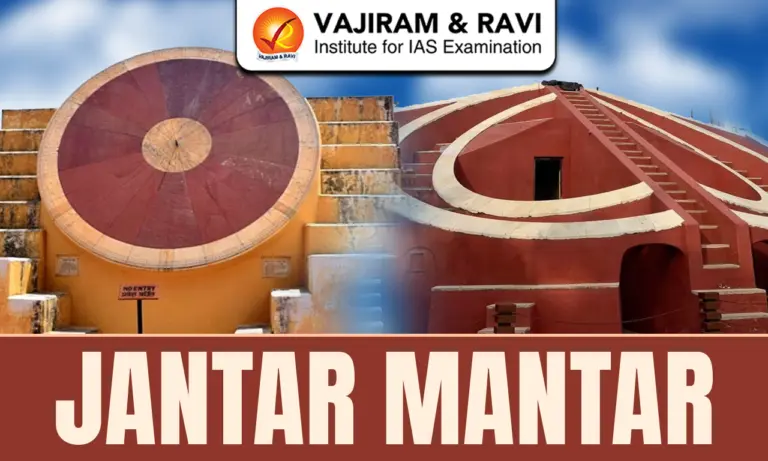
Jantar Mantar is one of India’s finest examples of scientific knowledge, architecture and astronomy coming together in a single monument. It was built during the early eighteenth century under Maharaja Sawai Jai Singh II. These observatories were designed to measure time, track celestial bodies and perform other astronomical activities.
What is Jantar Mantar?
The name ‘Jantar Mantar’ is derived from the Sanskrit words ‘Yantra’ meaning instrument and ‘Mantra’ meaning calculation. Together, they refer to instruments used for astronomical calculations. These observatories consist of large structures built for naked eye observations of the Sun, Moon, planets and stars. Their primary purpose was to determine time, predict eclipses, calculate planetary movements, prepare astronomical tables and improve the accuracy of astronomical observations using permanent masonry instruments.
Jantar Mantar History
The historical development and evolution of Jantar Mantar has been discussed below:
- Maharaja Sawai Jai Singh II (1693-1744), founder of Jaipur, commissioned the Jantar Mantars because of his deep interest in Indian, Islamic and European astronomy and the need for more accurate astronomical observations.
- The observatories were constructed between 1724 and 1735.
- The observatories followed the tradition of Ptolemaic positional astronomy, allowing astronomers to observe celestial bodies directly with the naked eye and compile astronomical tables called Zij.
- By 1735, nearly 23 astronomers worked at Jaipur, making it the principal astronomical research centre.
- Following Jai Singh II’s death in 1743, succession disputes reduced royal patronage, scientific activity declined and portions of the Jaipur observatory were later converted into a weapons factory.
- Maharaja Ram Singh restored the Jaipur observatory in 1876, strengthening several instruments using stone repairs and lead reinforcement before another restoration under Madho Singh II in 1901.
- Jaipur Jantar Mantar became a Monument of National Importance in 1968 and was inscribed as a UNESCO World Heritage Site in 2010 because of its outstanding scientific and architectural value.


How many Jantar Mantar in India?
Maharaja Sawai Jai Singh II established five Jantar Mantars at Delhi, Jaipur, Ujjain, Varanasi and Mathura during the early eighteenth century. Today only four Jantar Mantars remain, as the Mathura observatory was destroyed shortly before the Revolt of 1857.
- Oldest Jantar Mantar Observatory: The Delhi Jantar Mantar, completed in 1724, is the oldest surviving observatory among the remaining four.
- Largest Jantar Mantar Observatory: The Jaipur Jantar Mantar is the largest, most comprehensive and best preserved observatory, containing 19 astronomical instruments and the world’s largest stone sundial.
- UNESCO Recognized Jantar Mantar: The Jantar Mantar at Jaipur became a UNESCO World Heritage Site in 2010, making it internationally recognised for its scientific, architectural and cultural importance.
Jantar Mantar Architecture
The key architectural features of Jantar Mantar buildings has been discussed below:
- Construction Material: The observatories were built primarily using stone, marble, plaster and masonry, ensuring greater durability and measurement stability than contemporary metal instruments.
- Observation Method: All observations were performed with the naked eye, allowing astronomers to determine celestial positions without telescopes while maintaining remarkable accuracy.
- Instruments: The architecture involves several instruments across all four existing Jantar Mantars as highlighted below:
- Samrat Yantra: Standing about 27 metres high, it is the world’s largest stone sundial and can measure time with an accuracy of nearly two seconds.
- Jai Prakash Yantra: This hemispherical instrument helps determine the positions, altitude, azimuth, declination and hour angle of celestial bodies by projecting an inverted image of the sky.
- Ram Yantra: Designed as an upright cylindrical structure, it accurately measures the altitude and azimuth of the Sun and other celestial bodies.
- Misra Yantra: Located at Delhi, this composite instrument consists of five different devices and helps determine the shortest and longest days of the year.
- Rashi Valaya Yantra: Comprising twelve separate instruments, it measures planetary positions according to the twelve zodiac constellations.
- Laghu Samrat Yantra: A smaller sundial inclined at approximately 27 degrees, it measures local time with reasonable accuracy though less precise than the Vrihat Samrat Yantra.
- Nadi Valaya Yantra: This consists of two sundials representing the northern and southern hemispheres and measures local solar time with accuracy of less than one minute.
- Chakra Yantra: Four semicircular arcs determine the Sun’s declination at different times, similar to comparing local times across different world locations.
- Dakshin Bhitti Yantra: It measures meridian positions, zenith distance and altitude of celestial bodies during their daily movement across the sky.
- Digamsha Yantra: Used for determining the Sun’s azimuth while helping calculate sunrise and sunset timings.
- Disha Yantra: This instrument accurately determines geographical directions based on astronomical observations.
- Dhruva Darshak Yantra: Designed specifically to observe the Pole Star and determine its position relative to other celestial objects.
- Kranti Vritta Yantra: It measures the celestial latitude and longitude of heavenly bodies with considerable precision.
- Shastanadan Yantra: A dark chamber with a sixty degree meridian arc measures solar declination, zenith distance and even the apparent diameter of the Sun.
- Unnatamsa Yantra: A metal ring divided into four segments helps determine the altitude of celestial bodies.
- Scientific Basis: The observatories draw upon astronomical theories developed by Aryabhatta, Brahmagupta, Varahamihira, Lalla, Sripati and Bhaskara, whose works described several astronomical instruments and calculation methods.
Jantar Mantar Delhi
The Jantar Mantar in Delhi is the oldest surviving observatory and continues to remain both a protected monument and an important public gathering location.
- Construction: Built in 1724, it became the first surviving observatory established by Maharaja Sawai Jai Singh II.
- Size: It is the second largest Jantar Mantar after Jaipur and contains several important astronomical instruments.
- Purpose: The observatory was designed for accurate timekeeping, determining planetary positions and measuring celestial movements.
- Instrument: The Misra Yantra is unique to Delhi and calculates the shortest and longest days of the year.
- Protection: The monument is maintained by the Archaeological Survey of India (ASI) as a protected monument of national importance.
Jantar Mantar Jaipur
The Jantar Mantar in Jaipur represents the highest achievement of India’s historic astronomical observatories through its scale, preservation, scientific innovation and global recognition.
- Construction: The observatory was completed in 1734 and remained Maharaja Jai Singh II’s principal astronomical centre.
- Instruments: It houses 19 major fixed astronomical instruments, many of which are the largest masonry examples of their kind.
- UNESCO Status: It was inscribed as a UNESCO World Heritage Site in 2010 because of its outstanding universal scientific and architectural value.
- Scientific Importance: The observatory contributed to astronomical tables and observations following the Ptolemaic positional astronomy tradition practiced across several civilizations.
- Largest Sundial: The Samrat Yantra remains the world’s largest stone sundial with an accuracy of nearly two seconds.
- Purpose: It measured time, predicted eclipses, calculated planetary movements and prepared astronomical tables through direct celestial observation.
- National Recognition: The observatory was declared a Monument of National Importance in 1968.
Jantar Mantar Ujjain
Ujjain Jantar Mantar served as an important astronomical centre because of the city’s long standing association with astronomical calculations and observations.
- Construction: The Ujjain observatory was completed in 1725 under Maharaja Sawai Jai Singh II.
- Role: It functioned as an important centre for astronomical research and observation of celestial events.
- Instrument: It contains one of the largest sundials among the Jantar Mantar observatories.
- Purpose: Astronomers used it for measuring time, tracking celestial bodies and improving astronomical calculations.
Jantar Mantar Varanasi
The Varanasi Jantar Mantar observatory continued Maharaja Jai Singh II’s scientific programme through smaller but essential astronomical instruments for celestial observations.
- Establishment: The observatory was established in 1737 as one of the final Jantar Mantars.
- Scale: Although smaller than Jaipur and Delhi, it contains essential astronomical instruments for scientific observations.
- Purpose: It was designed mainly for measuring time and tracking planetary and stellar movements.
Jantar Mantar Mathura
The Jantar Mantar in Mathura marked the beginning of Maharaja Jai Singh II’s observatory programme but unfortunately no longer survives.
- Construction: Built in 1711, it is considered the earliest Jantar Mantar established by Jai Singh II.
- Historical Importance: It served as the foundation for the later observatories constructed at Delhi, Jaipur, Ujjain and Varanasi.
- Destruction: The observatory was destroyed shortly before the Revolt of 1857, leaving only historical records of its existence.
- Present Status: No substantial remains survive today, making it the only lost observatory among the original five.
Jantar Mantar Protests
The Jantar Mantar in Delhi evolved into a major democratic protest site while remaining a protected heritage monument, creating administrative and legal challenges.
- Protest Centre: During the 1990s, Jantar Mantar became Delhi’s principal location for organised public demonstrations.
- Major Movements: The site hosted significant protests including the Anna Hazare anti corruption movement, demonstrations seeking justice for Rohith Vemula, farmers’ protests, anti lynching campaigns, gatherings supporting free speech and recent Sonam Wangchuk’s Hunger Strike 2026 for Educational Reforms in India.
- Administrative Control: Protest permissions are regulated by the Delhi Police under the Ministry of Home Affairs, while the monument itself remains protected by the Archaeological Survey of India (ASI).
- NGT Restrictions: In 2017, the National Green Tribunal (NGT) restricted protests citing noise pollution, littering, sanitation problems, unauthorised loudspeakers, public inconvenience and the residential character of the locality.
- Constitutional Position: The right to assemble peacefully without arms is guaranteed under Article 19(1)(b) but remains subject to reasonable restrictions under Article 19(3) in the interests of public order and national sovereignty.
- Legal Debate: Discussions surrounding Jantar Mantar continue to balance the constitutional right to dissent, environmental concerns, heritage conservation, urban governance and effective regulation of public demonstrations.
- Impact on Heritage: Continuous protests, heavy public movement, littering, vibration and unregulated sound systems raised concerns regarding preservation of the nearly three century old protected monument, requiring careful management between democratic activities and conservation.

 Last updated on Sep, 2026
→ UPSC 2027 Notification will be released on 13 January 2027 at upsconline.nic.in.
→ Check out the latest UPSC Syllabus here.
→ Download UPSC Model Answers for Mains 2026
→ UPSC Mains Question Paper 2026 is out now for Essay & GS Paper 1, 2, 3 & 4.
→ UPSC Calendar 2027 has been released.
→ Enroll in Vajiram & Ravi’s UPSC Mains Test Series 2027 for structured answer writing practice, expert evaluation, and exam-oriented feedback.
→ Join Vajiram & Ravi’s UPSC Mentorship Program 2027 for personalized guidance, strategy planning, and one-to-one support from experienced mentors.
→ Go through the UPSC Mains Previous Year Papers to enhance your preparation.
→ UPSC has released UPSC Toppers List 2025 with the Civil Services final result on its official website.
→ Also check Best UPSC Coaching in India
Jantar Mantar FAQs
Q1. What is Jantar Mantar?+
Q2. How many Jantar Mantars are there in India?+
Q3. Which Jantar Mantar is a UNESCO World Heritage Site?+
Q4. What is the famous instrument at Jantar Mantar Jaipur?+
Q5. Why is Jantar Mantar Delhi famous for protests?+
Tags: architecture art and architecture historical monuments of india jantar mantar