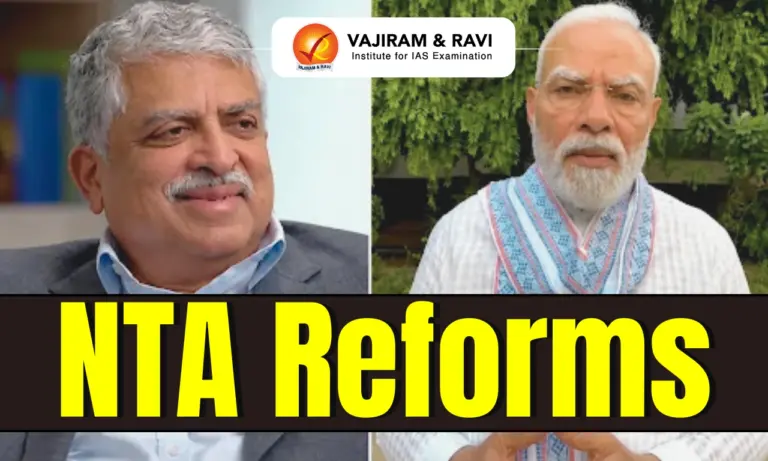
NTA Reforms Latest News
- The Union Government has constituted a high-powered task force under Infosys co-founder Nandan Nilekani to recommend next-generation reforms for the National Testing Agency (NTA) and India’s public examination system.
- The move follows repeated controversies over paper leaks, irregularities and technological failures, particularly in national entrance examinations such as NEET-UG.
- This comes alongside the proposed Public Examinations (Prevention of Unfair Means) Amendment Bill, 2026.
Reasons for Constituting Task Force
- The government aims to –
- Restore credibility, transparency and integrity of public examinations.
- Maximise the use of technology in conducting examinations.
- Prevent paper leaks, unfair means and cyber vulnerabilities.
- Strengthen institutional capacity and governance of the National Testing Agency (NTA) – an autonomous body (registered under the Societies Registration Act, 1860) established in 2017 under the Union Ministry of Education to conduct entrance examinations.
- Build a secure, technology-enabled and student-centric examination ecosystem.
- The Indian Prime Minister stated that while strict legal action is being taken against those involved in exam malpractices, long-term structural reforms are equally necessary to secure students’ future.


Composition of the High-Powered Task Force
- The multidisciplinary panel reflects expertise across technology, education, security and administration.
- Chairperson: Nandan Nilekani – Infosys co-founder and architect of Aadhaar.
- Members:
- S. Somanath – Former Chairman, ISRO.
- Tapan Deka – Former Director, Intelligence Bureau.
- V. Kamakoti – Director, IIT Madras.
- Anita Karwal – Former Education Secretary.
- Amrit Lal Meena – Logistics expert and former civil servant.
Mandate of the Task Force
- Technology-based examination reforms: Secure digital examination infrastructure, advanced cybersecurity mechanisms, greater use of digital authentication and monitoring, and technology-driven prevention of question paper leaks.
- Institutional reforms: Structural changes in the functioning of the NTA; improved governance, accountability and operational efficiency; and standardisation of examination processes.
- Operational improvements: Better logistics and examination management, enhanced transparency in examination administration, and strengthened mechanisms for conducting large-scale national examinations.
Legislative Backing and Background
- The announcement coincides with the proposed Public Examinations (Prevention of Unfair Means) Amendment Bill, 2026, which seeks to:
- Increase punishment for examination-related offences.
- Enhance monetary penalties for paper leaks and organised malpractice.
- Strengthen the legal framework against examination fraud.
- The government has also established fast-track courts to ensure speedy prosecution of such offences.
- The reforms come after:
- Allegations of NEET-UG paper leak and other examination irregularities.
- Nationwide protests questioning the credibility of competitive examinations.
- Judicial scrutiny and public demand for systemic reforms.
- Administrative restructuring of the NTA over recent months.
- The initiative represents the government’s broader attempt to rebuild trust in India’s public examination system.
Political Developments, Significance, and Challenges Ahead
- Developments:
- Former Education Minister Dharmendra Pradhan resigned recently. Pralhad Joshi assumed additional charge of the Ministry of Education and initiated a comprehensive review of the Ministry’s functioning.
- The review covered implementation of ongoing educational schemes and institutional reforms.
- Meanwhile, opposition leaders questioned the status of the K. Radhakrishnan Committee, constituted after the 2024 NEET-UG controversy, seeking clarity on the implementation of its recommendations.
- Key recommendations of the K. Radhakrishnan committee – Transition to computer-based testing (CBT), hybrid secure examination system (encrypted digital delivery of question papers; local printing at examination centres), multi-session and multi-stage testing, etc.
- Significance for India’s education system: The proposed reforms are expected to –
- Improve fairness and credibility of competitive examinations.
- Enhance public confidence in recruitment and admission processes.
- Integrate digital governance with educational administration.
- Strengthen cybersecurity and data protection in examination systems.
- Promote good governance, transparency and accountability in public institutions.
- Challenges ahead:
- Balancing technological innovation with data privacy and cybersecurity.
- Ensuring digital accessibility across urban and rural regions.
- Coordinating reforms among multiple examination bodies.
- Implementing recommendations without disrupting ongoing examinations.
- Building institutional capacity for long-term monitoring and compliance.

 Last updated on Sep, 2026
→ UPSC 2027 Notification will be released on 13 January 2027 at upsconline.nic.in.
→ Check out the latest UPSC Syllabus here.
→ Download UPSC Model Answers for Mains 2026
→ UPSC Mains Question Paper 2026 is out now for Essay & GS Paper 1, 2, 3 & 4.
→ UPSC Calendar 2027 has been released.
→ Enroll in Vajiram & Ravi’s UPSC Mains Test Series 2027 for structured answer writing practice, expert evaluation, and exam-oriented feedback.
→ Join Vajiram & Ravi’s UPSC Mentorship Program 2027 for personalized guidance, strategy planning, and one-to-one support from experienced mentors.
→ Go through the UPSC Mains Previous Year Papers to enhance your preparation.
→ UPSC has released UPSC Toppers List 2025 with the Civil Services final result on its official website.
→ Also check Best UPSC Coaching in India
NTA Reforms FAQs
Q1. How can technology-driven reforms enhance the credibility of India's public examination system? +
Q2. What is the significance of the Public Examinations (Prevention of Unfair Means) Amendment Bill, 2026? +
Q3. What is the need for institutional reforms in the NTA? +
Q4. Why is a multidisciplinary approach important for reforming India's examination ecosystem? +
Q5. What reforms are integral to good governance in education? +
Tags: nta Reforms