Red Sea Disruption and India’s Oil Security Latest News
- The Yemen-based Houthi militia announced recently that it will target Saudi Arabian tankers crossing the Bab al-Mandab strait.
- It has already attacked several ships — widening the West Asia conflict’s impact on India’s crude oil imports beyond the earlier Strait of Hormuz crisis.
The New Chokepoint Threat
- The Bab al-Mandab connects the Red Sea to the Gulf of Aden and the Arabian Sea — a critical global trade and energy chokepoint, alongside the Strait of Hormuz.
- Impact already visible: Vessel crossings through Bab al-Mandab fell to an average of 31 per day over the past three days, down from 43 per day in the first half of July (S&P Global data).
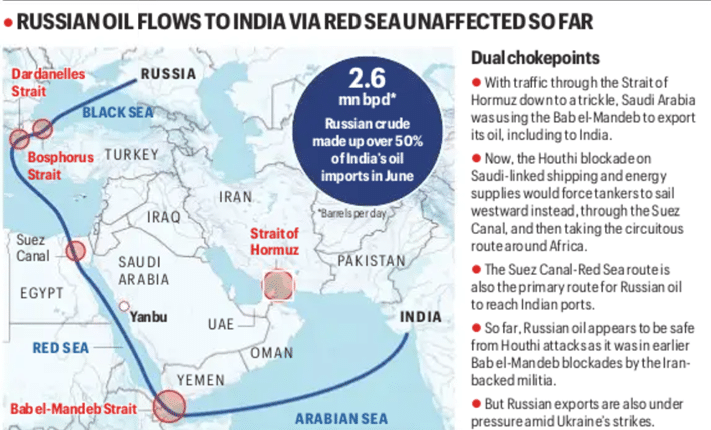
- Saudi Arabia had been using this route — independent of the Strait of Hormuz — to export oil, including to India, as Hormuz traffic dwindled to a trickle.
Immediate Consequences of a Houthi Blockade
- Oil shipments to Asia would face delays, as tankers reroute westward through the Suez Canal and around Africa.
- This could add up to four weeks to the journey and raise costs due to higher freight and insurance premiums.
- The blockade could keep oil prices elevated — a significant concern since India depends on imports for over 88% of its oil needs.
- Despite these risks, industry experts describe the situation as “a matter of concern” but manageable.


India’s First Fallback: Russian Crude
- Russian oil has so far remained safe from Houthi attacks, as in earlier Bab al-Mandab blockades by the Iran-backed militia.
- The Suez Canal-Red Sea route is the primary corridor for Russian oil reaching Indian ports.
- If Russian oil supply via this route remains unaffected while the blockade targets only Saudi Arabia, the impact should be limited — expecting Russian crude movement to increase and compensate for Saudi volume losses.

Scale of India’s Russian Oil Dependence
- Russian crude imports rose sharply from around 1 million bpd in February to record highs of 2.6 million bpd in June — over 50% of India’s total oil imports.
- July imports are tracking at similar levels.
- Before the war, over 40% of India’s oil imports came from West Asia via the Strait of Hormuz.
- As per the analysts, Russian crude imports could potentially rise toward or above 3 million bpd if market conditions and Russian export availability permit.
Other Supply Buffers
- Saudi Arabia’s East-West (Yanbu) pipeline currently supplies roughly 300,000–500,000 bpd, offering a buffer if Red Sea transit stays open.
- UAE’s Murban crude can bypass both the Strait of Hormuz and Bab al-Mandab, loading from Fujairah and reaching India in 5–6 days — a practical emergency option.
- American and South American oil remain theoretical alternatives, but long voyage times make them unsuitable as emergency replacement barrels.
- India’s increasingly diversified crude slate, spanning dozens of global suppliers, provides greater flexibility than in previous years, reducing severe disruption risk.
Pricing Pressure on Russian Oil
- Russian Urals crude was earlier offered at around a $7/barrel discount to Dubai crude before the latest escalation.
- These discounts have disappeared, with Russian barrels now trading at premiums as Indian refiners compete for supply.
- India’s incremental access to Urals is limited, as China and Turkey compete for the same barrels.
The Bigger Risk: Russia’s Black Sea Exports
- Experts flag that Russian Black Sea export infrastructure — particularly the Novorossiysk terminal — may pose a greater risk to India than the Red Sea disruption itself:
- Unlike Red Sea cargoes (reroutable via Africa), Black Sea export alternatives are limited.
- The Sheskharis terminal at Novorossiysk halted operations last week following Ukrainian strikes.
- This terminal is critical for India: of 1.1 million bpd loaded there in June, ~840,000 bpd went to India — the Novorossiysk complex supplied about 28% of India’s Russian crude imports that month.
- Satellite tracking suggests loadings paused from June 20, though some tankers are reportedly switching off transponders to avoid attacks; the port infrastructure itself appears undamaged, and the disruption is expected to be temporary.
Medium-Term Risk: Russian Refinery Recovery
- Russia recently increased crude exports as Ukrainian strikes forced several refineries offline for repairs, freeing additional barrels for export (mainly to China and India).
- Russia exported a record 4.5 million bpd of crude in June, of which about 55% went to India.
- As affected refineries resume operations, Moscow is expected to prioritise domestic fuel needs over exports — Russian crude exports could fall by as much as 1 million bpd once refineries fully recover.
Conclusion
- India’s oil security faces a layered risk — a Houthi blockade at Bab al-Mandab threatens Saudi supplies, but experts suggest Russian Black Sea export infrastructure, particularly around Novorossiysk, now poses an equally or more significant medium-term risk given Russia’s dominant 50%+ share of India’s crude imports.
- A diversified supplier base and flexible sourcing from the UAE and elsewhere give India some cushion, but sustained disruption on either front would test that resilience.

 Last updated on Sep, 2026
→ UPSC 2027 Notification will be released on 13 January 2027 at upsconline.nic.in.
→ Check out the latest UPSC Syllabus here.
→ Download UPSC Model Answers for Mains 2026
→ UPSC Mains Question Paper 2026 is out now for Essay & GS Paper 1, 2, 3 & 4.
→ UPSC Calendar 2027 has been released.
→ Enroll in Vajiram & Ravi’s UPSC Mains Test Series 2027 for structured answer writing practice, expert evaluation, and exam-oriented feedback.
→ Join Vajiram & Ravi’s UPSC Mentorship Program 2027 for personalized guidance, strategy planning, and one-to-one support from experienced mentors.
→ Go through the UPSC Mains Previous Year Papers to enhance your preparation.
→ UPSC has released UPSC Toppers List 2025 with the Civil Services final result on its official website.
→ Also check Best UPSC Coaching in India
Red Sea Disruption and India's Oil Security FAQs
Q1. How does Red Sea Disruption and India's Oil Security affect crude oil imports?+
Q2. Why is Russian crude important in Red Sea Disruption and India's Oil Security?+
Q3. What is the biggest risk discussed in Red Sea Disruption and India's Oil Security?+
Q4. How does India reduce risks highlighted in Red Sea Disruption and India's Oil Security?+
Q5. Why is Bab al-Mandab significant in Red Sea Disruption and India's Oil Security?+
Tags: mains articles Red Sea Disruption and India's Oil Security upsc current affairs upsc mains current affairs