About Giant Metrewave Radio Telescope (GMRT):
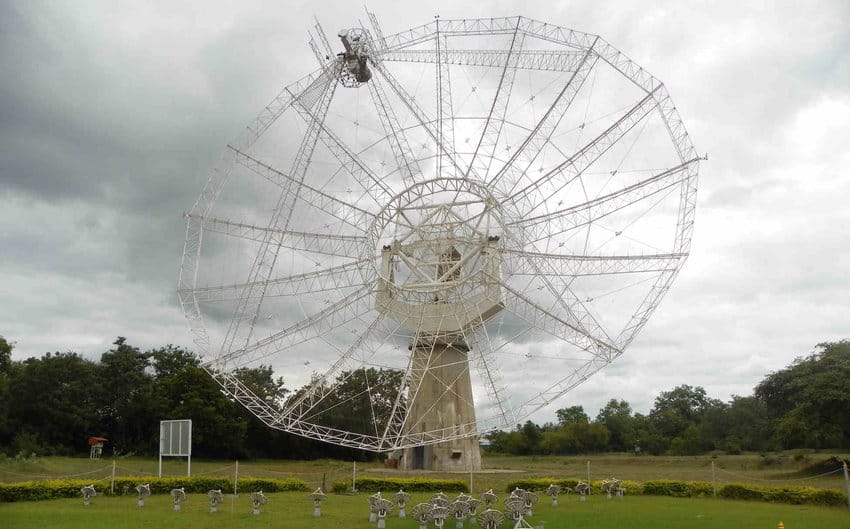
- GMRT is a low-frequency radio telescope that helps investigate various radio astrophysical problems ranging from nearby solar systems to the edge of the observable universe.
- Location: It is located at Khodad, 80 km north of Pune, Maharashtra.
- It is a project of the Department of Atomic Energy (DAE), operating under the Tata Institute of Fundamental Research (TIFR).
- The telescope is operated by the National Centre of Radio Astrophysics (NCRA). NCRA is a part of the TIFR, Mumbai.
- It consists of 30 fully- steerable dish-type antennas of 45-meter diameter each, spread over a 25-km region.
- GMRT is presently the world’s largest radio telescope operating at meter wavelength.
- It was recently upgraded with new receivers, after which it is also known as the upgraded Giant Metrewave Radio Telescope (uGMRT).
What are Pulsars?
- Pulsars are rotating neutron stars observed to have pulses of radiation at very regular intervals that typically range from milliseconds to seconds.
- Pulsars have very strong magnetic fields which funnel jets of particles out along the two magnetic poles.
- These accelerated particles produce very powerful beams of light.
- Often, the magnetic field is not aligned with the spin axis, so those beams of particles and light are swept around as the star rotates.
- Pulsars are among the few celestial objects that emit circular polarised light.
Q1) What is a Neutron Star?
Neutron stars are formed when a massive star runs out of fuel and collapses. The very central region of the star – the core – collapses, crushing together every proton and electron into a neutron. If the core of the collapsing star is between about 1 and 3 solar masses, these newly-created neutrons can stop the collapse, leaving behind a neutron star.
Source: Pune astronomers detect two new millisecond pulsars


 Last updated on Oct, 2026
→ UPSC 2027 Notification will be released on 13 January 2027 at upsconline.nic.in.
→ Asian Games 2026 are being held in Aichi-Nagoya, Japan, from 19 September to 4 October.
→ Check Nobel Prize 2026 Winners List here.
→ Download PIB PRiSM Monthly Magazine 2026 here.
→ Check UPSC Monthly Current Affairs Magazine The Recitals here.
→ Check out the latest UPSC Syllabus here.
→ Download UPSC Model Answers for Mains 2026
→ UPSC Mains Question Paper 2026 is out now for Essay & GS Paper 1, 2, 3 & 4.
→ UPSC Calendar 2027 has been released.
→ Enroll in Vajiram & Ravi’s UPSC Mains Test Series 2027 for structured answer writing practice, expert evaluation, and exam-oriented feedback.
→ Join Vajiram & Ravi’s UPSC Mentorship Program 2027 for personalized guidance, strategy planning, and one-to-one support from experienced mentors.
→ Go through the UPSC Mains Previous Year Papers to enhance your preparation.
→ UPSC has released UPSC Toppers List 2025 with the Civil Services final result on its official website.
→ Also check Best UPSC Coaching in India