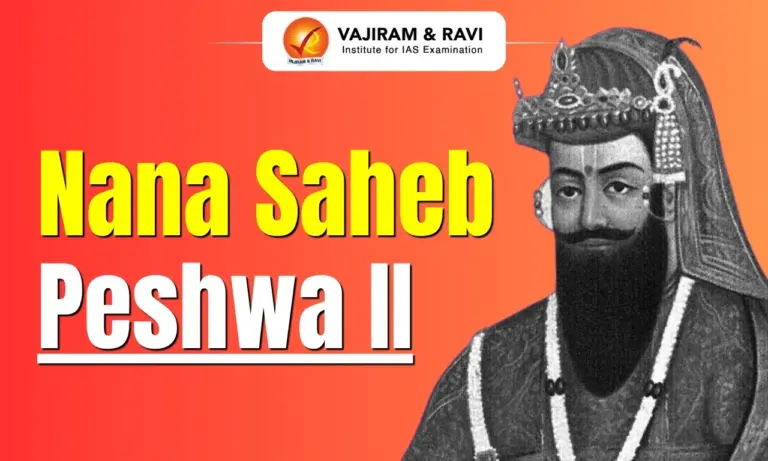
Nana Saheb Peshwa II was a prominent Indian leader best known for his role in the Revolt of 1857, one of the earliest major uprisings against British rule in India. Born as Dhondu Pant and adopted by Peshwa Baji Rao II, he grew up with a strong connection to the Maratha legacy. Although he was not officially recognized by the British as the successor to the Peshwa, this injustice led to deep resentment. Nana Saheb later emerged as a key figure in the struggle against British authority, especially in Kanpur, and is remembered as an important symbol of early resistance and the fight for Indian independence.
Nana Saheb Peshwa II
- Nana Saheb Peshwa II, also known as Dhondu Pant, was one of the most important leaders of the Revolt of 1857, often called India’s First War of Independence.
- He was the adopted son of Peshwa Baji Rao II, the last ruler (Peshwa) of the Maratha Empire, and grew up with a strong sense of royal identity and responsibility.
- Although the British did not officially recognize him as the successor, Nana Saheb believed he had the legitimate right to the Peshwa title and privileges.
- This denial played a major role in shaping his opposition to British rule, eventually turning him into a key face of resistance.
- He is especially remembered for his leadership in Kanpur, where he led rebel forces and challenged British authority.
Early Life and Background of Nana Saheb Peshwa II
- Nana Saheb was born in 1824 in Pune and was adopted by Baji Rao II in 1827, as the Peshwa had no biological heir .
- After the defeat of the Marathas, Baji Rao II was exiled by the British to Bithoor near Kanpur, where Nana Saheb spent most of his childhood.
- He grew up in a royal and well-maintained household, supported partly by a British pension granted to his adoptive father.
- Nana Saheb received training in administration, warfare, and leadership, preparing him for a future role in governance.
- He was closely associated with figures like Tatya Tope (his military mentor), Azimullah Khan (his advisor) and Rani Lakshmibai, all of whom later played key roles in the revolt.
- His upbringing exposed him to both Indian traditions and British political systems, shaping his ideas about power and justice.


Role of Nana Saheb Peshwa II in the Revolt of 1857
- Nana Saheb emerged as one of the main leaders of the 1857 uprising, particularly in North India, where he mobilized both soldiers and civilians.
- His participation was driven by personal injustice (loss of pension and recognition) as well as broader anti-British sentiments.
- During the revolt, he declared himself the Peshwa, symbolizing the revival of Indian rule and Maratha authority.
- He played a crucial role in turning the rebellion from a limited military mutiny into a wider political movement.
- By organizing troops and gaining public support, he helped strengthen the fight against colonial rule.
Nana Saheb Peshwa II and the Kanpur Uprising
- Kanpur became the main center of Nana Saheb’s activities during the revolt.
- He led the siege of British forces, where Indian rebels surrounded them and forced them into a difficult situation with limited supplies.
- Eventually, the British agreed to surrender, expecting safe passage, but the events at Satichaura Ghat turned violent and became highly controversial.
- This incident made the Kanpur uprising one of the most debated and emotionally charged events of the 1857 revolt.
- After initial success, British forces launched a strong counterattack, which weakened Nana Saheb’s position and forced him to retreat.
Causes of Conflict Between Nana Saheb Peshwa II and the British
- The primary cause of conflict was the British refusal to continue the pension that was granted to Baji Rao II after his death.
- The British also refused to recognize Nana Saheb’s adoption as valid for succession, ignoring Indian customs and traditions.
- The policy of Doctrine of Lapse, introduced by Lord Dalhousie, created widespread dissatisfaction among Indian rulers.
- Nana Saheb made several efforts to resolve the issue peacefully, even sending Azimullah Khan to England, but all appeals were rejected.
- These repeated rejections led to deep frustration and anger, which eventually turned into active rebellion against British rule.
Disappearance and Legacy of Nana Saheb Peshwa II
- After the British regained control of Kanpur, Nana Saheb disappeared, and his final fate remains unknown.
- Many accounts suggest that he escaped to Nepal, while others provide different theories, making his end a historical mystery.
- His life is remembered as a mix of courage, leadership, and controversy, especially due to the events at Kanpur.
- Some historians consider him a freedom fighter and nationalist hero, while others debate his role in certain incidents.
- Despite differing views, Nana Saheb remains an important figure in Indian history and a symbol of early resistance against British colonial rule.

 Last updated on Oct, 2026
→ UPSC 2027 Notification will be released on 13 January 2027 at upsconline.nic.in.
→ Asian Games 2026 are being held in Aichi-Nagoya, Japan, from 19 September to 4 October.
→ Check Nobel Prize 2026 Winners List here.
→ Download PIB PRiSM Monthly Magazine 2026 here.
→ Check UPSC Monthly Current Affairs Magazine The Recitals here.
→ Check out the latest UPSC Syllabus here.
→ Download UPSC Model Answers for Mains 2026
→ UPSC Mains Question Paper 2026 is out now for Essay & GS Paper 1, 2, 3 & 4.
→ UPSC Calendar 2027 has been released.
→ Enroll in Vajiram & Ravi’s UPSC Mains Test Series 2027 for structured answer writing practice, expert evaluation, and exam-oriented feedback.
→ Join Vajiram & Ravi’s UPSC Mentorship Program 2027 for personalized guidance, strategy planning, and one-to-one support from experienced mentors.
→ Go through the UPSC Mains Previous Year Papers to enhance your preparation.
→ UPSC has released UPSC Toppers List 2025 with the Civil Services final result on its official website.
→ Also check Best UPSC Coaching in India
Nana Saheb Peshwa II FAQs
Q1. Who was Nana Saheb Peshwa II?+
Q2. Why is Nana Saheb Peshwa II important in Indian history?+
Q3. What was Nana Saheb’s real name?+
Q4. What was Nana Saheb’s role in the Revolt of 1857?+
Q5. Why did Nana Saheb oppose the British?+
Q6. What happened during the Kanpur uprising?+
Q7. What happened to Nana Saheb after the revolt?+
Tags: modern history modern indian history notes nana saheb peshwa II